4,068 posters, 219 videos, 101 topics, 69 sessions, 14,365 authors, 6,128 institutions
ePostersLive by SciGen Technologies S.A. All rights reserved.
Alzheimer's Association International Conference 2026
July 12-15, 2026 | London, United Kingdom, and Online

13421
Beyond Apoe: Dissecting The Genetic Drivers Of Amyloid And Tau Pathology In Dementia With Lewy Bodies
Poster Presenter
Authors
Affiliations
Part of Topic
Basic Science and Pathogenesis -> Genetics -> Genetic factors of non-Alzheimer’s disease
Beyond APOE: Dissecting the Genetic Drivers of Amyloid and Tau Pathology in Dementia with Lewy Bodies
Claudia Olive1,2, Victor Andrade3,4, Pablo Garcia1,2, Paula Bayon1, Marta Rovira1, Alejandro Valenzuela1, Raquel Puerta1,2, Maria Capdevila1, Alvaro Muñoz1, Andrea de Miguel1, Berta Calm1, Adrian Hinojosa1, Amanda Cano1,5, Sergi Valero1,5, Pilar Sanz1, Oliver Peters8, Julian Hellmann-Regen8, Josef Priller8, Anja Schneider8, Jens Wiltfang8, Frank Jessen3,4,8,9, Emrah Düzel8, Katharina Buerger8, Robert Perneczky8, Stefan Teipel8, Christoph Laske8, Xavier Montalban1,6, Agustin Ruiz1,5,7, Merce Boada1,5, Alfredo Ramirez3,4,8,9, Victoria Fernandez1,5
- Ace Alzheimer Center Barcelona, Universitat Internacional de Catalunya, 08029 Barcelona, Spain;
- PhD Program in Biotechnology, Faculty of Pharmacy and Food Sciences, University of Barcelona, 08028 Barcelona, Spai
- Division of Neurogenetics and Molecular Psychiatry, Department of Psychiatry and Psychotherapy, Faculty of Medicine and University Hospital Cologne, University of Cologne, Cologne, Germany.
- Department of Old Age Psychiatry and Cognitive Disorders, University Hospital Bonn, University of Bonn, Bonn, Germany.
- Biomedical Research Networking Centre in Neurodegenerative Diseases (CIBERNED), National Institute of Health Carlos III, 28029 Madrid, Spain
- Department of Neurology and Multiple Sclerosis Center of Catalonia (Cemcat), Vall d’Hebron University Hospital, Universitat Autònoma de Barcelona (UAB), Barcelona, Spain
- Glenn Biggs Institute for Alzheimer’s & Neurodegenerative Diseases, University of Texas Health Science Center, San Antonio, TX 77204, USA
- German Center for Neurodegenerative Diseases (DZNE), Bonn, Venusberg-Campus 1, 53127 Bonn, Germany
- Cluster of Excellence on Cellular Stress Responses in Aging-Associated Diseases (CECAD), University of Cologne, Joseph-Stelzmann-Strasse 26, 50931Köln, Germany
Introduction
Dementia with Lewy bodies (DLB) is frequently misdiagnosed as Alzheimer's disease (AD) due to overlapping clinical features. Unlike AD, DLB is primarily characterized by α-synuclein pathology, though amyloid and tau co-pathology is common. The genetic architecture of DLB remains poorly characterized, and post-mortem tissue — the gold standard for pathological assessment — is scarce. Alternative approaches leveraging in vivo biomarker data are needed to investigate how genetic variation shapes DLB biology and disentangle shared from disease-specific mechanisms across dementias.
Methods
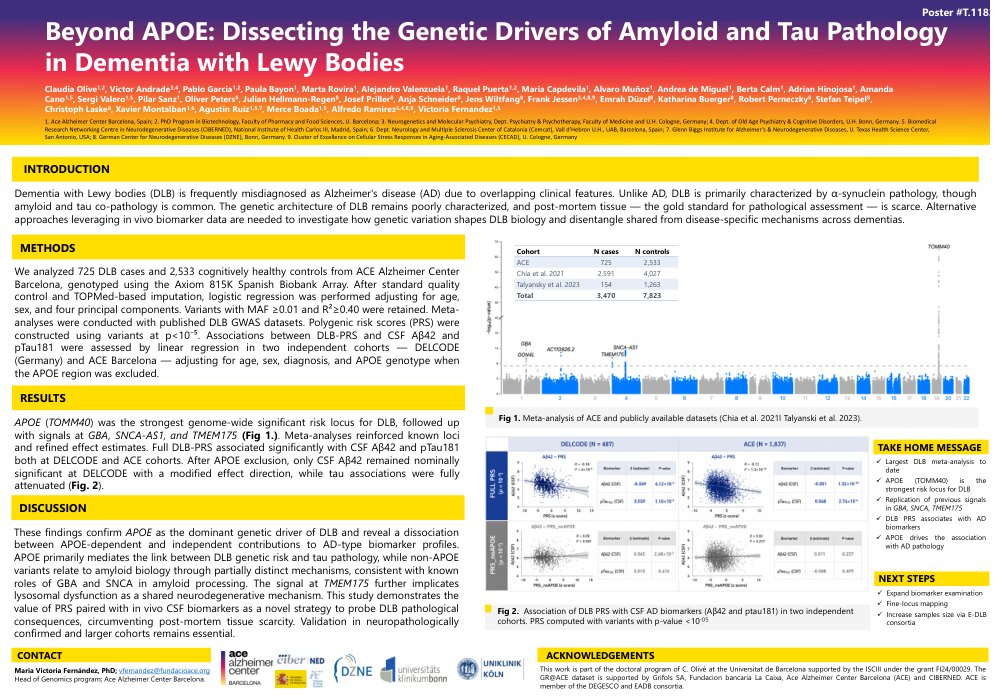
We analyzed 725 DLB cases and 2,533 cognitively healthy controls from ACE Alzheimer Center Barcelona, genotyped using the Axiom 815K Spanish Biobank Array. After standard quality control and TOPMed-based imputation, logistic regression was performed adjusting for age, sex, and four principal components. Variants with MAF ≥0.01 and R²≥0.40 were retained. Meta-analyses were conducted with published DLB GWAS datasets. Polygenic risk scores (PRS) were constructed using variants at p<10⁻⁵. Associations between DLB-PRS and CSF Aβ42, pTau181, pTau217, and NFL were assessed by linear regression in two independent cohorts — DELCODE (Germany) and ACE Barcelona — adjusting for age, sex, diagnosis, and APOE genotype when the APOE region was excluded.
Results
APOE was the strongest genome-wide significant risk locus for DLB, with suggestive signals at GBA, SNCA-AS1, and TMEM175. Meta-analyses reinforced known loci and refined effect estimates. Full DLB-PRS associated significantly with CSF Aβ42 (p=4.12×10⁻³), pTau181 (p=1.10×10⁻²), and pTau217 (p=1.27×10⁻³). After APOE exclusion, only CSF Aβ42 remained nominally significant (p=2.68×10⁻²), with a modified effect direction, while tau associations were fully attenuated.
Discussion/Conclusions
These findings confirm APOE as the dominant genetic driver of DLB and reveal a dissociation between APOE-dependent and independent contributions to AD-type biomarker profiles. APOE primarily mediates the link between DLB genetic risk and tau pathology, while non-APOE variants relate to amyloid biology through partially distinct mechanisms, consistent with known roles of GBA and SNCA in amyloid processing. The suggestive signal at TMEM175 further implicates lysosomal dysfunction as a shared neurodegenerative mechanism. This study demonstrates the value of PRS paired with in vivo CSF biomarkers as a novel strategy to probe DLB pathological consequences, circumventing post-mortem tissue scarcity. Validation in neuropathologically confirmed and larger cohorts remains essential.
Comments
Email is required but is not shown publicly.
Loading comments...