4,068 posters, 219 videos, 101 topics, 69 sessions, 14,365 authors, 6,128 institutions
ePostersLive by SciGen Technologies S.A. All rights reserved.
Alzheimer's Association International Conference 2026
July 12-15, 2026 | London, United Kingdom, and Online

13340
Associations Between Plasma Biomarkers And Postmortem Cerebral Amyloid Angiopathy And Alpha-synuclein Pathology In Alzheimer's Disease
Poster Presenter
Part of Topic
Basic Science and Pathogenesis -> Human Neuropathology -> Mixed pathology/comorbidities
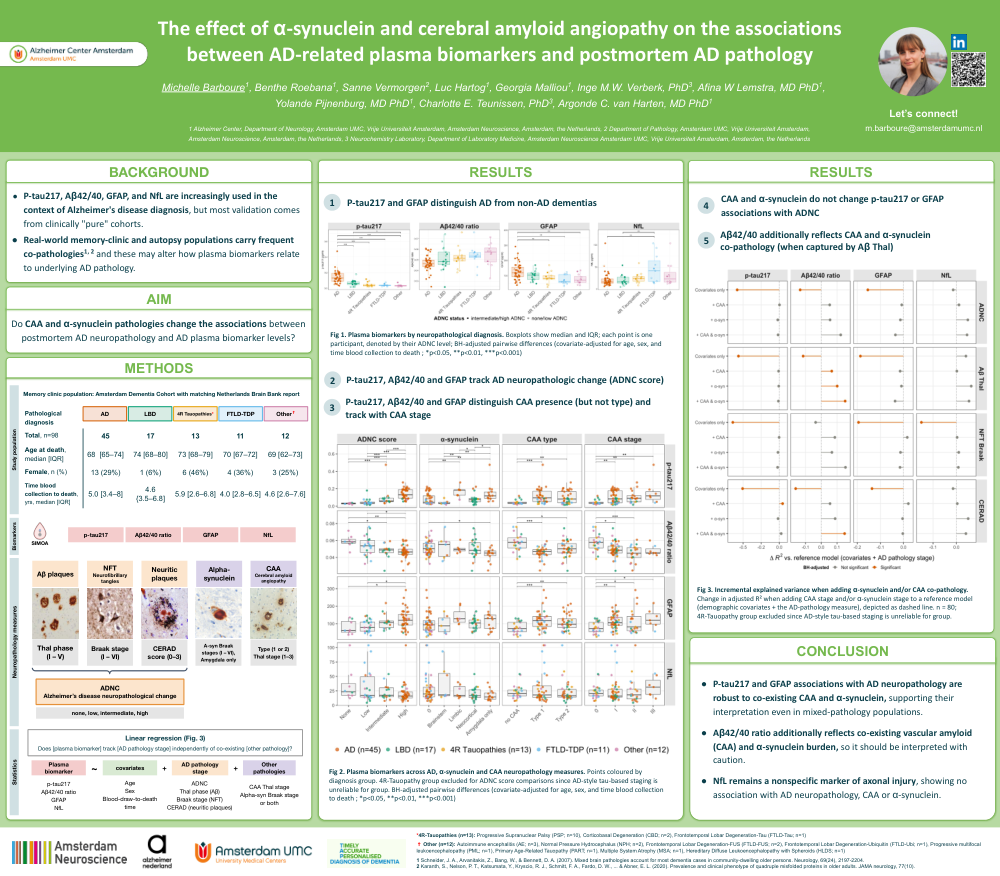
Title: The effect of α-synuclein and cerebral amyloid angiopathy on the associations between AD-related plasma biomarkers and postmortem AD pathology
Background:
P-tau217, Aβ42/40, GFAP, and NfL are increasingly used in the context of Alzheimer's disease diagnosis, but most validation comes from clinically "pure" cohorts.
Real-world memory-clinic and autopsy populations carry frequent co-pathologies, and these may alter how plasma biomarkers relate to underlying AD pathology.
Aim: Do CAA and α-synuclein pathologies change the associations between postmortem AD neuropathology and AD plasma biomarker levels?
Results:
- P-tau217 and GFAP distinguish AD from non-AD dementias
- P-tau217, Aβ42/40 and GFAP track AD neuropathologic change (ADNC score)
- P-tau217, Aβ42/40 and GFAP distinguish CAA presence (but not type) and track with CAA stage
P-tau217 and GFAP associations with AD neuropathology are robust to co-existing CAA and α-synuclein, supporting their interpretation even in mixed-pathology populations. Aβ42/40 ratio additionally reflects co-existing vascular amyloid (CAA) and α-synuclein burden, so it should be interpreted with caution.
NfL remains a nonspecific marker of axonal injury, showing no association with AD neuropathology, CAA or α-synuclein.
Comments
Email is required but is not shown publicly.
Loading comments...