4,068 posters, 219 videos, 101 topics, 69 sessions, 14,365 authors, 6,128 institutions
ePostersLive by SciGen Technologies S.A. All rights reserved.
Alzheimer's Association International Conference 2026
July 12-15, 2026 | London, United Kingdom, and Online

13554
Amyloid-ί And Orexin Moderate Rem Theta-gamma Coupling Effects On Cognitive Decline In Alzheimer’s Disease.
Part of Topic
Basic Science and Pathogenesis -> Molecular and Cell Biology -> Neurodegeneration and neuroprotection
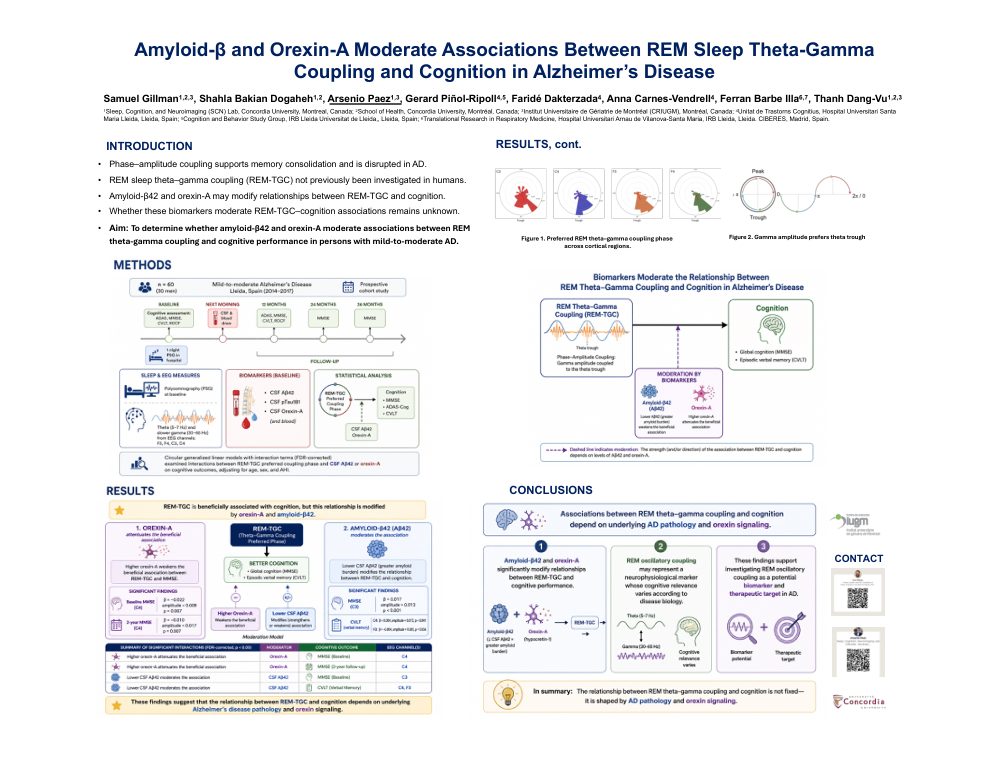
Amyloid-β and Orexin-A Moderate Associations Between REM Sleep Theta–Gamma Coupling and Cognition in Alzheimer’s Disease
Background: Phase–amplitude coupling (PAC) is a fundamental mechanism supporting memory consolidation and is disrupted in Alzheimer’s disease (AD). Although theta–gamma coupling (TGC) during wakefulness and non-rapid eye movement sleep has been studied, REM sleep theta–gamma coupling (REM-TGC) has not previously been characterized in humans. Because amyloid-β42 (Aβ42) and orexin-A are key biomarkers implicated in AD pathophysiology and sleep regulation, we investigated whether they modify associations between REM-TGC and cognitive performance.
Methods: Sixty persons with mild-to-moderate AD (30 women) from a prospective cohort in Lleida, Spain underwent overnight polysomnography and cerebrospinal fluid (CSF) sampling at baseline. REM-TGC was quantified using theta (5–7 Hz) phase and gamma (30–65 Hz) amplitude from frontal (F3, F4) and central (C3, C4) EEG channels. Cognitive assessments were performed at baseline and during follow-up (12, 24, and 36 months). Circular sine/cosine linear regression models with interaction terms, adjusted for age, sex, apnea–hypopnea index, CSF Aβ42, and orexin-A, were used to examine whether Aβ42 and orexin-A moderated associations between REM-TGC preferred coupling phase and cognition. False discovery rate correction was applied for multiple comparisons.
Results: Gamma amplitude was consistently coupled to the theta trough across frontal and central EEG channels during REM sleep. Higher CSF orexin-A significantly attenuated the beneficial association between REM-TGC and global cognition (MMSE) at baseline and at 2-year follow-up. CSF Aβ42 also significantly moderated associations between REM-TGC and both global cognition (MMSE) and episodic verbal memory (CVLT), indicating that the relationship between REM oscillatory coupling and cognition varies according to underlying AD pathology.
Conclusions: These findings demonstrate that the cognitive significance of REM theta–gamma coupling depends on biological markers of Alzheimer’s disease and sleep–wake regulation. REM-TGC may represent a novel neurophysiological biomarker whose relationship with cognition is influenced by amyloid pathology and orexin signaling. These results support further investigation of REM oscillatory coupling as both a potential biomarker and a therapeutic target for cognitive impairment in Alzheimer’s disease.
Comments
Email is required but is not shown publicly.
Loading comments...