4,068 posters, 219 videos, 101 topics, 69 sessions, 14,365 authors, 6,128 institutions
ePostersLive by SciGen Technologies S.A. All rights reserved.
Alzheimer's Association International Conference 2026
July 12-15, 2026 | London, United Kingdom, and Online

13619
Age-preserving 3D Induced Neurons Constructs Reveal Amyloid-independent Neuronal Vulnerability In Sporadic Alzheimer's Disease
Poster Presenter
Authors
Lucia Zhou Yang, Abrar Hakami, Oliver Borgogno, Inola Kopic, Lukas Karbacher, Attila Szücs, Silvia Pelucchi, Sophie Hill, Larissa Traxler, Sophie Eichhorner, Alysson R. Muotri R. Muotri, Fred H. Gage, Douglas Galasko, Bernhard Wolfrum, Ben Newland, Jerome Mertens
Affiliations
Department of Neurosciences, UC San Diego School of Medicine, University of California, La Jolla, USA, Department of Pharmaceutics, Faculty of Pharmacy, King Abdulaziz University, Jeddah, Saudi Arabia, SA, Neuroelectronics Laboratory, Munich Institute of Biomedical Engineering, School of Computation, Information and Technology, T echnical University of Munich, DE, Institute of Clinical Pathophysiology, Semmelweis University, Budapest, HU, Department of Pharmacological and Biomolecular Sciences “Rodolfo Paoletti”, Università degli Studi di Milano, Milan, IT, School of Pharmacy and Pharmaceutical Sciences, Cardiff University, Wales, UK, Department of Pediatrics, School of Medicine, University of California, San Diego, La Jolla, CA, USA, Laboratory of Genetics, The Salk Institute for Biological Studies, La Jolla, USA
Part of Topic
Basic Science and Pathogenesis -> Molecular and Cell Biology -> APP/Abeta/Amyloid
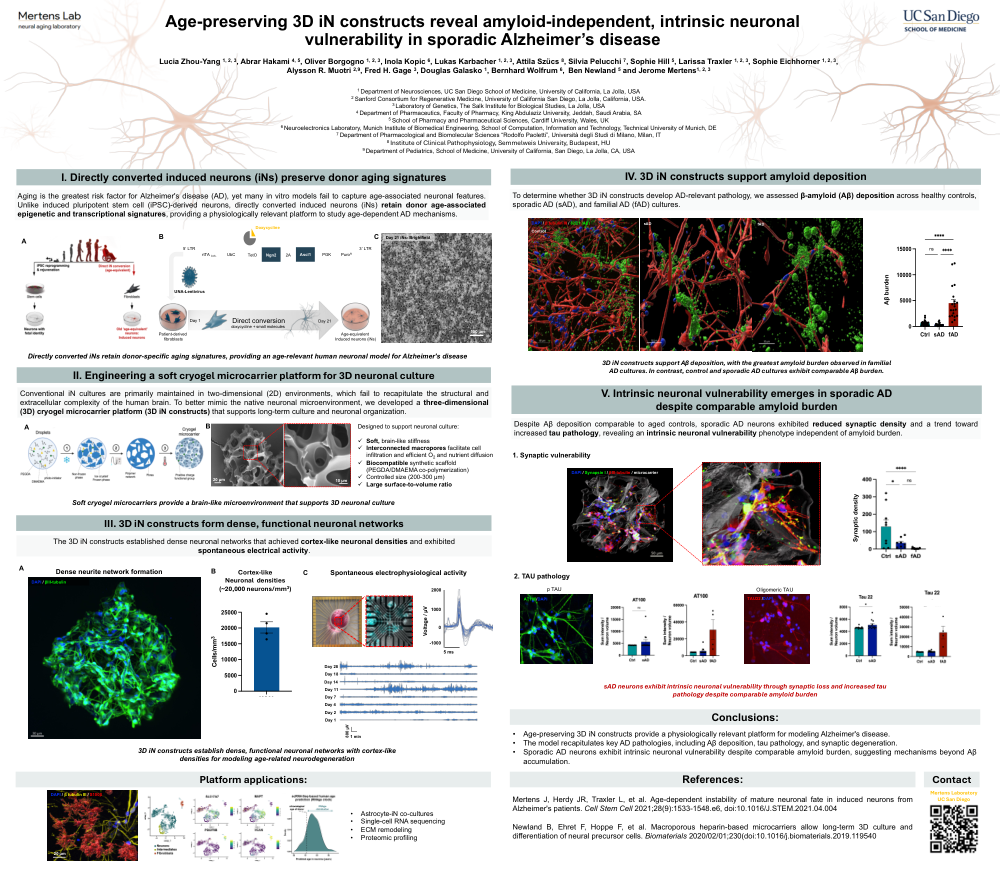
Age-preserving 3D iN models reveal intrinsic neuronal vulnerability in sporadic Alzheimer’s disease
Background
Directly induced neurons (iNs) retain donor-specific aging signatures, providing a powerful platform to study age-associated mechanisms in Alzheimer’s disease (AD), particularly in sporadic AD (sAD). However, current iN-based systems remain limited in their ability to support key disease-related phenotypes, including long-term protein retention and its relationship to neuronal vulnerability. We hypothesized that engineering a three-dimensional (3D) microenvironment would enable the emergence of these features in patient-derived neurons.
Methods
We engineered a 3D iN platform by seeding patient-derived neurons onto synthetic microcarriers that support structural complexity and functional network formation. iNs were generated from fibroblasts of familial AD (fAD), sAD patients and age-matched controls. Cultures were maintained under conditions that enable endogenous Aβ production and accumulation. We assessed Aβ aggregation and cell-intrinsic vulnerability phenotypes, including Tau pathology and synaptic resilience.
Results
The 3D iN platform supported the formation of complex, highly interconnected neuronal networks with sustained electrical activity, indicating stable long-term maturation. Within this context, the system enabled the retention and aggregation of endogenously produced Aβ. Notably, sAD-derived 3D iNs exhibited a distinct vulnerability phenotype, characterized by reduced synaptic resilience and increased Tau pathology. Importantly, this phenotype emerged independently of differences in Aβ levels, suggesting that intrinsic neuronal susceptibility is a key component of sAD pathology.
Conclusions
By combining aging-preserving iNs with a 3D microenvironment, we establish a model that supports long-term functional neuronal networks, enables Aβ retention and aggregation, and reveals intrinsic neuronal vulnerability in sAD. This platform provides a physiologically relevant, patient-specific system to investigate AD mechanisms and identify therapeutic strategies targeting neuronal resilience.
Comments
Email is required but is not shown publicly.
Loading comments...