4,068 posters, 219 videos, 101 topics, 69 sessions, 14,365 authors, 6,128 institutions
ePostersLive by SciGen Technologies S.A. All rights reserved.
Alzheimer's Association International Conference 2026
July 12-15, 2026 | London, United Kingdom, and Online

12012
A Preliminary Study On Estimating Amyloid-beta Clearance Efficiency In The Perivascular Space With Electro-osmotic Effects
Part of Topic
Basic Science and Pathogenesis -> Molecular and Cell Biology -> Vascular factors
A Preliminary Study On Estimating Amyloid-beta Clearance Efficiency In The Perivascular Space With Electro-osmotic Effects
Author Block: junghwa hong, Jaemin Kim, Soonmoon Jung, Youngho Lee, Hyeyeong Song, Seungyun Oh, Inyeop Na, Jiwoo Jang, Kyunghun Noh, Youngjae Park.
Department of Control and Instrumentation Engineering, Korea university, Sejong, Korea, Republic of.
Abstract:
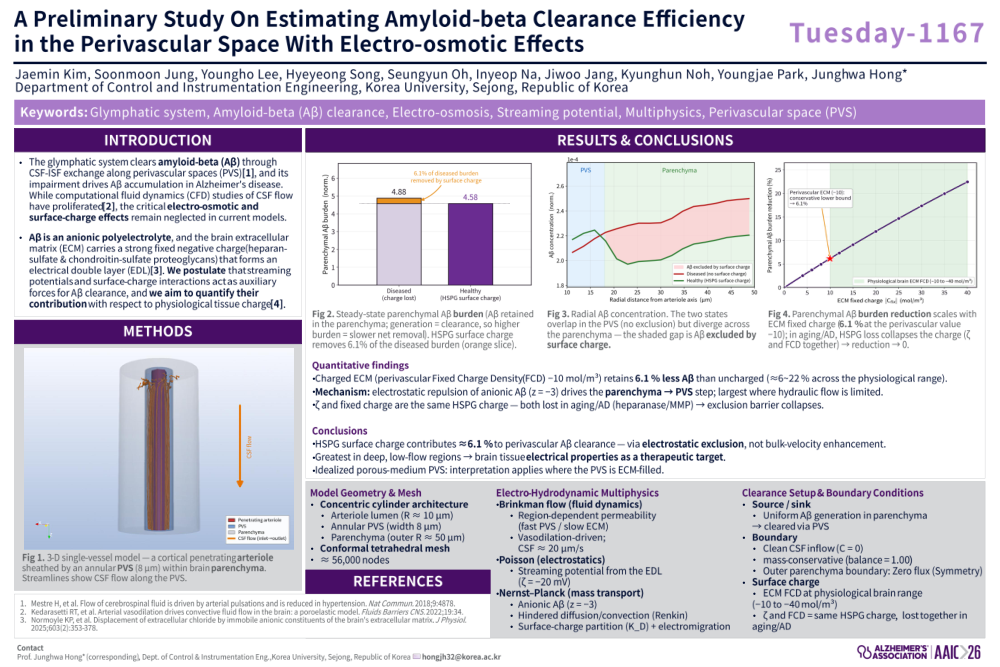
Background: Numerous studies indicate that the glymphatic system is integral to amyloid-beta (Aβ) clearance, and its impairment results in Aβ accumulation implicated in Alzheimer’s disease (AD). While computational fluid dynamics (CFD) studies on cerebrospinal fluid (CSF) flow have proliferated, electroosmotic effects remain neglected. Given that Aβ acts as an anionic polyelectrolyte and the perivascular space (PVS) forms an electrical double layer (EDL) via negatively charged heparan sulfate proteoglycans, electro-osmotic effects should be considered. This study postulates that streaming potentials and surface charge interactions function as auxiliary forces for Aβ clearance and validates this by estimating clearance rate with respect to zeta potential within the EDL.
Methods: A finite element model (FEM) was developed in COMSOL Multiphysics to investigate vasodilation-driven CSF transport and streaming potential (STP). The model represents a cortical penetrating arteriole with arterial wall, a highly permeable poroelastic PVS (width: 8 µm), and brain parenchyma. The simulation employs a fully coupled mixture theory with geometric nonlinearity and fluid inertia, integrated with electro-osmosis equations via the Weak Form PDE interface. Arterial pulsation was idealized as prescribed radial wall displacement (1 Hz, 2 µm). This approach enables quantitative assessment of Aβ clearance efficiency relative to zeta potential, explicitly accounting for electro-hydrodynamic influence on solute transport.
Results: The computational model evaluated electro-hydrodynamic influence on clearance velocity.
Under physiologic pressure gradients, the healthy model (ζ = −20 mV) showed an enhanced mean velocity of approximately 22 µm/s, reflecting electro-osmotic facilitation. Conversely, the diseased model (ζ = 0 mV) exhibited approximately 5-6%, suggesting surface charge interactions contribute to transport efficiency.
Conclusion: Our findings demonstrate that Aβ clearance is facilitated by coupled electro-hydrodynamic mechanisms, with vascular surface charge contributing approximately 5-6% to clearance velocity within the PVS. This highlights the potential of electro-osmotic effects, suggesting that electrical properties of brain tissue may contribute to Aβ removal, particularly in deep regions where hydraulic flow is limited.
However, the study idealizes the PVS as a porous medium, so the interpretation applies specifically to conditions where the PVS is filled with extracellular matrix.
Comments
Email is required but is not shown publicly.
Loading comments...