141 posters, 8 videos, 8 audios, 5 topics, 442 authors, 228 institutions
ePostersLive by SciGen Technologies S.A. All rights reserved.
6th World Congress on Vascular Access 2021
April 29 - 30, 2021 | Virtual

P008
SPAD-CARE: Semi-permanent access device care
Part of Topic
Education & Training
Video
SPAD-CARE: SEMI-PERMANENT ACCESS DEVICE CARE
a) Introduction
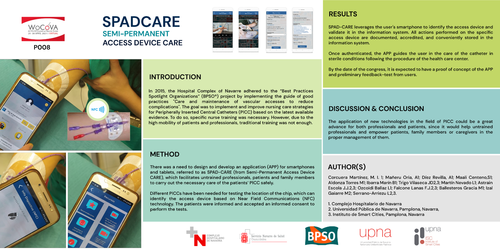
In 2015, the Hospital Complex of Navarre adhered to the “Best Practices Spotlight Organizations” (BPSO®) project by implementing the guide of good practices "Care and maintenance of vascular accesses to reduce complications". The goal was to implement and improve nursing care strategies for Peripherally Inserted Central Catheters (PICC) based on the latest available evidence. To do so, specific nurse training was necessary. However, due to the high mobility of patients and professionals, traditional training was not enough.
b) Method
There was a need to design and develop an application (APP) for smartphones and tablets, referred to as SPAD-CARE (from Semi-Permanent Access Device CARE), which facilitates untrained professionals, patients and family members to carry out the necessary care of the patients’ PICC safely.
Different PICCs have been needed for testing the location of the chip, which can identify the access device based on Near Field Communications (NFC) technology. The patients were informed and accepted an informed consent to perform the tests.
c) Results
SPAD-CARE leverages the user's smartphone to identify the access device and validate it in the information system. All actions performed on the specific access device are documented, accredited, and conveniently stored in the information system.
Once authenticated, the APP guides the user in the care of the catheter in sterile conditions following the procedure of the health care center.
By the date of the congress, it is expected to have a proof of concept of the APP and preliminary feedback-test from users.
d) Discussion & Conclusion
The application of new technologies in the field of PICC could be a great advance for both professionals and patients, since it would help untrained professionals and empower patients, family members or caregivers in the proper management of them.
Author(s)
Corcuera Martínez, M. I. 1; Mañeru Oria, A1; Díez Revilla, A1; Maali Centeno,S1; Aldonza Torres M1; Ibarra Marín B1; Trigo Vilaseca JD2,3; Martín Nevado L1; Astrain Escola J.J.2,3; Ozcoidi Ballaz L1; Falcone Lanas F.J.2,3; Ballesteros Gracia M1; Casado del Olmo, MI 1; Jimenez Echeverría, O1; Izal Gaiarre M2; Serrano-Arriezu L2,3.
1 Complejo Hospitalario de Navarra
2 Universidad Pública de Navarra, Pamplona, Navarra,
3 Instituto de Smart Cities, Pamplona, Navarra