141 posters, 8 videos, 8 audios, 5 topics, 442 authors, 228 institutions
ePostersLive by SciGen Technologies S.A. All rights reserved.
6th World Congress on Vascular Access 2021
April 29 - 30, 2021 | Virtual

P002
The Vicious Cycle of Vascular Access
Poster Presenter
Authors
Affiliations
Part of Topic
Education & Training
BACKGROUND: Following a review of the current available literature, certain gaps were evident, including a focus on patient experience and meaning making. The majority of previous studies focus on patient satisfaction and quality of life rather than patient experience. Therefore, in-depth, meaningful details about how participants make sense of their experiences and their meaning-making processes have been understudied. The approach taken for theseMstudies focused on the ‘what’ of the experience rather than ‘how’ the experience impacted on the participant.
AIM: To explore, in-depth, the lived experience of cancer patients with a Vascular Access Device.
DESIGN / METHODS: This study followed an Interpretive PhenomenologicalAnalysis (IPA) approach. A purposive sampling technique was used to identify eleven patients who had a vascular access device in situ and were willing to share their experiences. Semi- structured interviews were the data collection tool. Interviews were digitally recorded, transcribed and analysed using IPA.
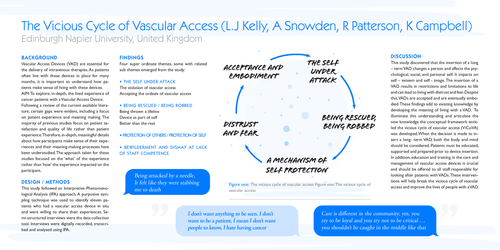
Four superordinate themes were identified:
1) The self under attack;
2) Being rescued / being robbed;
3) Protection of others / Protection of self and
4) Bewilderment and dismay at lack of staff competence.
DISCUSSION: This study discovered that the insertion of a long – term VAD changes a person and affects the psychological, social, and personal self. It impacts on self – esteem and self - image. The insertion of a VAD results in restrictions and limitations to life and can lead to living with distrust and fear. Despite this, VADs are accepted and are eventually embodied. These findings add to existing knowledge by developing the meaning of living with a VAD. To illuminate this understanding and articulate the new knowledge the conceptual framework entitled the vicious cycle of vascular access (ViCoVA) was developed. When the decision is made to insert a long- term VAD, both the body and mind should be considered. Patients must be educated, supported and prepared prior to device insertion. In addition, education and training in the care and management of vascular access devices is crucial and should be offered to all staff responsible for
looking after patients with VADs. These interventions will help break the vicious cycle of vascular access and improve the lives of people with a VAD.
CONCLUSION
VAD affects the psychological, social, and personal self and impacts on self-esteem and self-image. Despite this, VADs are accepted by patients and are eventually embodied.