141 posters, 8 videos, 8 audios, 5 topics, 442 authors, 228 institutions
ePostersLive by SciGen Technologies S.A. All rights reserved.
6th World Congress on Vascular Access 2021
April 29 - 30, 2021 | Virtual

P006
Case report: Internal jugular vein thrombosis due to wrong primary PICC tip placement. Importance of the intracavitary ECG method
Poster Presenter
Part of Topic
Education & Training
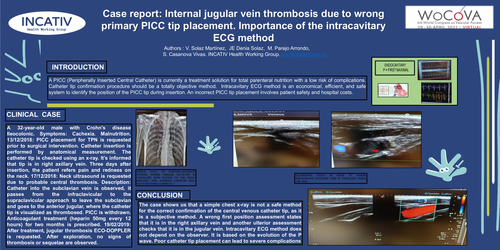
Tittle: Case report: Internal jugular vein thrombosis due to wrong primary PICC tip placement. Importance of the intracavitary ECG method.
Introduction: A PICC (Peripherally Inserted Central Catheter) is currently a treatment solution for total parenteral nutrition with a low risk of complications. Catheter tip confirmation procedure should be a totally objective method. Intracavitary ECG method is an economic, efficient, and safe system to identify the position of the PICC tip during insertion. An incorrect PICC tip placement involves patient safety and hospital costs.
Clinical case: A 32-year-old male with Crohn's disease Ileocolonic. Symptoms: Cachexia. Malnutrition. 13/12/2018: PICC placement for TPN is requested prior to surgical intervention. Catheter insertion is performed by anatomical measurement. Catheter tip is checked using an x-ray. It’s informed that tip is in right axillary vein. Three days after insertion, patient refers pain and redness on the neck. 17/12/2018: Neck ultrasound is requested due to probable central thrombosis. Description: Catheter into the subclavian vein is observed, it passes from the infraclavicular to the supraclavicular approach to leave the subclavian and goes to the anterior jugular, where catheter tip is visualized as thrombosed. PICC is withdrawn. Anticoagulant treatment (heparin 50mg every 12 hours) for two months is prescribed. 19/02/2019: After treatment, jugular thrombosis ECO-DOPPLER is requested. After exploration, no signs of thrombosis or sequelae are observed.
Conclusion: The case shows us that a simple chest x-ray is not a safe method for the correct confirmation of the central venous catheter tip, as it is a subjective method. A wrong first position assessment states that it is in the right axillary vein and another ulterior assesment checks that it is in the jugular vein. Intracavitary ECG method does not depend on the observer. It is based on the evolution of the P wave. Poor catheter tip placement can lead to severe complications.