141 posters, 8 videos, 8 audios, 5 topics, 442 authors, 228 institutions
ePostersLive by SciGen Technologies S.A. All rights reserved.
6th World Congress on Vascular Access 2021
April 29 - 30, 2021 | Virtual

P024
Collaborative approach to improve PIVC outcomes
Poster Presenter
Authors
Affiliations
Part of Topic
Education & Training
The Why?
The implementation of a standardised pathway approach to PIVC selection, insertion,care and maintenance can lead to better patient outcomes and reduced costs
(Easterlow 2010; Bolton 2015). National and international evidence-based guidelines(INS 2016; RCN 2016; Loveday et al, 2014) support the choice of device based on its functional features to improve insertion success rate, indwell times and reduction ofassociated complications. Furthermore, closed system PIVCs have been shown to be the most effective system in reducing phlebitis and PIVC-related infection rates,alongside decreasing the risk of the operator coming into contact with the patient’s blood (Bitmead and Oliver 2018; Gonzalez-Lopez et al. 2014; Shaw 2017).
An internal audit within the Organisation highlighted that PIVC first stick success had decreased from 92% to 76%. Additional cannulation attempts increase patient discomfort and result in a waste of valuable resources of equipment and nursing time. There were two types of PIVC in use, an open cannula plus extension set
and an integrated closed system (BD Nexiva) only used in anaesthetics and theatre departments. In comparison to an open system PIVC, the integrated closed system BD NexivaTM has been proven to reduce the number of manipulations required, reduce accidental dislodgement, lessen exposure to blood, lower the chance of mechanical phlebitis, and has a median dwell time of 6 days as opposed to 4 with an open system (Gonzalez-Lopez et al. 2014). Current evidence-based best practice guidelines recommend the removal of PIVCs when clinically indicated as opposed to routine replacement (INS 2016; RCN 2016; Loveday et al. 2014).The potential increase in PIVC dwell time from BD Nexiva could lead to substantial savings in both nursing time and cost, as well as the obvious benefit to the patient.
The Challenge
The challenge was to implement a change in the ingrained practice of inserting a‘traditional’ open system cannula that people were familiar with, to an integrated
closed system cannula in order to standardise practice across all clinical areas, in an attempt to improve outcomes and minimise the risks associated with open
PIVCs within the Trust. BD was chosen as the partner of choice as they offered a comprehensive evidence-based programme that integrated policy, practice and
products (BD Nexiva) to support this standardisation process.
The Solution
A multifaceted collaborative approach between the Organisation and BD to facilitate and implement change in practice.
Aim: To facilitate a smooth and effective transition from an open PIVC plus extension set to an integrated closed system PIVC throughout all clinical areas.
Objectives:
> Standardise Practice
> Improve PIVC first stick success
> Minimise operator exposure to blood
> Reduce the number of manipulations required, in order to minimise phlebitis rates and the risk of PIVC related infection to increase overall cannula dwell time
> Support the Trust to identify areas of potential improvement/development and implement plan of action
Methods:
Phase 1 - A systematic Practice vs Guidelines (PvG) review of the current peripheral IV Cannulation practice was performed by BD clinical nursing team, prior to
implementing a training programme for the use of the new integrated closed system PIVC.
Phase 2 - The BD clinical team spent four weeks performing hands on training and support to both hospital sites during the implementation phase. The training was bespoke and tailored to the staff needs in all clinical areas. Group training or 1 to 1 as required. Extra training is available on request.
Phase 3 - Roll out of a redesigned IV Training Programme to include online modules for venepuncture and cannulation and monthly classroom sessions overseen by a BD Clinical Nurse Specialist and RMH Practice Educator. Followed up with clinical support and assessments/sign off by RMH Clinical Practice Educator.
Phase 4 - Continue to monitor practice by peer review, repeat PvG review and adherence to current national and international best evidence based guidelines.
Results:
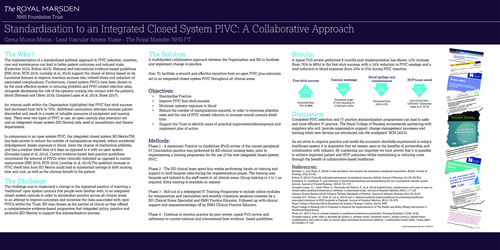
A repeat PvG review performed 8 months post implementation has shown 12% increase (from 76% to 88%) in the first stick success, with a 34% reduction in PIVC wastage and a total reduction to blood exposure (from 24% to 0%) during PIVC insertion.
Discussion
Consistent PIVC selection and IV practice standardisation programmes can lead to safer and more efficient IV practice. The Royal College of Nursing recommends partnering with suppliers who will ‘provide organisation support, change management processes and training when new devices are introduced into the workplace’ RCN (2013).