141 posters, 8 videos, 8 audios, 5 topics, 442 authors, 228 institutions
ePostersLive by SciGen Technologies S.A. All rights reserved.
6th World Congress on Vascular Access 2021
April 29 - 30, 2021 | Virtual

P021
The impact of a standardised, blended learning, simulation-based education program on clinicians’ confidence in placing acute central venous catheters: a mixed methods review of attendee evaluations
Poster Presenter
Authors
Affiliations
Part of Topic
Education & Training
The impact of a standardised, blended learning, simulation-based educational program on clinicians’ confidence in placing acute central venous catheters:
a mixed method review of attendee evaluations.
Hayleigh Haggerty, MSc, ICU (Cert), BSc (Hons), RN and Maria Sedano, RN.
Introduction
The ‘Ultrasound-Guided Central Venous Access: Compliance within Practice Course’ is an evidence-based, multimodal educational program that supports clinicians to develop their knowledge, skills and competence to safely and effectively insert acute Central Venous Catheters (CVCs). This course was developed by the Clinical and Medical Affairs Team at Teleflex, and was launched in the UK in 2017 having been adapted from a format designed within the USA. The program has a blended learning approach with a particular focus on simulation, has been facilitated within six acute National Health Service hospital trusts in the UK and has received accreditation from the Royal College of Anaesthetists. Following a successful implementation, the attendee evaluations were then retrospectively reviewed to explore the impact on learners’ confidence, their learning experiences, and to review their comments.
Background
Teleflex is a global medical device company which manufactures and sells a variety of clinical products within different specialities. Within the organisation, there is a non-commercial component called ‘Clinical and Medical Affairs’, which is comprised of clinicians and exclusively focuses on developing and delivering high quality procedural education to support the safe and effective use of their products. It is within this team that the ‘Ultrasound-Guided Central Venous Access: Compliance within Practice Course’ was developed in response to a recognised learning need within the clinical environment. It was noted that historically CVCs were inserted using landmarking techniques (Hoffman et al., 2017), yet the evidence surrounding this procedure increasingly concludes that ultrasound guidance is safer and more effective (Saugel, Scheeren & Teboul, 2017), therefore this course was designed to empower CVC inserters to practice within these recommendations.
The course is run in collaboration with a hospital, with a local contact overseeing the local logistics and arrangements. The course is provided by a faculty of experienced CVC inserters, all of whom must attend a Train the Trainer course prior to teaching to ensure they are appropriately prepared to deliver the course effectively. The course lasts one full day, is opened with a series of short lectures on vessel health and device selection, then the attendees are split into groups of four or five and attend separate workstations. These are attended in a rotation by all groups, and each station has its own set of learning objectives. These stations include needling technique, complication recognition and management, and CVC insertion; all are practical or simulation based. Prior to the event, all attendees are provided with access to an e-book on the topic, are requested to review this before attending and to use it as a resource following the event. At the end of each session attendees are asked to complete an online learning evaluation via a tablet before leaving the course, or later if this was not possible at the site. Follow-up, competency assessment and further learning needs are managed by the local team and do not include Teleflex unless specifically requested.
Method
A retrospective mixed methods approach has been utilised to evaluate the impact of the course on attendees’ confidence in inserting and managing acute CVCs. Thus far there have been 12 courses with a total of 211 attendees, of which 186 have completed the online evaluation undertaken upon completion of the course. Within this each attendee was asked to state their level of confidence with specific components of the CVC insertion and management process before and after the course, evaluate organisational aspects of the course, while also allowing for open comments about their learning experience.
Results
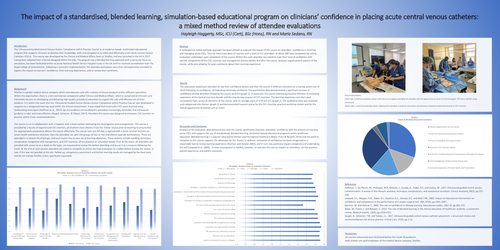
The evaluation asked each attendee to rate their confidence before and after the course in different elements on a scoring system out of 10 (0 indicating no confidence, 10 indicating extremely confident). The quantitative data demonstrated a significant increase in confidence among attendees following the course (p<0.01) (graph 1). In particular, the course seemed particularly effective at increasing awareness of the Central Line Care Bundle and the step by step process of CVC insertion. The learning experience was also rated consistently high, across all elements of the course, with an average score of 4.54 out of 5 (graph 2). The qualitative data was reviewed and categorised into themes (graph 3) and demonstrated frequent praise for the CVC insertion practical workshop station and for the overall opportunity to attend such an event.
Discussion and Conclusion
Analysis of the evaluation data demonstrates that this course significantly improves attendees’ confidence with the process of inserting acute CVCs and supports the use of standardised, blended learning, simulation-based educational programs within healthcare education. Blended learning is a popular educational format used throughout healthcare (Rowe, Franz & Bozalek, 2012) and the positive reception to this course supports the advocates for this theory. In addition, evaluation of confidence has been recognised as a reasonable tool to review learning experience (Norman and Hyland, 2003), and in turn may positively impact competency of undertaking the skill (Leopold et al., 2005). Further investigation is needed, however, to evaluate the courses impact on attendees’ clinical practice, patient experience and patient outcomes.