141 posters, 8 videos, 8 audios, 5 topics, 442 authors, 228 institutions
ePostersLive by SciGen Technologies S.A. All rights reserved.
6th World Congress on Vascular Access 2021
April 29 - 30, 2021 | Virtual

P018
A Pan European Review of Peripheral IV Practices: Can we do better?
Poster Presenter
Authors
Affiliations
Part of Topic
Education & Training
A Pan European Review of Peripheral IV Practices: Can we do better?
Servane Pellé Lombardy, Shannon Hillyer, Stephen Church
Introduction
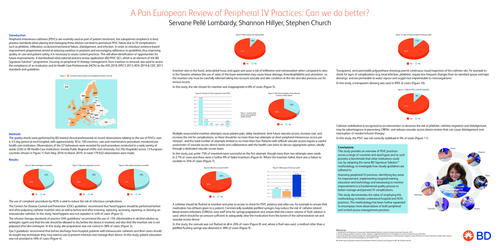
Peripheral intravenous catheters (PIVCs) are routinely used as part of patient treatment, but suboptimal compliance to best practice standards when placing and managing these devices can lead to premature PIVC failure due to IV complications such as phlebitis, infiltration, occlusion/mechanical failure, dislodgement, and infection. In order to introduce evidence-based improvement programmes aimed at reducing variation in practices and encouraging adherence to guidelines, thus improving quality of care and patient safety, it is necessary to assess current practices. This will allow identification of opportunities for future improvements. A standardised observational practice review application (BD PIVC QC), which is an element of the BD Signature SolutionTM programme, focusing on peripheral IV therapy management, from insertion to removal, was used to assess the compliance of an institution and its Health Care Professionals (HCPs) to the INS 2016; EPIC3 2013; RCN 2016 & CDC 2011 standards and guidelines.
Methods
The quality checks were performed by BD trained clinical professionals to record observations relating to the use of PIVCs, over a 3-5 day period at each hospital, with approximately 30 to 100 insertion, care and maintenance procedures monitored per health care institution. Observations of the 57 behaviours were recorded for each procedure conducted in a wide variety of wards (326) in 98 Health Care institutions (mostly Public Regional (40%) and University (42.3%) Hospitals) across 13 European countries (shown in Figure 1) from May 2016 to March 2019. In total 179,922 observations were made.
Results
The use of compliant procedures by HCPs is vital to reduce the risk of infectious complications.
The Centers for Disease Control and Prevention (CDC) guidelines1 recommend that hand hygiene should be performed before and after palpating catheter insertion sites as well as before and after inserting, replacing, accessing, repairing, or dressing an intravascular catheter. In this study, hand hygiene was not repeated in 44% of cases (Figure 2).
The infusion therapy standards of practice (INS guidelines)2 recommend the use of >5% chlorhexidine in alcohol solution as antiseptic agent and that the site should be allowed to dry before the device is inserted, and also that the insertion site is not palpated after skin antisepsis. In this study, skin preparation was not correct in 38% of cases (Figure 3).
Epic3 guidelines3 recommend that before discharge from hospital, patients with intravascular catheters and their carers should be taught any techniques they may need to use to prevent infection and manage their device. In this study, patient education was not provided in 49% of cases (Figure 4).
Insertion sites in the hand, antecubital fossa, and upper arm pose a risk of infiltration and extravasation when compared to sites in the forearm, whereas the use of veins of the lower extremities may cause tissue damage, thrombophlebitis and ulceration2, so the insertion site must be carefully selected taking into account vascular and skin condition at the site and also previous use for venous access.
In this study, the site chosen for insertion was inappropriate in 8% of cases (Figure 5).
Multiple unsuccessful insertion attempts cause patient pain, delay treatment, limit future vascular access, increase cost, and increase the risk for complications, so there should be no more than two attempts at short peripheral intravenous access per clinician2, and the total number of attempts limited to no more than four. Patients with difficult vascular access require a careful assessment of vascular access device needs and collaboration with the health care team to discuss appropriate option, ideally through a dedicated vascular access team.
In this study, just under 75% of insertions were successful on the first attempt, though more than two attempts were made in 2.7% of cases and there were a further 9% of failed insertions (Figure 6). Where the insertion failed, there was a failure to escalate in 35% of cases (Figure 7).
A catheter should be flushed at insertion and prior to access to check for PIVC patency and after use, for example to ensure that medication has all been given to a patient. Commercially available prefilled syringes may reduce the risk of catheter related blood stream infections (CRBSIs), save staff time for syringe preparation and ensure that the correct volume of flush solution is used, which should be an amount sufficient to adequately clear the medication from the lumen of the administration set and vascular access device.2
In this study, the cannula was not flushed at all in 20% of cases (Figure 8) and, where a flush was used, a method other than a prefilled flushing syringe was observed in 38% of cases (Figure 9).
Transparent, semi-permeable polyurethane dressings permit continuous visual inspection of the catheter site, for example to check for signs of complications (e.g. local infection, phlebitis), require less frequent changes than do standard gauze and tape dressings1 and are permeable to water vapour and oxygen but impermeable to microorganisms.3
In this study, a transparent dressing was used in 89% of cases (Figure 10).
Catheter stabilisation is recognised as an intervention to decrease the risk of phlebitis, catheter migration and dislodgement, may be advantageous in preventing CRBSIs1 and reduces vascular access device motion that can cause dislodgement and interruption of needed infusion therapy.2
In this study, the PIVC was not correctly stabilised in 9% of cases (Figure 11).
Conclusions
This study provides an overview of PIVC practices across a range of countries and ward types and as such provides a benchmark that other institutions could use, by adopting the same BD Signature SolutionTM methodology, to investigate how closely guidelines are adhered to.
Assessing peripheral IV practices, identifying key areas for improvement, implementing targeted training, education and technology and reassessing to monitor improvements is a fundamental quality process to better manage and prevent IV complications.
This study demonstrates the value of employing this methodology to better understand hospital and HCPs practices. The methodology has been further expanded to encompass more observations of both peripheral and central access management practices.
References
1. Guidelines for the Prevention of Intravascular Catheter-Related Infections. Centers for Disease Control and Prevention. 2011
2. Infusion therapy standards of practice. Gorski L, Hadaway L, Hagle ME, McGoldrick M, Orr M, Doellman D. Journal of Infusion Nursing. 2016;39:S1
3. epic3: National Evidence-Based Guidelines for Preventing Healthcare-Associated Infections in NHS Hospitals in England. Loveday HP, Wilson JA, Pratt RJ, Golsorkhi M, Tingle A, Bak A, Browne J, Prieto J, M. Wilcox. Journal of Hospital Infection. 2014;86S1:S1–S70
BD, the BD Logo and Signature Solutions are trademarks of Becton, Dickinson and Company. © 2021 BD. All rights reserved.