141 posters, 8 videos, 8 audios, 5 topics, 442 authors, 228 institutions
ePostersLive by SciGen Technologies S.A. All rights reserved.
6th World Congress on Vascular Access 2021
April 29 - 30, 2021 | Virtual

P017
Restoring patency of central venous port-catheter with low-dose thrombolysis
Poster Presenter
Authors
V.Ch Chovanec, J.R Raupach, O.R. Renc, P.Z. Žák, P.P. Priester, J.V. Vackova, P.V. Vyletova
Affiliations
Dept of Radiology, University Hospital Hradec Kralove, Dept of Radiology, University Hospital, 1st Dept of Internal Medicine - Haematology, University Hospital, Dept of Oncology and Radiotherapy, University Pharmacy, University Hospital
Part of Topic
Education & Training
Restoring patency of central venous port-catheter with low-dose thrombolysis.
Chovanec V.1, Raupach J.1, Renc O.1, Žák P.2, Priester P.3, Vackova J.4, Vyletova P.1
1Dept. of Radiology, University Hospital Hradec Kralove, Czech Republic
24th Dept. of Internal Medicine - Haematology, University Hospital, Hradec Kralove, Czech Republic
3Dept. of Oncology and Radiotherapy, University Hospital, Hradec Kralove, Czech Republic
4Hospital Pharmacy, University Hospital, Hradec Kralove, Czech Republic
Background:
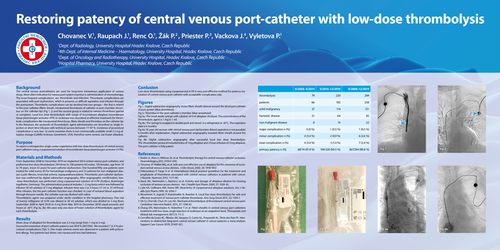
The central venous portcatheters are used for long-term intravenous application of various drugs. Most often indication for venous port system insertion is administration of chemotherapy. The most frequent complications are thrombotic and infection. Thrombotic complications are associated with port dysfunction, which is presents as difficult aspiration and infusion through the portsystem. Thrombotic complications can be devided into two groups – the first is related to the port catheter (fibrin sheath, intraluminal thrombosis of catheter or port chamber, thrombus on the catheter tip)(Fig 1,2) and the second group is related to venous thrombosis (partial or complete). Local low dose thrombolysis with usage of recombinant alteplase (recombinant tissue plasminogen activator rtPA) or urokinase was described as effective treatment for thrombotic complications like intraluminal thrombosis, fibrin sheath and thrombus on the catheter tip. In the literature, the protocols of thrombolytic agent administration are described as single injection or short time infusion with technical success between 77 - 97 %. Incidence of procedural complication is very low. In some countries there is not commercially available small 2,2 mg alteplase dosage (Cathflo Activase, Genentech, USA), therefore some centres use frozen alteplase.
Purpose:
To report a retrospective single center experience with low-dose thrombolysis of central venous port catheters using cryopreserved solution of recombinant tissue plasminogen activator (rt-PA).
Materials and Methods:
From September 2008 to December 2019 we implanted 5554 central venous port-catheters and performed low-dose thrombolysis 294 times in 258 patients (63 males, 195 females, age from 19 to 79 years, mean 55 years) for port-catheter dysfunction. One hundred fifty one patients were treated for solid tumor, 85 for hematologic malignancy and 22 patients for non-malignant disease (cystic fibrosis, bronchial asthma, hypoparathyreoidism). Thrombotic port-catheter dysfunction was confirmed by digital subtraction angiography. After angiographic comfirmation, low-dose thrombolysis was performed using cryopreserved solution of rt-PA (Actilyse, Boehringer Ingelheim, Germany). The administration protocol includes 1-2 mg bolus which was followed by infusion 50 ml solution of 3 mg alteplase. Infusion time was 2 or 3 hours (17 ml or 25 ml/hour). After infusion, the the port catheter function was checked. In case of restored blood aspiration through the port needle, the catheter was was flushed with saline.
Thrombolytic agent was prepared under sterile condition in the hospital pharmacy. One vial of twenty milligrams of rt-PA was diluted in 20 ml solution, which was divided to 5 mg (from September 2008 to April 2014) or 4 mg (from May 2014 to December 2019) equal amounts and frozen at - 20 ̊ C (Fig3a,b). We used only one dose of frozen solution of thrombolytic agent for each thrombolysis.
Results:
Mean dose of alteplase for thrombolysis was 3.5 mg (range from 1 mg to 5 mg).
Successful restoration of port-catheter patency was 90.8 % (267/294). We recorded 7 (2.4 %) procedural complications (Tab 1). One major adverse event was observed in a patient with polyvalent allergy. Two patients had shiver, two nausea and two had faintness.
Conlusion:
Low-dose thrombolysis using cryopreserved rt-PA is very cost-effective method for patency restoration of central venous port catheter with acceptable complication rate.
References:
1 Baskin JL, Reiss U, Wilimas JA, et al. Thrombolytic therapy for central venous catheter occlusion. Heamatologica,2012, 97:641-650.
2 Timoney JP, Malkin MG, et al. Safe and cost effective use of alteplase for the clearence of occluded central venous access devices. J Clin Oncol, 2002, 20: 1918-1922
3 Debourdeau P, Farge D et al. International clinical practice guidelines for the treatment and prophylaxis of thormbosis associated with central venous catheters in patients with cancer. J thromb Haemost 2013, 11:71-80.
4 Davis SN., Vermeulen L, BantonJ, et al. Activity and dosage of alteplase dilution for clearing occlusion of venous-access devices. Am J Health-Syst Pharm 2000, 57: 1039-45.
5 Calis KA, Cullinane AM, Horne MK. Bioactivity of cryopreserved alteplase solutions. Am J Health-Syst Pharm,1999, 56: 2056-7.
6 Massmann A, Jagoda P, Kranzhoefer N, Buecker A. Local low-dose thrombolysis for safe and effective treatment of venous port-catheter thrombosis. Ann Surg Oncol 2015, 22: 1593-7.
7 Oh SJ, Choi GB, Chun JH, Lee HG. Mechanical thrombolysis of thrombosed central venous port. CardioVasc Intervent Radiol. 2014, 37: 1358-62.
8 Chang DH, Mammadov K, Hickethier T et al. Fibrin sheaths in central venous port catheters: treatment with low-dose, single injection of urokinase on an outpatient basis. Therapeutic and clinical risk management 2017,13: 111-5.
9 Carvalho da Costa AC, Ribeiro JM, Vasques CI, Canto GL, Porporatti AL, Diniz dos Reis PE. Interventions to obstructive long-term central venous catheter in cancer patients: a meta-analysis. Support Care Cancer 2019, 27:407-421.