141 posters, 8 videos, 8 audios, 5 topics, 442 authors, 228 institutions
ePostersLive by SciGen Technologies S.A. All rights reserved.
6th World Congress on Vascular Access 2021
April 29 - 30, 2021 | Virtual

P015
The role of simulation training in increasing the time of less-event exploitation of intravascular catheters
Poster Presenter
Authors
A.V Satsuk, U Loaisa, EV Korneeva, V.V. Schukin, O.V. Pimenova, G.G. Solopova
Affiliations
Dmitry Rogachev National Medical Research Center Of Pediatric Hematology, Oncology and Immunology, Dmitry Rogachev National Medical Research Center Of Pediatric Hematology, Oncology and Immunology, P, «Dmitry Rogachev National Medical Research Center of Pediatric Hematology, Oncology and Immunology».
Part of Topic
Education & Training
Satsuk A.V., Schukin V.V., Solopova G.G., Loaisa U., Pimenova O.V., Korneeva E.V.
THE ROLE OF SIMULATION TRAINING IN INCREASING THE TIME OF LESS-EVENT EXPLOITATION OF INTRAVASCULAR CATHETERS.
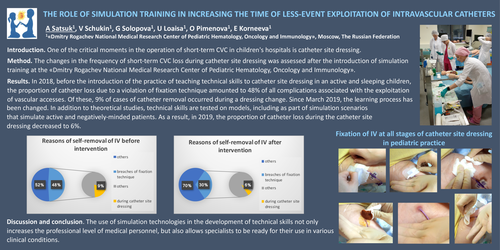
Introduction. One of the critical moments in the operation of short-term CVC in children's hospitals is catheter site dressing.
Method. The changes in the frequency of short-term CVC loss during catheter site dressing was assessed after the introduction of simulation training at the «Dmitry Rogachev National Medical Research Center of Pediatric Hematology, Oncology and Immunology».
Results. In 2018, before the introduction of the practice of teaching technical skills to catheter site dressing in an active and sleeping children, the proportion of catheter loss due to a violation of fixation technique amounted to 48% of all complications associated with the exploitation of vascular accesses. Of these, 9% of cases of catheter removal occurred during a dressing change. Since March 2019, the learning process has been changed. In addition to theoretical studies, technical skills are tested on models, including as part of simulation scenarios that simulate active and negatively-minded patients. As a result, in 2019, the proportion of catheter loss during the catheter site dressing decreased to 6%.
Discussion and conclusion.
The use of simulation technologies in the development of technical skills not only increases the professional level of medical personnel, but also allows specialists to be ready for their use in various clinical conditions.