141 posters, 8 videos, 8 audios, 5 topics, 442 authors, 228 institutions
ePostersLive by SciGen Technologies S.A. All rights reserved.
6th World Congress on Vascular Access 2021
April 29 - 30, 2021 | Virtual

P013
Adeguate preliminar ultrasound vascular assessment, basic decision-making point: a case report
Poster Presenter
Part of Topic
Education & Training
ADEGUATE PRELIMINAR ULTRASOUND VASCULAR ASSESSMENT, BASIC DECISION-MAKING POINT: A CASE REPORT
Introduction
A 43-year-old woman affected by breast cancer with secondary metastasis at the lymph node, skin (thoracic and left subclavicular region), bones, pleura and lung.
Clinical synthesis: left mastectomy after neoadjuvant chemotherapy treatment in 2015, radiotherapy on the left chest wall and adjuvant chemotherapy in 2016. Left axillary lymphadenectomy in 2017 with subsequent left upper limb lymphedema. Chemotherapy was performed by a totally implantable venous catheter removed in 2019 for CR-BSI.
Method
Need for stable venous access for continuous infusions, chemotherapy and high doses of intravenous opioids for pain management. Ultrasound assessment of the venous district of the upper right limb for the possible positioning of a PICC - Peripherally Inserted Central Catheter.
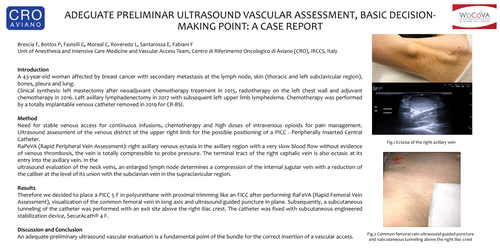
RaPeVA (Rapid Peripheral Vein Assessment): right axillary venous ectasia in the axillary region with a very slow blood flow without evidence of venous thrombosis, the vein is totally compressible to probe pressure. The terminal tract of the right cephalic vein is also ectasic at its entry into the axillary vein. In the
ultrasound evaluation of the neck veins, an enlarged lymph node determines a compression of the internal jugular vein with a reduction of the caliber at the level of its union with the subclavian vein in the supraclavicular region.
Results
Therefore we decided to place a PICC 5 F in polyurethane with proximal trimming like an FICC after performing RaFeVA (Rapid Femoral Vein Assessment), visualization of the common femoral vein in long axis and ultrasound-guided puncture in plane. Subsequently, a subcutaneous tunneling of the catheter was performed with an exit site above the right iliac crest. The catheter was fixed with subcutaneous engineered stabilization device, SecurAcath® 4 F.
Discussion and Conclusion
An adequate preliminary ultrasound vascular evaluation is a fundamental point of the bundle for the correct insertion of a vascular access.