141 posters, 8 videos, 8 audios, 5 topics, 442 authors, 228 institutions
ePostersLive by SciGen Technologies S.A. All rights reserved.
6th World Congress on Vascular Access 2021
April 29 - 30, 2021 | Virtual

P012
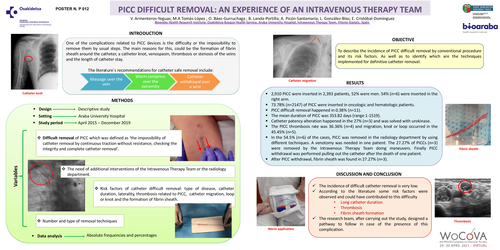
PICC difficult removal: an experience of an Intravenous Therapy Team
Part of Topic
Education & Training
PICC difficult removal: an experience of an Intravenous Therapy Team
Introduction
One of the complications related to PICC devices is the difficulty or the impossibility to remove them by usual steps. The reasons of PICC difficult removal are the fibrin sheath formation, vein thrombosis or stenosis and the long catheter duration.
Objective
The aim is to describe the incidence of PICC difficult removal by conventional procedure, its risk factors and the techniques implemented for definitive removal.
Method
A descriptive study was carried out at Araba University Hospital between April 2015 and December 2019. The sample was all the PICC lines inserted by the Intravenous Therapy Team (ITT) during this period. The main variable was the difficult PICC removal defined as the impossibility of catheter removal by continuous traction without resistance, checking the total catheter removal and consequently, the need of additional interventions of the ITT (massage and heat compress over the extremity, the withdrawal over a wire…) or radiological interventions.
Risk factors of difficult removal (type of disease, catheter duration, laterality, thrombosis, migration, loop or knot and the fibrin sheath formation) and those related to removal techniques were collected. Number and type of removal techniques.Variables were expressed in absolute frequencies and percentages.
Results
2,910 PICC were inserted in 2,393 patients, 52% were men. 73.78% of PICC were inserted in oncologic and hematologic patients. PICC difficult removal happened in 0.38% (n=11). 54% (n=6) were inserted in the right arm. The mean duration of PICC was 353.82 days (range 1-1519). Catheter patency alteration happened in 27% (n=3). The PICC thrombosis rate was 36.36% (n=4) and migration, knot or loop occurred in 45.45% (n=5). In the 54.5% (n=6) of the cases, PICC was removed in the radiology department by using different techniques. A venotomy was needed in one patient. The 27.27% of PICCs (n=3) were removed by the Intravenous Therapy Team doing maneuvers. Finally PICC withdrawal was performed pulling out the catheter after the death of one patient.Fibrin sheath was found in 27.27% (n=3).
Discussion & Conclusion
The incidence of this event is very low. According to the literature some risk factors were observed and could have contributed to this difficulty: long catheter duration, thrombosis, fibrin sheath formation.The research team, after carrying out the study, designed a pathway to follow in case of the presence of this complication.