141 posters, 8 videos, 8 audios, 5 topics, 442 authors, 228 institutions
ePostersLive by SciGen Technologies S.A. All rights reserved.
6th World Congress on Vascular Access 2021
April 29 - 30, 2021 | Virtual

P011
Observational study and analysis of complications in patients candidate for the positioning of PICC-port
Part of Topic
Education & Training
OBSERVATIONAL STUDY AND ANALYSIS OF COMPLICATIONS IN PATIENTS CANDIDATE FOR THE POSITIONING OF PICC-PORT
Introduction
The recent development of innovative materials and techniques of ultrasound-guided venipuncture of the deep veins of the arm has led to an increase in the diffusion of peripheral insertion central venous catheters (PICC). The same methodology applied to brachial ports has made these devices alternative to thoracic ports. The indications for positioning are the same as for the thoracic port: need for venous access for more than three months, with discontinuous use. The PICC-port has specific indications: radiotherapy or muscle-skin reconstructions in the thoracic region, tracheostomy, radiodermatitis or subclavicular skin alterations, monoclonal antibody therapies that determine the appearance of micro-pustules in the thoracic region, patient preference for psychological or aesthetic reasons.
Method
We analyzed data from a cohort of 150 PICC-ports in women with breast cancer during one year, using 5 F polyurethane catheter and mini-invasive ultrasound venipuncture technique with microintroduction set. Procedures performed by expert operator with application of the local protocol for the prevention of infections and catheter-related thrombosis: chlorhexidine 2%, maximum barrier protection, catheter/vein ratio <1/3, ECG tip location, intradermal suture and cyanoacrylate glue. We focused on the cumulative of early and late complications.
Results
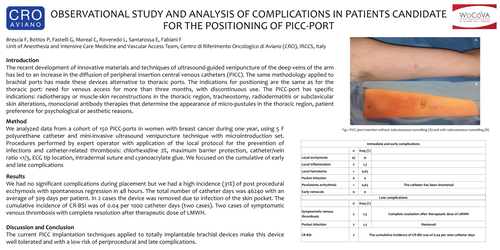
We had no significant complications during placement but we had a high incidence (31%) of post procedural ecchymosis with spontaneous regression in 48 hours. The total number of catheter days was 46240 with an average of 309 days per patient. In 2 cases the device was removed due to infection of the skin pocket. The cumulative incidence of CR-BSI was of 0.04 per 1000 catheter days (two cases). Two cases of symptomatic venous thrombosis with complete resolution after therapeutic dose of LMWH.
Discussion and Conclusion
The current PICC implantation techniques applied to totally implantable brachial devices make this device well tolerated and with a low risk of periprocedural and late complications.