1,267 posters, 47 videos, 13 topics, 4 sessions, 853 authors
ePostersLive by SciGen Technologies S.A. All rights reserved.
SOHO 2026 Annual Meeting
September 9 - 12, 2026 | George R. Brown Convention Center, Houston, Texas

AML - 1751
Accelerated Biological Ageing Amplifies the Association Between Dietary Advanced Glycation End-Products and Hematologic Malignancy Prevalence: A U.S. Population-Based Study
Poster Presenter
Authors
Part of Topic
Acute Myeloid Leukemia (AML)
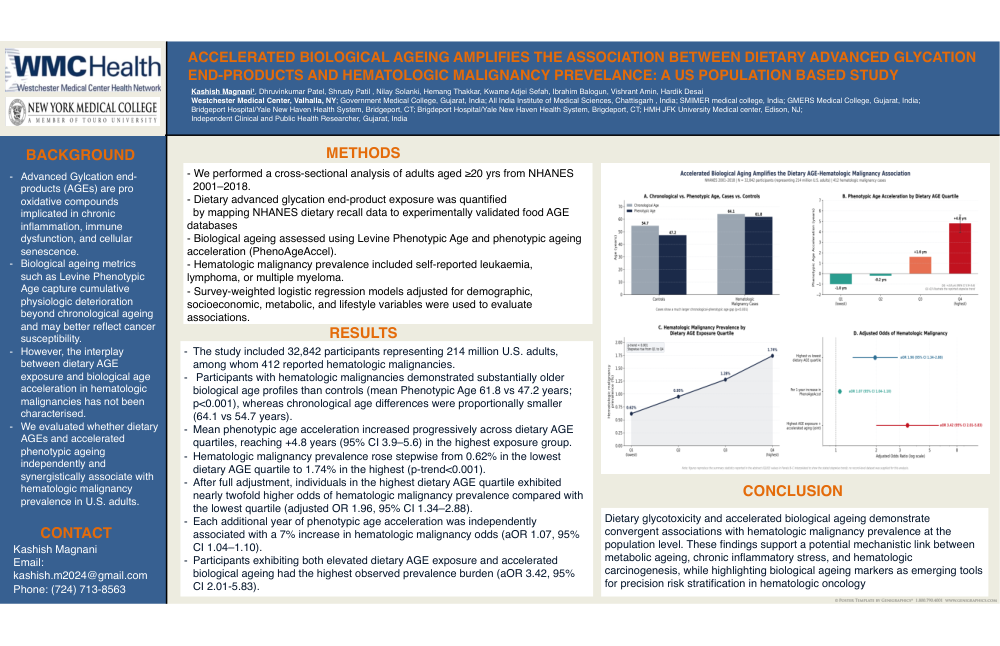
ACCELERATED BIOLOGICAL AGEING AMPLIFIES THE ASSOCIATION BETWEEN DIETARY ADVANCED GLYCATION END-PRODUCTS AND HEMATOLOGIC MALIGNANCY PREVELANCE: A US POPULATION BASED STUDY
Kashish Magnani¹, Dhruvinkumar Patel, Shrusty Patil , Nilay Solanki, Hemang Thakkar, Kwame Adjei Sefah, Ibrahim Balogun, Vishrant Amin, Hardik Desai Westchester Medical Center, Valhalla, NY; Government Medical College, Gujarat, India; All India Institute of Medical Sciences, Chattisgarh , India; SMIMER medical college, India; GMERS Medical College, Gujarat, India; Bridgeport Hospital/Yale New Haven Health System, Bridgeport, CT; Brigdeport Hospital/Yale New Haven Health System, Brigdeport, CT; HMH JFK University Medical center, Edison, NJ; Independent Clinical and Public Health Researcher, Gujarat, India
Background- Advanced Gylcation end- products (AGEs) are prooxidative compounds implicated in chronic inflammation, immune dysfunction, and cellular senescence.Biological ageing metrics such as Levine Phenotypic Age capture cumulative physiologic deterioration beyond chronological ageing and may better reflect cancer susceptibility. However, the interplay between dietary AGE exposure and biological age acceleration in hematologic malignancies has not been characterised. We evaluated whether dietary AGEs and accelerated phenotypic ageing independently and synergistically associate with hematologic malignancy prevalence in U.S. adults.
Methods- We performed a cross-sectional analysis of adults aged ≥20 yrs from NHANES 2001–2018. Dietary advanced glycation end-product exposure was quantified by mapping NHANES dietary recall data to experimentally validated food AGE databases. Biological ageing assessed using Levine Phenotypic Age and phenotypic ageing acceleration (PhenoAgeAccel). Hematologic malignancy prevalence included self-reported leukaemia, lymphoma, or multiple myeloma. Survey-weighted logistic regression models adjusted for demographic, socioeconomic, metabolic, and lifestyle variables were used to evaluate associations.
Results- The study included 32,842 participants representing 214 million U.S. adults, among whom 412 reported hematologic malignancies. Participants with hematologic malignancies demonstrated substantially older biological age profiles than controls (mean Phenotypic Age 61.8 vs 47.2 years; p<0.001), whereas chronological age differences were proportionally smaller (64.1 vs 54.7 years). Mean phenotypic age acceleration increased progressively across dietary AGE quartiles, reaching +4.8 years (95% CI 3.9–5.6) in the highest exposure group. Hematologic malignancy prevalence rose stepwise from 0.62% in the lowest dietary AGE quartile to 1.74% in the highest (p-trend<0.001). After full adjustment, individuals in the highest dietary AGE quartile exhibited nearly twofold higher odds of hematologic malignancy prevalence compared with the lowest quartile (adjusted OR 1.96, 95% CI 1.34–2.88). Each additional year of phenotypic age acceleration was independently associated with a 7% increase in hematologic malignancy odds (aOR 1.07, 95% CI 1.04–1.10). Participants exhibiting both elevated dietary AGE exposure and accelerated biological ageing had the highest observed prevalence burden (aOR 3.42, 95% CI 2.01-5.83).
Conclusion- Dietary glycotoxicity and accelerated biological ageing demonstrate convergent associations with hematologic malignancy prevalence at the population level. These findings support a potential mechanistic link between metabolic ageing, chronic inflammatory stress, and hematologic carcinogenesis, while highlighting biological ageing markers as emerging tools for precision risk stratification in hematologic oncology