1,267 posters, 47 videos, 13 topics, 4 sessions, 853 authors
ePostersLive by SciGen Technologies S.A. All rights reserved.
SOHO 2026 Annual Meeting
September 9 - 12, 2026 | George R. Brown Convention Center, Houston, Texas

ALL - 1736
The Efficacy and Safety of Single-Product Bispecific CD19/CD22 Chimeric Antigen Receptor T-Cell Therapy in Children, Adolescents, and Young Adults With Relapsed or Refractory B-Cell Acute Lymphoblastic Leukemia: A Systematic Review and Meta-Analysis
Poster Presenter
Authors
Part of Topic
Acute Lymphoblastic Leukemia (ALL)
Title:
The Efficacy and Safety of Single-Product Bispecific CD19/CD22 Chimeric Antigen Receptor T-Cell Therapy in Children, Adolescents, and Young Adults with Relapsed or Refractory B-Cell Acute Lymphoblastic Leukemia: A Systematic Review and Meta-Analysis
Authors:
Dania A. Monagel1,2,3, Faisal A. Alharbi1,2, Mahmoud A. Wazzan1,2, Moudi F. Aleidi1,2, Joudi H. Alsagaf1,2
- College of Medicine, King Saud bin Abdulaziz University for Health Sciences, Jeddah, Saudi Arabia
- King Abdullah International Medical Research Center, Jeddah, Saudi Arabia
- Department of Pediatric Hematology/Oncology, Section of Blood and Marrow Transplant and Cellular Therapy, King Abdullah Specialized Children’s Hospital, Jeddah, Saudi Arabia
Introduction:
- B-ALL is the most common pediatric malignancy with cure rates >85%, but 15–20% relapse/refractory (r/r)
- CD19 CAR-T is standard for r/r B-ALL but limited by CD19-negative antigen escape; and CD22 CAR-T faces similar antigen loss
- CD19/CD22 dual-targeting strategies address this via two approaches:
1-two separately manufactured products, co-administered or sequential
2-a single-product bispecific construct which offers greater uniformity and lower complexity
Aim:
Existing evidence is fragmented, made up of small, heterogeneous trials, and prior meta-analyses pool adults with children or lack survival data, leaving no focused, current review for the pediatric/AYA population
Methods:
- PRISMA 2020-guided systematic review;searching PubMed, Embase, Web of Science, Scopus, ScienceDirect, and Cochrane, through Feb 2026
- 826 records identified→ 37 full texts retrieved → 5 studies included (n=73)
- PICO-defined eligibility: pediatric/AYA (≤35y), r/r B-ALL, single-product bispecific CD19/CD22 CAR-T only
- Joanna Briggs Institute (JBI) critical appraisal tool was used for risk of bias
- Random-effects (DerSimonian-Laird) proportional meta-analysis, logit-transformed, in R software
- OS reconstructed from published KM curves
- Leave-one-out sensitivity analysis for every pooled outcome
Results & Conclusion:
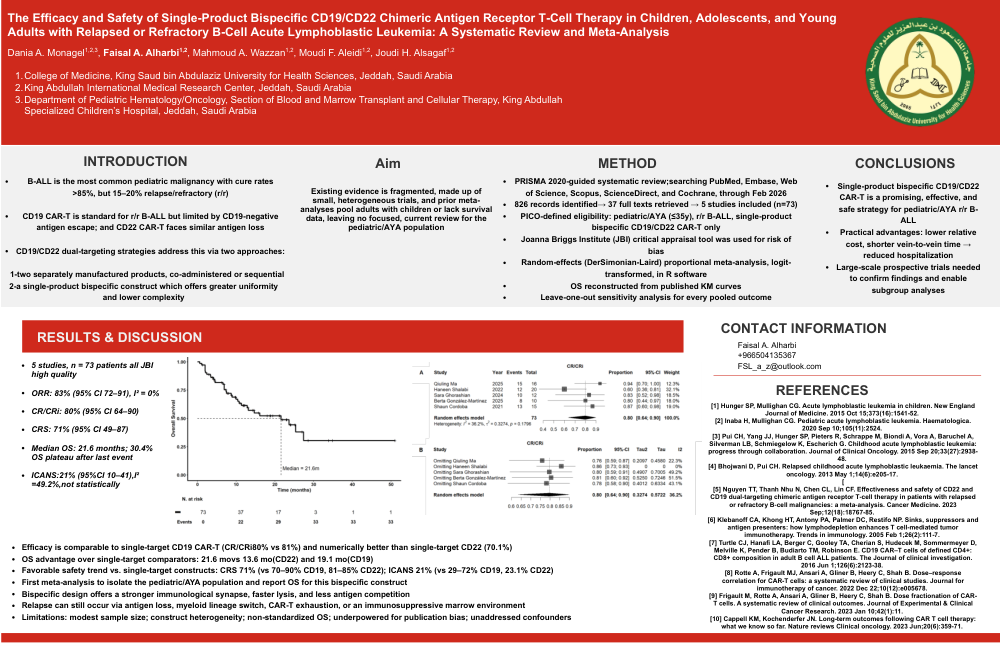
- 5 studies, n = 73 patients all JBI high quality
- ORR: 83% (95% CI 72–91), I² = 0%
- CR/CRi: 80% (95% CI 64–90)
- CRS: 71% (95% CI 49–87)
- Median OS: 21.6 months; 30.4% OS plateau after last event
- ICANS:21% (95%CI 10–41),I² =49.2%,not statistically
- Efficacy is comparable to single-target CD19 CAR-T (CR/CRi80% vs 81%) and numerically better than single-target CD22 (70.1%)
- OS advantage over single-target comparators: 21.6 movs 13.6 mo(CD22) and 19.1 mo(CD19)
- Favorable safety trend vs. single-target constructs: CRS 71% (vs 70–90% CD19, 81–85% CD22); ICANS 21% (vs 29–72% CD19, 23.1% CD22)
- First meta-analysis to isolate the pediatric/AYA population and report OS for this bispecific construct
- Bispecific design offers a stronger immunological synapse, faster lysis, and less antigen competition
- Relapse can still occur via antigen loss, myeloid lineage switch, CAR-T exhaustion, or an immunosuppressive marrow environment
- Limitations: modest sample size; construct heterogeneity; non-standardized OS; underpowered for publication bias; unaddressed confounders
Conclusion: - Single-product bispecific CD19/CD22 CAR-T is a promising, effective, and safe strategy for pediatric/AYA r/r B-ALL
- Practical advantages: lower relative cost, shorter vein-to-vein time → reduced hospitalization
- Large-scale prospective trials needed to confirm findings and enable subgroup analyses
Contact information: -
Faisal A. Alharbi
+966504135367
FSL_a_z@outlook.com
- References:
-
[1] Hunger SP, Mullighan CG. Acute lymphoblastic leukemia in children. New England Journal of Medicine. 2015 Oct 15;373(16):1541-52.
[2] Inaba H, Mullighan CG. Pediatric acute lymphoblastic leukemia. Haematologica. 2020 Sep 10;105(11):2524.
[3] Pui CH, Yang JJ, Hunger SP, Pieters R, Schrappe M, Biondi A, Vora A, Baruchel A, Silverman LB, Schmiegelow K, Escherich G. Childhood acute lymphoblastic leukemia: progress through collaboration. Journal of Clinical Oncology. 2015 Sep 20;33(27):2938-48.
[4] Bhojwani D, Pui CH. Relapsed childhood acute lymphoblastic leukaemia. The lancet oncology. 2013 May 1;14(6):e205-17.
[
[5] Nguyen TT, Thanh Nhu N, Chen CL, Lin CF. Effectiveness and safety of CD22 and CD19 dual‐targeting chimeric antigen receptor T‐cell therapy in patients with relapsed or refractory B‐cell malignancies: a meta‐analysis. Cancer Medicine. 2023 Sep;12(18):18767-85.
[6] Klebanoff CA, Khong HT, Antony PA, Palmer DC, Restifo NP. Sinks, suppressors and antigen presenters: how lymphodepletion enhances T cell-mediated tumor immunotherapy. Trends in immunology. 2005 Feb 1;26(2):111-7.
[7] Turtle CJ, Hanafi LA, Berger C, Gooley TA, Cherian S, Hudecek M, Sommermeyer D, Melville K, Pender B, Budiarto TM, Robinson E. CD19 CAR–T cells of defined CD4+: CD8+ composition in adult B cell ALL patients. The Journal of clinical investigation. 2016 Jun 1;126(6):2123-38.
[8] Rotte A, Frigault MJ, Ansari A, Gliner B, Heery C, Shah B. Dose–response correlation for CAR-T cells: a systematic review of clinical studies. Journal for immunotherapy of cancer. 2022 Dec 22;10(12):e005678.
[9] Frigault M, Rotte A, Ansari A, Gliner B, Heery C, Shah B. Dose fractionation of CAR-T cells. A systematic review of clinical outcomes. Journal of Experimental & Clinical Cancer Research. 2023 Jan 10;42(1):11.
[10] Cappell KM, Kochenderfer JN. Long-term outcomes following CAR T cell therapy: what we know so far. Nature reviews Clinical oncology. 2023 Jun;20(6):359-71.