1,267 posters, 47 videos, 13 topics, 4 sessions, 853 authors
ePostersLive by SciGen Technologies S.A. All rights reserved.
SOHO 2026 Annual Meeting
September 9 - 12, 2026 | George R. Brown Convention Center, Houston, Texas

MPN - 1689
Impact of GLP-1 Agonists on Clinical Outcomes in Patients With Essential Thrombocythemia: A Propensity-Matched Analysis
Poster Presenter
Authors
Part of Topic
Myeloproliferative Neoplasms (MPN)
Background
Patients with essential thrombocythemia are at increased risk of thrombotic, cardiovascular, and hemorrhagic complications. Glucagon-like peptide 1 (GLP-1) receptor agonists have demonstrated cardiovascular and anti-inflammatory benefits in other populations, but their impact in patients with essential thrombocythemia remains unclear.
Methods
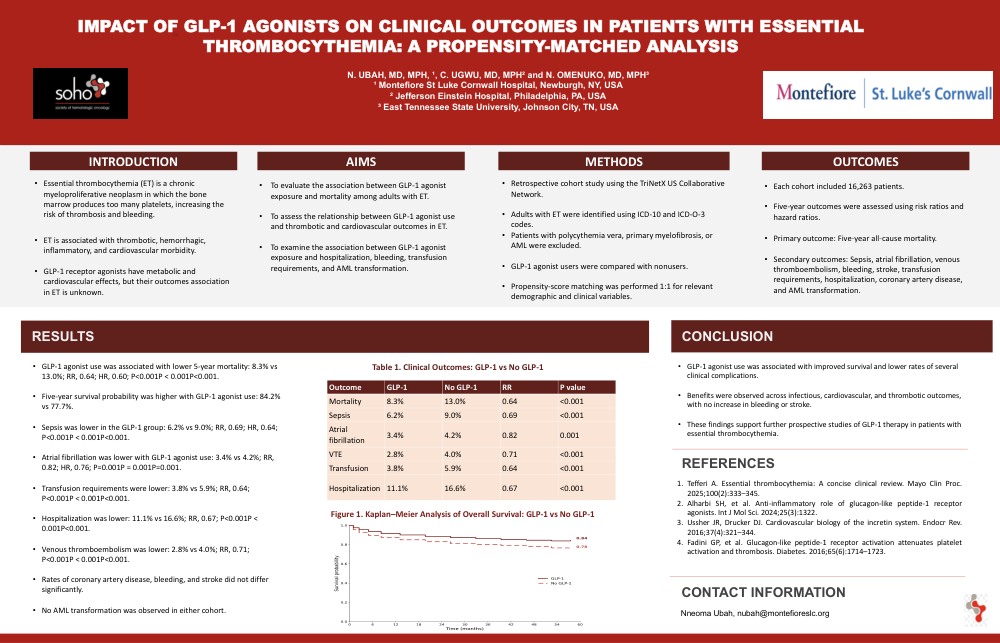
We conducted a retrospective cohort study using the TriNetX US Collaborative Network. Adult patients with essential thrombocythemia were identified using International Classification of Diseases, 10th Revision (ICD-10) and International Classification of Diseases for Oncology, 3rd Edition (ICD-O-3) codes. Patients with polycythemia vera, primary myelofibrosis, or acute myeloid leukemia (AML) were excluded. Patients receiving GLP-1 agonists were compared with those with essential thrombocythemia who were not exposed to GLP-1. Propensity score matching (1:1) was performed for demographics, cardiovascular comorbidities, diabetes, chronic kidney disease, obesity, atrial fibrillation (AF), thrombotic history, and hemoglobin, yielding 16263 patients in each cohort. Outcomes over 5 years included mortality, sepsis, AF, venous thromboembolism (VTE), bleeding, stroke, transfusion requirements, hospitalization, coronary artery disease (CAD), and AML transformation.
Results
GLP-1 use was associated with significantly lower mortality compared with no GLP-1 exposure (8.3% vs 13.0%; risk ratio [RR], 0.64; 95% confidence interval [CI], 0.60–0.68; hazard ratio [HR], 0.60; 95% CI, 0.56–0.64; P<0.001). Five-year survival probability was higher in the GLP-1 cohort (84.2% vs 77.7%). Patients receiving GLP-1 agonists also had lower risks of sepsis (6.2% vs 9.0%; RR, 0.69; HR, 0.64; P<0.001), AF (3.4% vs 4.2%; RR, 0.82; HR, 0.76; P=0.001), transfusion requirements (3.8% vs 5.9%; RR, 0.64; P<0.001), hospitalization (11.1% vs 16.6%; RR, 0.67; P<0.001), and VTE (2.8% vs 4.0%; RR, 0.71; P<0.001). Rates of CAD, bleeding, and stroke did not differ significantly between groups. No AML transformation was observed in either cohort.
Conclusions
Among patients with essential thrombocythemia, GLP-1 agonist use was associated with improved survival and lower rates of infectious, cardiovascular, and thrombotic complications. These findings suggest a potential protective role for GLP-1 therapy in essential thrombocythemia and thus warrant prospective investigation.