1,267 posters, 47 videos, 13 topics, 4 sessions, 853 authors
ePostersLive by SciGen Technologies S.A. All rights reserved.
SOHO 2026 Annual Meeting
September 9 - 12, 2026 | George R. Brown Convention Center, Houston, Texas

ABCL - 1668
Frailty and Outcomes With CAR-T Cell Therapy and Bispecific Antibodies in Hematologic Malignancies: A Scoping Review
Poster Presenter
Authors
Part of Topic
Aggressive B-Cell Lymphoma (ABCL)
Title: Frailty and Outcomes With CAR-T Cell Therapy and Bispecific Antibodies in Hematologic Malignancies: A Scoping Review
Authors: Yagnapriya Chirrareddy MD; Bhaswanth Bollu MD; Ritwik Dey MD; Harshitha Popuri MD; Jesus A. Gomez MD. Texas Tech University Health Sciences Center, El Paso, Texas, USA; University Medical Center, El Paso, Texas, USA.
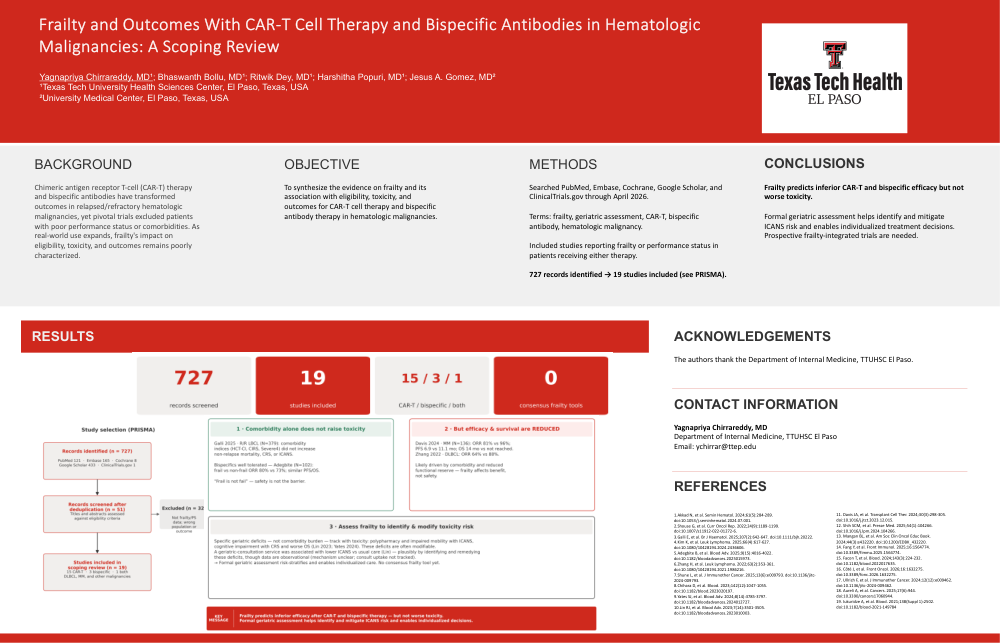
Background: CAR-T cell therapy and bispecific antibodies have transformed the treatment of relapsed/refractory hematologic malignancies, but pivotal trials largely excluded patients with poor performance status or significant comorbidities. As real-world use expands to older and frailer patients, the impact of frailty on eligibility, toxicity, and outcomes remains poorly characterized.
Objective: To synthesize the evidence on frailty and its association with eligibility, toxicity, and outcomes for CAR-T cell therapy and bispecific antibody therapy in hematologic malignancies.
Methods: We conducted a scoping review of PubMed, Embase, Cochrane Library, Google Scholar, and ClinicalTrials.gov through April 2026. Of 727 records identified, 19 studies met inclusion criteria after screening and deduplication. Included studies comprised predominantly retrospective cohorts spanning CAR-T (15 studies), bispecific antibodies (3 studies), and both (1 study), across diffuse large B-cell lymphoma, multiple myeloma, and other hematologic malignancies. Frailty was assessed heterogeneously across studies, using tools including comprehensive geriatric assessment, HCT-CI, CIRS, ECOG performance status, and simplified frailty indices, with no consensus instrument.
Results: Comorbidity burden alone was not associated with increased toxicity. In the largest study (Galli et al., N=379), comorbidity indices did not predict non-relapse mortality, cytokine release syndrome (CRS), or immune effector cell-associated neurotoxicity syndrome (ICANS). Bispecific antibodies were well tolerated in frail patients (Adegbite et al., N=102: overall response rate 80% vs 73% in non-frail; similar progression-free and overall survival). However, frailty was associated with reduced efficacy and survival: Davis et al. (multiple myeloma, N=136) reported lower overall response (81% vs 96%), shorter progression-free survival (6.9 vs 11.1 months), and shorter overall survival (14 months vs not reached); Zhang et al. (DLBCL) reported lower overall response (64% vs 88%). Specific, often modifiable geriatric deficits, rather than overall comorbidity, tracked with toxicity: polypharmacy and impaired mobility were associated with ICANS, and cognitive impairment with CRS and worse survival (Lin et al., 2023; Yates et al., 2024). A geriatric-consultation service was associated with lower ICANS incidence versus usual care, although these data are observational and the mechanism is not established.
Conclusion: Frailty predicts inferior CAR-T efficacy but not worse toxicity. Formal geriatric assessment helps identify and mitigate ICANS risk and enables individualized treatment decisions. Frailty assessment remains heterogeneous with no consensus tool. Prospective, frailty-integrated trials are needed.
Keywords: frailty; geriatric assessment; comprehensive geriatric assessment; CAR-T cell therapy; bispecific antibodies; hematologic malignancies; multiple myeloma; diffuse large B-cell lymphoma; cytokine release syndrome; CRS; ICANS; immune effector cell-associated neurotoxicity syndrome; polypharmacy; older adults; scoping review.