Loading...

1,267 posters, 47 videos, 13 topics, 4 sessions, 853 authors

ePostersLive by SciGen Technologies S.A. All rights reserved.

SOHO 2026 Annual Meeting

September 9 - 12, 2026 | George R. Brown Convention Center, Houston, Texas

SOHO 2026 Annual Meeting banner

MM - 1659

Prophylactic Tocilizumab During Bispecific Antibody Step-Up Dosing in Relapsed/Refractory Multiple Myeloma: CRS Mitigation, Low-Dose Strategies, and Outpatient Feasibility
Part of Topic

Multiple Myeloma (MM)

Prophylactic Tocilizumab During Bispecific Antibody Step-Up Dosing in Relapsed/Refractory Multiple Myeloma: CRS Mitigation, Low-Dose Strategies, and Outpatient Feasibility

Aqsa Zoey Sorathia, Valerin Arno, Yazmin Almonacid, Rouba Isshak


Abstract

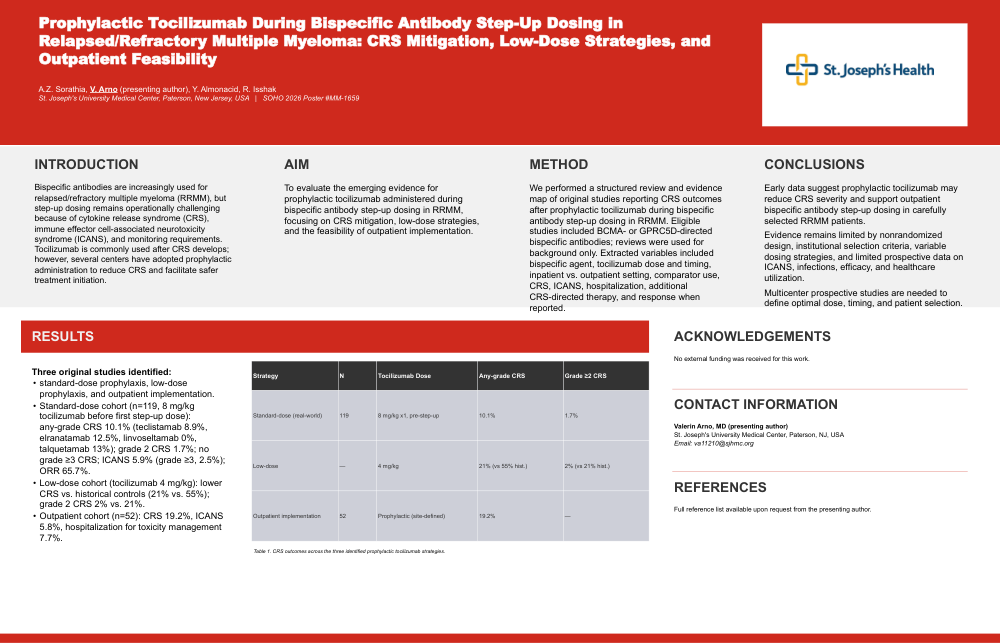
Background: Bispecific antibodies are increasingly used for relapsed/refractory multiple myeloma (RRMM), but step-up dosing remains operationally challenging because of cytokine release syndrome (CRS), immune effector cell-associated neurotoxicity syndrome (ICANS), and monitoring requirements. Tocilizumab is commonly used after CRS develops; however, several centers have adopted prophylactic administration to reduce CRS and facilitate safer treatment initiation. We evaluated the emerging evidence for prophylactic tocilizumab during bispecific antibody step-up dosing.

Methods: We performed a structured review and evidence map of original studies reporting CRS outcomes after prophylactic tocilizumab during bispecific antibody step-up dosing in RRMM. Eligible studies included BCMA- or GPRC5D-directed bispecific antibodies. Reviews were used for background only. Extracted variables included bispecific agent, tocilizumab dose and timing, inpatient versus outpatient setting, comparator use, CRS, ICANS, hospitalization, additional CRS-directed therapy, and response when reported.


Results: Three original studies were identified, representing standard-dose prophylaxis, low-dose prophylaxis, and outpatient implementation. In the largest real-world cohort, 119 patients received one 8 mg/kg tocilizumab dose before the first bispecific step-up dose. Any-grade CRS occurred in 10.1%, with drug-specific CRS rates of 8.9% for teclistamab, 12.5% for elranatamab, 0% for linvoseltamab, and 13% for talquetamab. Ten of 12 CRS events were grade 1; grade 2 CRS occurred in 1.7%, and no grade ≥3 CRS occurred. ICANS occurred in 5.9%, including grade ≥3 ICANS in 2.5%. No additional tocilizumab or corticosteroids were required for CRS, and overall response rate was 65.7%. In a low-dose study, prophylactic tocilizumab 4 mg/kg was associated with lower author-reported CRS compared with historical controls without prophylaxis, 21% versus 55%, with grade 2 CRS 2% versus 21%. In an outpatient step-up dosing protocol of 52 selected patients receiving prophylactic tocilizumab, CRS occurred in 19.2%, ICANS in 5.8%, and hospitalization for toxicity management in 7.7%.


Conclusion: Early single-center data suggest that prophylactic tocilizumab may reduce CRS severity and support outpatient bispecific antibody step-up dosing in carefully selected RRMM patients. The evidence remains limited by nonrandomized design, institutional selection criteria, variable dosing strategies, and limited prospective data on ICANS, infections, efficacy, and healthcare utilization. Multicenter prospective studies are needed to define optimal dose, timing, and patient selection

soho2026 banner
Copyright © 2015-2026, ePostersLive® SciGen is a registered trademark of SciGen Technologies S.A. Patent pending.

This website and third-party tools we use rely on cookies for the best user experience. By selecting "I agree", you agree to cookie usage as described in our Privacy Policy.