1,267 posters, 47 videos, 13 topics, 4 sessions, 853 authors
ePostersLive by SciGen Technologies S.A. All rights reserved.
SOHO 2026 Annual Meeting
September 9 - 12, 2026 | George R. Brown Convention Center, Houston, Texas

MM - 1520
Redefining the Horizon: A Deep Survival Mixture Meta-Analysis Quantifying the Statistical Cure Fraction of Cellular Therapies in Relapsed Multiple Myeloma
Poster Presenter
Authors
Part of Topic
Multiple Myeloma (MM)
Redefining the Horizon: A Deep Survival Mixture Meta-Analysis Quantifying the Statistical Cure Fraction of Cellular Therapies in Relapsed Multiple Myeloma
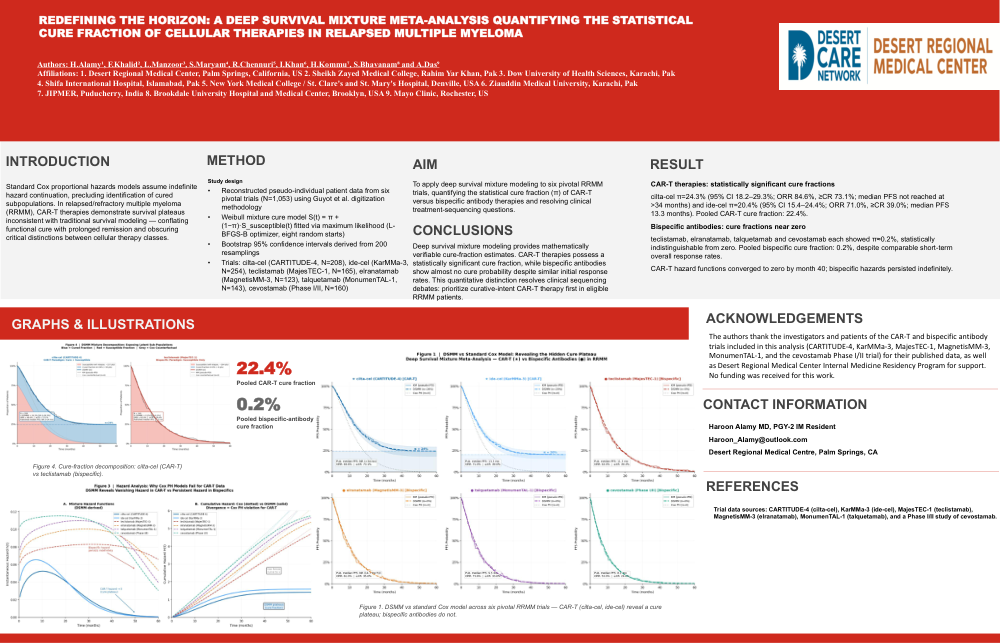
Background: Standard Cox proportional hazards models assume indefinite hazard continuation, mathematically precluding identification of cured subpopulations. In relapsed/refractory multiple myeloma (RRMM), CAR-T therapies demonstrate survival plateaus inconsistent with traditional survival modeling. This misclassification conflates functional cure with prolonged remission, obscuring critical therapeutic distinctions between cellular therapy classes.
Methods: We reconstructed pseudo-individual patient data from six pivotal trials (N=1,053) using Guyot et al. digitization methodology. A Weibull mixture cure model S(t) = π + (1-π)·S_susceptible(t) was fitted via maximum likelihood estimation (L-BFGS-B optimizer, eight random starts) to quantify the statistical cure fraction (π). Bootstrap 95% confidence intervals were derived from 200 resamplings. Trials included cilta-cel (CARTITUDE-4, N=208), ide-cel (KarMMa-3, N=254), teclistamab (MajesTEC-1, N=165), elranatamab (MagnetisMM-3, N=123), talquetamab (MonumenTAL-1, N=143), and cevostamab (Phase I/II, N=160).
Results: CAR-T therapies demonstrated statistically significant cure fractions: cilta-cel π=24.3% (95% CI: 18.2–29.3%; Weibull λ=14.15 months, k=1.331; published median PFS not reached at >34 months; ORR 84.6%, ≥CR 73.1%) and ide-cel π=20.4% (95% CI: 15.4–24.4%; Weibull λ=11.60 months, k=1.218; published median PFS 13.3 months; ORR 71.0%, ≥CR 39.0%). Pooled CAR-T cure fraction: 22.4%. In contrast, bispecific antibodies showed cure fractions statistically indistinguishable from zero: teclistamab π=0.2% (95% CI: 0.2–0.2%), elranatamab π=0.2% (95% CI: 0.2–0.2%), talquetamab π=0.2% (95% CI: 0.2–0.7%), and cevostamab π=0.2% (95% CI: 0.2–1.2%). Pooled bispecific cure fraction: 0.2%. CAR-T hazard functions converged to zero by month 40; bispecific hazards persisted indefinitely despite comparable short-term overall response rates.
Conclusions: Deep survival mixture modeling provides mathematically verifiable cure fraction estimates. CAR-T therapies possess a statistically significant cure fraction, while bispecific antibodies demonstrate almost nil cure probability despite similar initial response rates. This quantitative distinction resolves clinical sequencing debates: prioritize curative-intent CAR-T therapy first in eligible RRMM patients.