1,267 posters, 47 videos, 13 topics, 4 sessions, 853 authors
ePostersLive by SciGen Technologies S.A. All rights reserved.
SOHO 2026 Annual Meeting
September 9 - 12, 2026 | George R. Brown Convention Center, Houston, Texas

MM - 1510
Beyond ICANS: A Pharmacovigilance Study on Neurotoxicity Related to Bispecific Antibodies in Multiple Myeloma
Poster Presenter
Authors
Part of Topic
Multiple Myeloma (MM)
Background. The therapeutic landscape in multiple myeloma has evolved rapidly since the approval of bispecific antibodies. Neurotoxicity attributed to these agents has been framed almost entirely around immune effector cell–associated neurotoxicity syndrome (ICANS). The spectrum of non-ICANS neurotoxicity remains poorly characterized.
Objective. To characterize non-ICANS neurotoxicity associated with bispecific antibodies using the FDA Adverse Event Reporting System (FAERS).
Methods. The FAERS public dashboard was queried for neurotoxicity reported with teclistamab, talquetamab, and elranatamab. Nervous system toxicities were extracted, ICANS events were separated, and the remaining non-ICANS events were categorized into groups: taste disturbance, peripheral/sensory neuropathy, consciousness and cognitive events, and cranial nerve palsies.
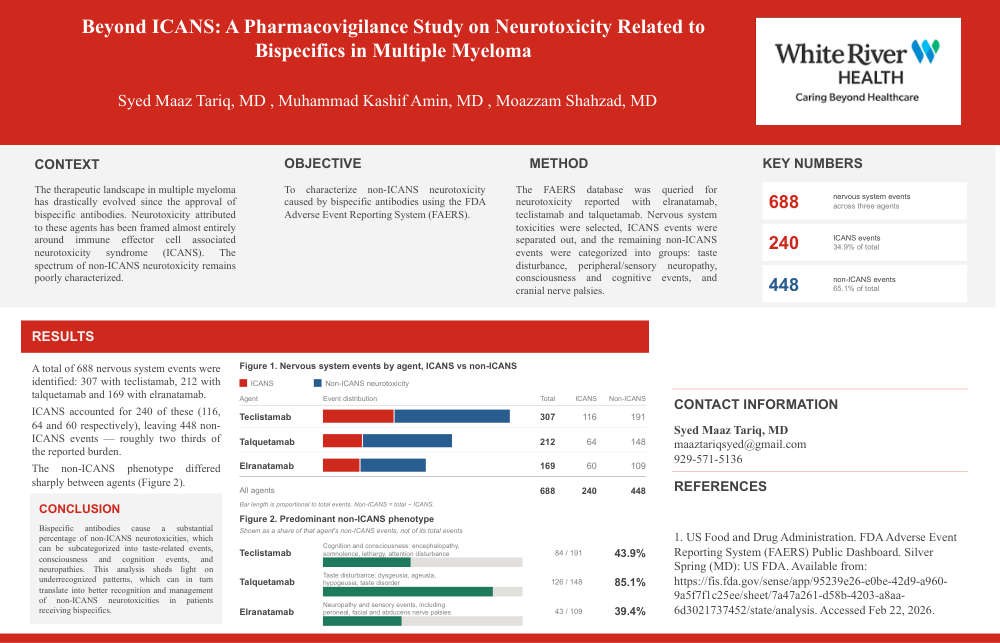
Results. A total of 688 nervous system events were identified: 307 with teclistamab, 212 with talquetamab, and 169 with elranatamab. ICANS accounted for 240 events (116, 64, and 60, respectively), leaving 448 non-ICANS events — approximately two-thirds of the reported burden. The predominant non-ICANS phenotype differed by agent. Taste-related events (dysgeusia, ageusia, hypogeusia, taste disorder) accounted for 126 of 148 non-ICANS events with talquetamab (85.1%). Consciousness and cognitive events (depressed level of consciousness, disturbance in attention, lethargy, encephalopathy, somnolence) accounted for 84 of 191 with teclistamab (43.9%). Neuropathy and sensory events, including peroneal, facial, and abducens nerve palsies, accounted for 43 of 109 with elranatamab (39.4%).
Conclusion. Bispecific antibodies cause a substantial proportion of non-ICANS neurotoxicities, which can be subcategorized into taste-related events, consciousness and cognition events, and neuropathies. This analysis highlights underrecognized patterns that may translate into better recognition and management of non-ICANS neurotoxicity in patients receiving bispecifics.