1,267 posters, 47 videos, 13 topics, 4 sessions, 853 authors
ePostersLive by SciGen Technologies S.A. All rights reserved.
SOHO 2026 Annual Meeting
September 9 - 12, 2026 | George R. Brown Convention Center, Houston, Texas

AML - 1475
Lower-Intensity Versus Intensive Therapy in Older Adults With Newly Diagnosed AML: A Systematic Review and Meta-Analysis
Poster Presenter
Authors
Part of Topic
Acute Myeloid Leukemia (AML)
Lower-Intensity Versus Intensive Therapy in Older Adults With Newly Diagnosed AML: A Systematic Review and Meta-Analysis
Musa Kiyani, MD, MBA, MPH¹; Owen Clanahan, BS²; Justin Patterson, BS²; Sunil G. Iyer, MD³
¹University of Miami/HCA Florida JFK Hospital, Atlantis, FL, USA; ²Kansas City University College of Osteopathic Medicine, Kansas City, MO, USA; ³Columbia University Irving Medical Center, New York, NY, USA
KEYWORDS: acute myeloid leukemia, venetoclax, hypomethylating agents, intensive chemotherapy, elderly AML
CONTEXT: Treatment selection in older adults with newly diagnosed acute myeloid leukemia (AML) remains challenging because intensive chemotherapy may improve remission rates but is associated with substantial toxicity and early mortality. Lower-intensity approaches, including hypomethylating agents (HMAs), low-dose cytarabine (LDAC), and venetoclax-based regimens, are increasingly used; however, comparative outcomes across treatment strategies remain incompletely defined.
OBJECTIVE: To compare remission, early mortality, and treatment-related toxicity across intensive and lower-intensity treatment strategies in older adults with newly diagnosed AML.
DESIGN: Systematic review and meta-analysis conducted using PubMed studies published from 2010-2025 evaluating lower-intensity and intensive treatment strategies in older adults with newly diagnosed AML.
PATIENTS AND PARTICIPANTS: Adults aged ≥65 years with newly diagnosed AML treated with HMAs, LDAC, venetoclax-based combinations, or intensive chemotherapy.
MAIN OUTCOME MEASURES: Complete remission (CR), complete remission with incomplete count recovery (CRi), 30- and 60-day mortality, infection, and grade ≥3 neutropenia.
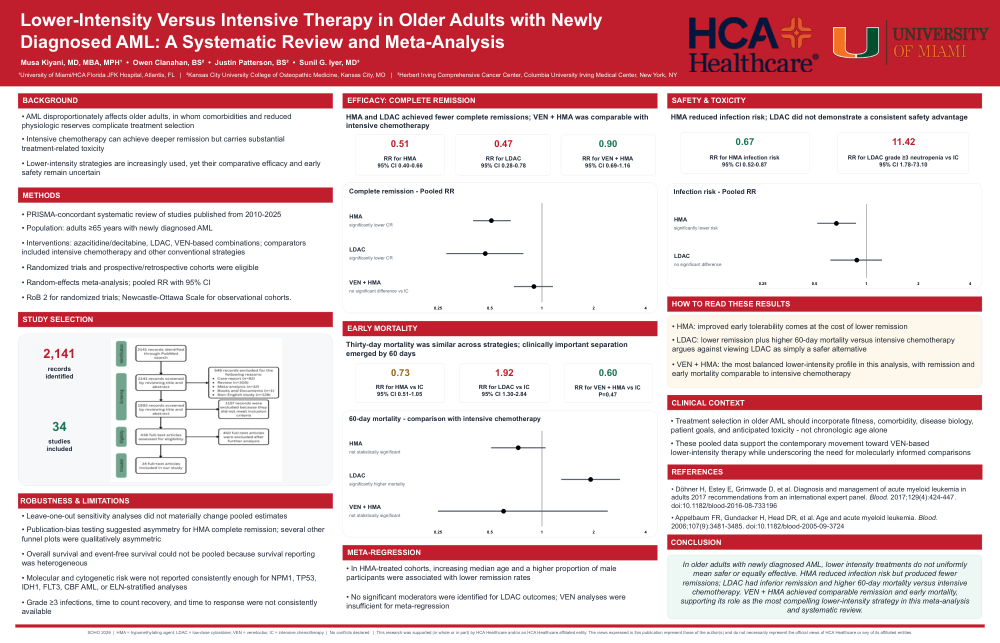
RESULTS: A total of 34 studies with 8,883 patients were included. HMA-based therapy was associated with lower CR rates compared with conventional treatment (RR 0.51, 95% CI 0.40-0.66; p<0.00001), but lower 60-day mortality (RR 0.52, 95% CI 0.35-0.79; p=0.002) and reduced infection risk (RR 0.67, 95% CI 0.52-0.87; p=0.002). LDAC-based therapy demonstrated inferior CR rates (RR 0.47, 95% CI 0.28-0.78; p=0.004), increased 60-day mortality compared with intensive chemotherapy (RR 1.92, 95% CI 1.30-2.84; p=0.001), and higher rates of grade ≥3 neutropenia (RR 11.42, 95% CI 1.78-73.10; p=0.01). Venetoclax-based regimens achieved remission outcomes comparable to intensive chemotherapy (RR 0.90, 95% CI 0.69-1.16; p=0.40) without increased early mortality.
CONCLUSIONS: Intensive chemotherapy remains associated with superior remission outcomes in older adults with AML, whereas HMA-based therapy may reduce early mortality and infectious complications. LDAC demonstrated limited clinical benefit and was associated with worse mortality and toxicity outcomes. Venetoclax-based regimens achieved outcomes comparable to intensive chemotherapy, supporting their role as a preferred lower-intensity strategy for selected older adults with AML.