1,267 posters, 47 videos, 13 topics, 4 sessions, 853 authors
ePostersLive by SciGen Technologies S.A. All rights reserved.
SOHO 2026 Annual Meeting
September 9 - 12, 2026 | George R. Brown Convention Center, Houston, Texas

HL - 1461
Redefining "Safe" Anthracycline Limits: A Restricted Cubic Spline Meta-Analysis of Continuous Cumulative Dosing and Non-Linear Cardiotoxicity in Hodgkin Lymphoma Survivors
Poster Presenter
Authors
Part of Topic
Hodgkin Lymphoma (HL)
Redefining "Safe" Anthracycline Limits: A Restricted Cubic Spline Meta-Analysis of Continuous Cumulative Dosing and Non-Linear Cardiotoxicity in Hodgkin Lymphoma Survivors
Background: Anthracycline-based chemotherapy remains a cornerstone of curative treatment for Hodgkin lymphoma (HL), yet cumulative dose thresholds for long-term cardiotoxicity remain poorly defined and inconsistently applied. Traditional clinical guidelines cite 250–450 mg/m² as "safe" cumulative limits, but emerging evidence from contemporary cohorts suggests substantial risk accumulation at lower exposures. We conducted a comprehensive dose-response meta-analysis to characterize the continuous, non-linear relationship between anthracycline cumulative dose and heart failure risk in long-term HL survivors.
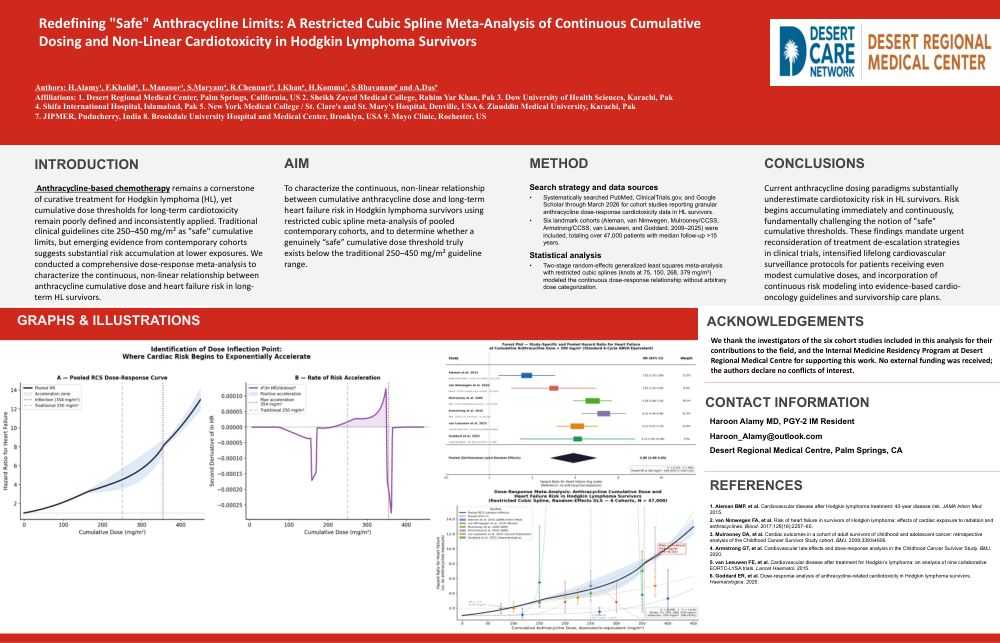
Methods: We systematically searched PubMed, Clinicaltrials.com and Google Scholar through March 2026 for cohort studies reporting anthracycline dose-specific cardiotoxicity outcomes in HL survivors with granular dose-response data. Six landmark cohorts were included: Aleman et al. (JAMA Intern Med 2015, n=2,524), van Nimwegen et al. (Blood 2016, n=2,617), Mulrooney et al. (BMJ/CCSS 2009, n=14,358), Armstrong et al. (BMJ/CCSS 2020, n=24,214), van Leeuwen et al. (Lancet Haematol 2015, 9-cohort pooled analysis), and Goddard et al. (Haematologica 2025, n=806), totaling over 47,000 patients with median follow-up >15 years. We performed a two-stage random-effects generalized least squares meta-analysis with restricted cubic splines (4 knots positioned at 75, 150, 268, 379 mg/m²) to model continuous dose-response relationships without arbitrary categorization.
Results: The pooled dose-response curve demonstrated a continuous, monotonically increasing, non-linear relationship with no identifiable safe threshold. Hazard ratios reached 2.0 at 92 mg/m²—far below the traditional 250 mg/m² threshold—and 3.0 at 150 mg/m². At 300 mg/m² (standard 6-cycle ABVD regimen), the pooled HR was 3.89 (95% CI: 2.68–5.65). Maximum curvature occurred at 354 mg/m², indicating accelerating risk beyond this inflection point. Heterogeneity was moderate (τ²=0.153, I²=66%). Egger's test suggested potential small-study effects (intercept=-0.314, p=0.009). Critically, risk accumulation began from the first treatment cycle, with no evidence of a dose below which cardiotoxicity risk plateaus or remains negligible.
Conclusions: Current anthracycline dosing paradigms substantially underestimate cardiotoxicity risk in HL survivors. Risk begins accumulating immediately and continuously, fundamentally challenging the notion of "safe" cumulative thresholds. These findings mandate urgent reconsideration of treatment de-escalation strategies in clinical trials, intensified lifelong cardiovascular surveillance protocols for patients receiving even modest cumulative doses, and incorporation of continuous risk modeling into evidence-based cardio-oncology guidelines and survivorship care plans.