1,267 posters, 47 videos, 13 topics, 4 sessions, 853 authors
ePostersLive by SciGen Technologies S.A. All rights reserved.
SOHO 2026 Annual Meeting
September 9 - 12, 2026 | George R. Brown Convention Center, Houston, Texas

AML - 1455
Immune-Cytokine Signature and Vitamin D Associated With Clinical Remission Status in Acute Myeloid Leukemia
Poster Presenter
Authors
Part of Topic
Acute Myeloid Leukemia (AML)
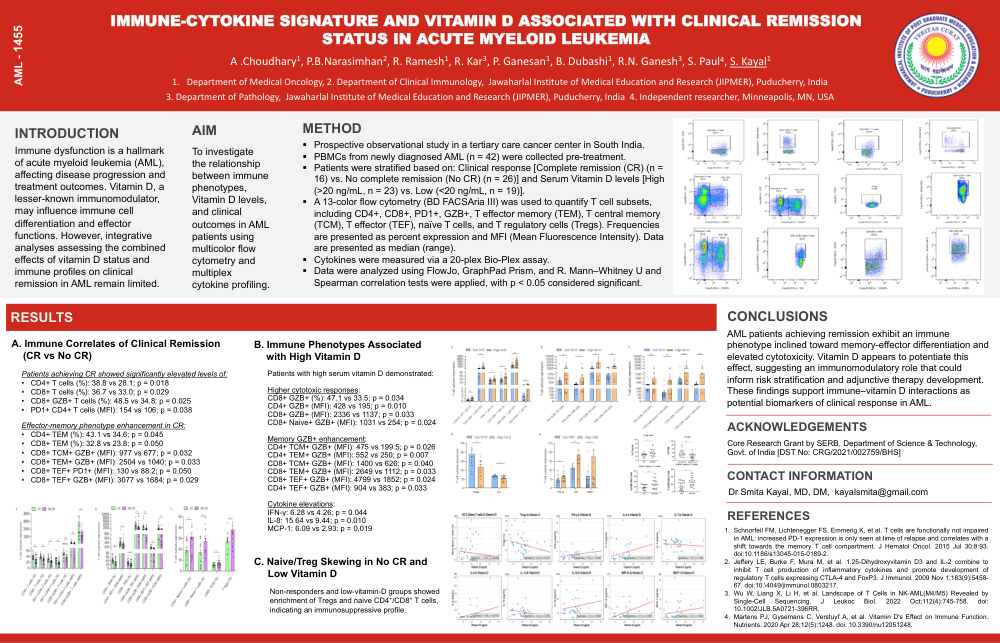
Context: Immune dysfunction is a hallmark of acute myeloid leukemia (AML), affecting disease progression and treatment outcomes. Vitamin D, a known immunomodulator, may influence immune cell differentiation and effector functions. However, integrative analyses assessing the combined effects of vitamin D status and immune profiles on clinical remission in AML remain limited.
Objectives: To investigate the relationship between immune phenotypes, vitamin D levels, and clinical outcomes in AML patients using multicolor flow cytometry and multiplex cytokine profiling.
Patients & Methods: This prospective observational study was conducted in a tertiary cancer care center in South India. Peripheral blood mononuclear cells (PBMCs) from newly diagnosed AML patients (n = 42) were collected pre-treatment. Patients were stratified based on:
Clinical response [Complete remission (CR) (n = 16) vs. No complete remission (NoCR) (n = 26)] and Serum Vitamin D levels [High (>20 ng/mL, n = 23) vs. Low (<20 ng/mL, n = 19)].
A 13-color flow cytometry panel (BD FACSAria III) was used to quantify T cell subsets, including CD4+, CD8+, PD1+, GZB+, TEM, TCM, TEF, naïve T cells, and Tregs. Frequencies are presented as percent expression and MFI. Data is presented as median (range). Cytokines were measured via a 20-plex Bio-Plex assay. Data were analyzed using FlowJo, GraphPad Prism, and R. Mann–Whitney U and Spearman correlation tests were applied with p < 0.05 considered significant.
Results: Patients achieving remission showed elevated cytotoxic (CD8⁺GZB⁺, CD4⁺GZB⁺), memory-effector (TEM, TCM⁺GZB⁺), and PD1⁺ T cell phenotypes. Higher vitamin D levels correlated with increased IFN-γ, IL-8, MCP-1, and granzyme B⁺ memory/cytotoxic T cell subsets. In contrast, non-responders and low vitamin D groups showed enrichment of Tregs and naive CD4⁺/CD8⁺ T cells, indicating an immunosuppressive profile. These findings support the role of vitamin D–linked immune fitness in AML prognosis.
Conclusion: AML patients achieving remission exhibit an immune phenotype inclined toward memory-effector differentiation and elevated cytotoxicity. Vitamin D appears to potentiate this effect, suggesting an immunomodulatory role that could inform risk stratification and adjunctive therapy development. These findings support immune–vitamin D interactions as potential biomarkers of clinical response in AML.