1,267 posters, 47 videos, 13 topics, 4 sessions, 853 authors
ePostersLive by SciGen Technologies S.A. All rights reserved.
SOHO 2026 Annual Meeting
September 9 - 12, 2026 | George R. Brown Convention Center, Houston, Texas

AML - 1312
Clinical Outcomes of ETO Positive Acute Myeloid Leukemia: A Single-Center Experience From Pakistan
Poster Presenter
Authors
Part of Topic
Acute Myeloid Leukemia (AML)
Title:
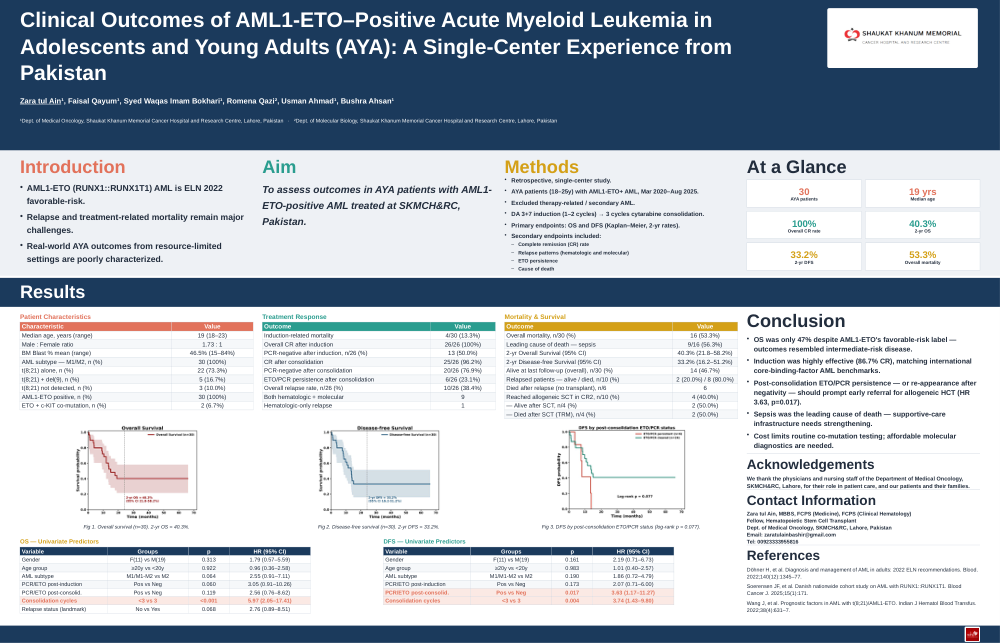
Clinical Outcomes of AML1-ETO–Positive Acute Myeloid Leukemia in Adolescents and Young Adults (AYA): A Single-Center Experience from Pakistan
Authors:
Zara tul Ain¹, Faisal Qayum¹, Syed Waqas Imam Bokhari¹, Romena Qazi², Usman Ahmad¹, Bushra Ahsan¹
Affiliations:
¹Dept. of Medical Oncology, Shaukat Khanum Memorial Cancer Hospital and Research Centre, Lahore, Pakistan
²Dept. of Molecular Biology, Shaukat Khanum Memorial Cancer Hospital and Research Centre, Lahore, Pakistan
Introduction:
AML1-ETO (RUNX1::RUNX1T1) AML is ELN 2022 favorable-risk. Relapse and treatment-related mortality remain major challenges. Real-world AYA outcomes from resource-limited settings are poorly characterized.
Aim:
To assess outcomes in AYA patients with AML1-ETO-positive AML treated at SKMCH&RC, Pakistan.
Methods:
Retrospective, single-center study. AYA patients (18–25y) with AML1-ETO+ AML, March 2020–August 2025. Excluded therapy-related/secondary AML. Treatment: DA 3+7 induction (1–2 cycles) followed by 3 cycles cytarabine consolidation. Primary endpoints: overall survival (OS) and disease-free survival (DFS), Kaplan–Meier, 2-year rates. Secondary endpoints: complete remission (CR) rate, relapse patterns (hematologic and molecular), ETO persistence, cause of death.
At a Glance:
30 AYA patients. Median age 19 years. Overall CR rate 100%. 2-year OS 40.3%. 2-year DFS 33.2%. Overall mortality 53.3%.
Results — Patient Characteristics:
Median age 19 years (range 18–23). Male:Female ratio 1.73:1. BM blast % mean 46.5% (range 15–84%). AML subtype M1/M2 in 30 (100%). t(8;21) alone in 22 (73.3%). t(8;21)+del(9) in 5 (16.7%). t(8;21) not detected in 3 (10.0%). AML1-ETO positive in 30 (100%). ETO+c-KIT co-mutation in 2 (6.7%).
Results — Treatment Response:
Induction-related mortality 4/30 (13.3%). Overall CR after induction 26/26 (100%). PCR-negative after induction 13/26 (50.0%). CR after consolidation 25/26 (96.2%). PCR-negative after consolidation 20/26 (76.9%). ETO/PCR persistence after consolidation 6/26 (23.1%). Overall relapse rate 10/26 (38.4%) — 9 both hematologic and molecular, 1 hematologic-only.
Results — Mortality & Survival:
Overall mortality 16/30 (53.3%). Leading cause of death: sepsis, 9/16 (56.3%). 2-year OS 40.3% (95% CI 21.8–58.2%). 2-year DFS 33.2% (95% CI 16.2–51.2%). Alive at last follow-up 14/30 (46.7%). Relapsed patients alive/died: 2/10 (20.0%) / 8/10 (80.0%). Died after relapse without transplant: 6/6. Reached allogeneic stem cell transplant in CR2: 4/10 (40.0%) — 2/4 (50.0%) alive after SCT, 2/4 (50.0%) died after SCT (transplant-related mortality).
Results — OS Univariate Predictors: Gender, age group, AML subtype, and PCR/ETO status after induction or consolidation were not statistically significant. Consolidation cycles (<3 vs 3) was significant: HR 5.97 (95% CI 2.05–17.41), p<0.001.
Results — DFS Univariate Predictors: PCR/ETO post-consolidation status was significant: HR 3.63 (95% CI 1.17–11.27), p=0.017. Consolidation cycles (<3 vs 3) was significant: HR 3.74 (95% CI 1.43–9.80), p=0.004.
Conclusion:
Overall survival was only 47% despite AML1-ETO's favorable-risk label, with outcomes resembling intermediate-risk disease. Induction was highly effective (86.7% CR), matching international core-binding-factor AML benchmarks. Post-consolidation ETO/PCR persistence — or its re-appearance after negativity — should prompt early referral for allogeneic hematopoietic cell transplantation (HR 3.63, p=0.017). Sepsis was the leading cause of death, indicating that supportive-care infrastructure needs strengthening. Cost limits routine co-mutation testing; affordable molecular diagnostics are needed.
Acknowledgements:
We thank the physicians and nursing staff of the Department of Medical Oncology, SKMCH&RC, Lahore, for their role in patient care, and our patients and their families.
Contact:
Zara tul Ain, MBBS, FCPS (Medicine), FCPS (Clinical Hematology), Fellow, Hematopoietic Stem Cell Transplant, Dept. of Medical Oncology, SKMCH&RC, Lahore, Pakistan. Email: zaratulainbashir@gmail.com. Tel: 00923333955816.
References:
- Döhner H, et al. Diagnosis and management of AML in adults: 2022 ELN recommendations. Blood. 2022;140(12):1345–77.
- Soerensen JF, et al. Danish nationwide cohort study on AML with RUNX1::RUNX1T1. Blood Cancer J. 2025;15(1):171.
- Wang J, et al. Prognostic factors in AML with t(8;21)/AML1-ETO. Indian J Hematol Blood Transfus. 2022;38(4):631–7