1,267 posters, 47 videos, 13 topics, 4 sessions, 853 authors
ePostersLive by SciGen Technologies S.A. All rights reserved.
SOHO 2026 Annual Meeting
September 9 - 12, 2026 | George R. Brown Convention Center, Houston, Texas

CT - 1297
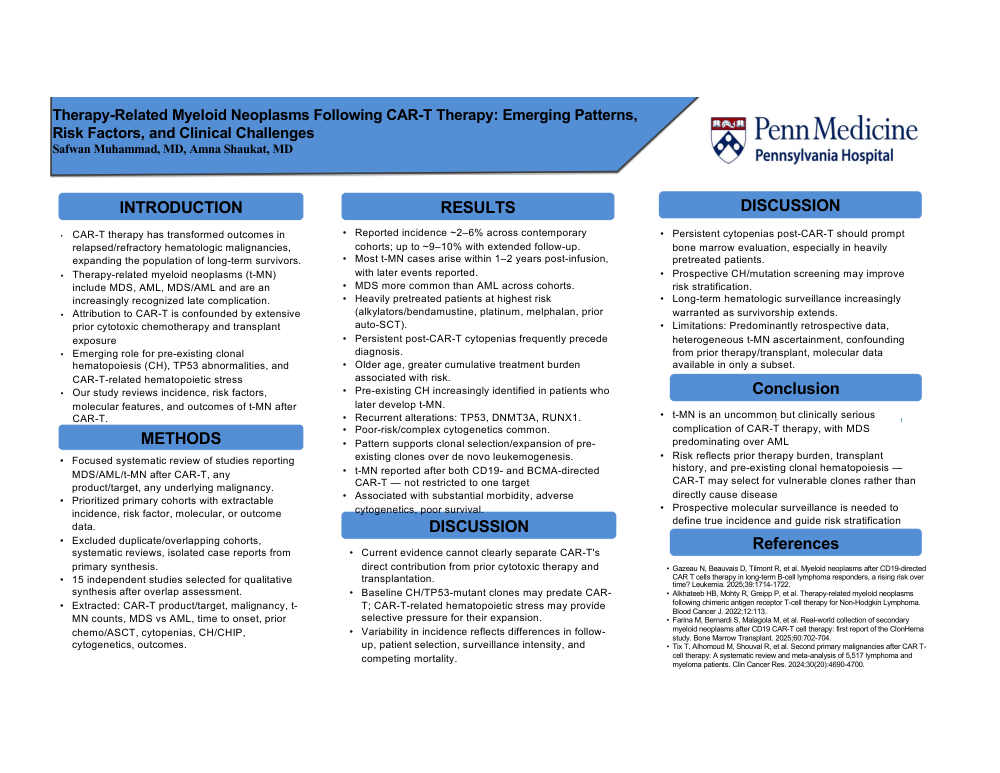
Therapy-Related Myeloid Neoplasms Following CAR-T Therapy: Emerging Patterns, Risk Factors, and Clinical Challenges
Poster Presenter
Authors
Part of Topic
Cellular Therapy (CT)
Therapy-Related Myeloid Neoplasms Following CAR-T Therapy: Emerging Patterns, Risk Factors, and Clinical Challenges
Safwan Muhammad, MD, Amna Shaukat, MD
INTRODUCTION
-
CAR-T therapy has transformed outcomes for patients with relapsed/refractory hematologic malignancies, creating an expanding population of long-term survivors.
-
Secondary malignancies, particularly therapy-related myeloid neoplasms (t-MNs), are increasingly recognized after CAR-T therapy.
-
Reported t-MNs include myelodysplastic syndromes (MDS), acute myeloid leukemia (AML), and MDS/AML.
-
Attribution to CAR-T remains challenging given extensive prior exposure to cytotoxic chemotherapy and hematopoietic transplantation.
-
Emerging data implicate pre-existing clonal hematopoiesis (CH), TP53 abnormalities, and treatment-related hematopoietic stress in t-MN development.
-
Objective: To characterize the incidence, clinical patterns, risk factors, molecular features, and outcomes of t-MNs following CAR-T therapy.
METHODS
-
Focused systematic literature review of published studies reporting MDS, AML, or other t-MNs following CAR-T therapy.
-
Included studies involving any CAR-T target/product and underlying hematologic malignancy.
-
Prioritized primary cohort studies with extractable data on incidence, risk factors, molecular findings, or outcomes.
-
Duplicate/overlapping cohorts, systematic reviews, and isolated case reports were excluded from the primary evidence synthesis.
-
15 studies were selected for qualitative synthesis following assessment of relevance and potential cohort overlap.
-
Extracted variables included:
-
CAR-T product/target and underlying malignancy
-
Patient and t-MN numbers
-
MDS vs AML
-
Follow-up and time to t-MN
-
Prior chemotherapy/ASCT
-
Cytopenias and hematologic toxicity
-
CH/CHIP and molecular abnormalities
-
Cytogenetics and clinical outcomes
-
RESULTS
Incidence & Timing
-
Reported t-MN incidence across contemporary cohorts was generally ~2–6%, with cumulative incidence increasing with longer follow-up.
-
Contemporary cohorts demonstrated cumulative incidence approaching ~9–10% with extended follow-up.
-
t-MNs generally developed within 1–2 years after CAR-T, although later events were observed.
-
MDS was more frequently reported than AML among post-CAR-T myeloid neoplasms.
Clinical Risk Factors
-
Patients developing t-MNs were typically heavily pretreated.
-
Common prior exposures included:
-
Alkylating agents/bendamustine
-
Platinum-based chemotherapy
-
Melphalan in multiple myeloma
-
Autologous stem-cell transplantation
-
-
Persistent/prolonged cytopenias and hematologic toxicity following CAR-T were frequently observed.
-
Older age and greater cumulative treatment exposure were associated with increased risk in several cohorts.
Molecular Features
-
Pre-existing clonal hematopoiesis was increasingly identified among patients who subsequently developed t-MN.
-
Recurrent alterations included TP53, DNMT3A, RUNX1, and other myeloid-associated genes.
-
Poor-risk/complex cytogenetic abnormalities were frequently reported.
-
Detection of pre-existing clones supports a model of clonal selection/expansion rather than purely de novo leukemogenesis.
Disease Spectrum
-
MDS predominated, followed by AML.
-
t-MNs have been reported after both CD19- and BCMA-directed CAR-T.
-
Cases occurred across lymphoma, ALL, and multiple myeloma populations.
-
Emerging BCMA CAR-T data suggest that t-MN risk is not restricted to CD19-directed therapy.
Outcomes
-
Development of t-MN was associated with substantial morbidity and poor clinical outcomes.
-
Patients frequently presented with persistent cytopenias, adverse cytogenetics, and high-risk molecular features.
-
Available data suggest poor survival after development of AML/MDS, highlighting the need for early recognition.
DISCUSSION
-
The available evidence does not establish CAR-T as an independent leukemogenic exposure.
-
Extensive prior cytotoxic therapy and transplantation remain major potential contributors to t-MN risk.
-
Increasing evidence of baseline CH and TP53-associated clones suggests that pre-existing hematopoietic vulnerability may precede CAR-T therapy.
-
CAR-T-associated immune/hematopoietic stress may provide selective pressure favoring expansion of pre-existing abnormal clones.
-
Differences in follow-up, patient selection, surveillance, and competing mortality contribute to variability in reported incidence.
-
Persistent cytopenias after CAR-T should prompt consideration of bone marrow evaluation, particularly in heavily pretreated patients.
-
Prospective assessment of CH and myeloid-associated mutations may improve risk stratification.
-
Long-term hematologic surveillance is warranted as CAR-T survivors live longer.
LIMITATIONS
-
Predominantly retrospective cohort data with heterogeneous follow-up.
-
Variable definitions and ascertainment of t-MN across studies.
-
Significant confounding from prior chemotherapy and transplantation.
-
Molecular data were available only in a subset of patients.
-
Potential cohort overlap required careful study selection.
-
Limited event numbers restrict the ability to establish independent risk factors.
CONCLUSION
-
Therapy-related myeloid neoplasms are uncommon but clinically serious complications following CAR-T therapy.
-
MDS appears to be the predominant phenotype, with AML representing an important subset.
-
Risk is likely multifactorial, involving prior cytotoxic therapy, transplantation, persistent hematologic toxicity, and pre-existing clonal hematopoiesis.
-
Emerging molecular evidence suggests CAR-T-associated hematopoietic stress may select for pre-existing vulnerable clones rather than directly causing de novo myeloid neoplasia.
-
Long-term follow-up and prospective molecular surveillance are needed to define true incidence, identify high-risk patients, and clarify the contribution of CAR-T therapy itself.