1,267 posters, 47 videos, 13 topics, 4 sessions, 853 authors
ePostersLive by SciGen Technologies S.A. All rights reserved.
SOHO 2026 Annual Meeting
September 9 - 12, 2026 | George R. Brown Convention Center, Houston, Texas

TCL - 1239
Discordance Between Complete Metabolic Remission and Persistent Bone Marrow Minimal Residual Disease in Primary Cutaneous Gamma-Delta T-Cell Lymphoma: Therapeutic Implications
Poster Presenter
Authors
Part of Topic
T-Cell Lymphoma (TCL)
Discordance Between Complete Metabolic Remission and Persistent Bone Marrow Minimal Residual Disease in Primary Cutaneous Gamma-Delta T-Cell Lymphoma: Therapeutic Implications
Marilyne Sily, MD; Hady Ghanem, MD; Rita Khoury, MD; Christina Khater, MD; Annoir Shayya, MD; Colette Hanna, MD
Lebanese American University Medical Center, Beirut, Lebanon
Background:
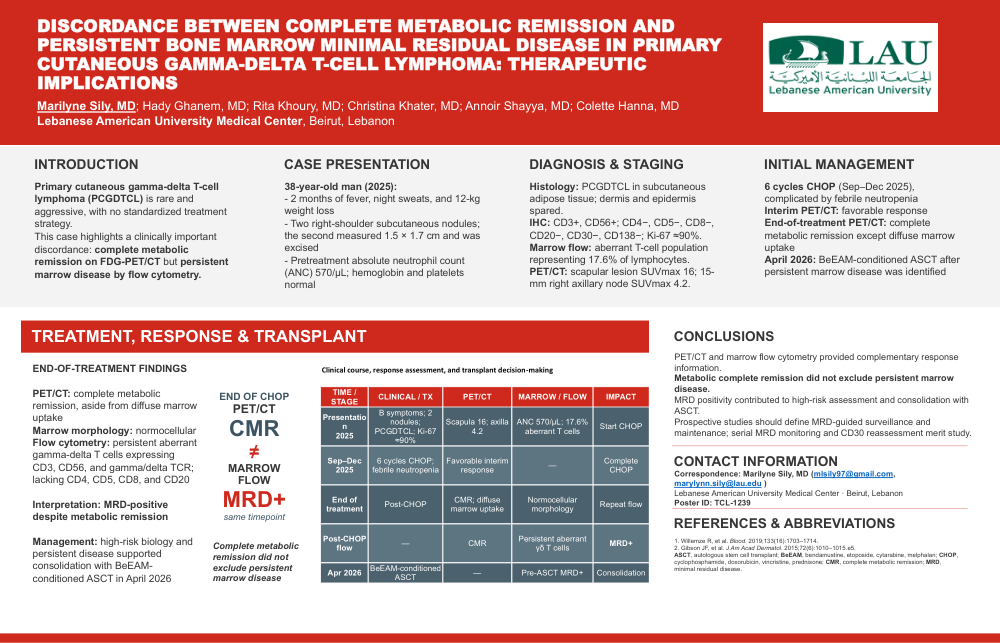
Primary cutaneous gamma-delta T-cell lymphoma (PCGDTCL) is a rare and aggressive lymphoma with no standardized treatment strategy. This case highlights discordance between complete metabolic remission on FDG-PET/CT and persistent bone marrow disease detected by flow cytometry.
Case presentation:
A 38-year-old man presented in 2025 with two months of fever, night sweats, and 12-kg weight loss. He developed two right-shoulder subcutaneous nodules, and excision of the second 1.5 × 1.7 cm lesion established the diagnosis. His pretreatment absolute neutrophil count was 570/µL, while hemoglobin and platelet levels were normal.
Diagnostic findings:
Histopathology demonstrated PCGDTCL infiltrating the subcutaneous adipose tissue while sparing the dermis and epidermis. Immunohistochemistry showed CD3- and CD56-positive atypical lymphoid cells that were negative for CD4, CD5, CD8, CD20, CD30, and CD138, with a Ki-67 proliferation index of approximately 90%. Bone marrow flow cytometry identified an aberrant T-cell population representing 17.6% of lymphocytes. Staging FDG-PET/CT demonstrated an intensely avid right scapular soft-tissue lesion with SUVmax 16 and a 15-mm right axillary lymph node with SUVmax 4.2.
Treatment and response:
The patient received six cycles of CHOP between September and December 2025, complicated by febrile neutropenia. Interim FDG-PET/CT showed a favorable response. End-of-treatment FDG-PET/CT demonstrated complete metabolic remission aside from diffuse bone marrow uptake. Bone marrow morphology was normocellular; however, flow cytometry detected persistent aberrant gamma-delta T cells expressing CD3, CD56, and gamma/delta T-cell receptors and lacking CD4, CD5, CD8, and CD20. These findings were consistent with minimal residual disease positivity. Given the aggressive disease biology, persistent marrow disease, and high relapse risk, the patient underwent autologous stem cell transplantation with BeEAM conditioning in April 2026.
Conclusion:
FDG-PET/CT and bone marrow flow cytometry provided complementary response information. Complete metabolic remission did not exclude persistent marrow disease. Prospective studies are needed to define the prognostic significance of MRD and the role of MRD-directed surveillance and maintenance strategies following autologous stem cell transplantation in rare peripheral T-cell lymphomas.
Keywords:
Primary cutaneous gamma-delta T-cell lymphoma; PCGDTCL; minimal residual disease; MRD; flow cytometry; FDG-PET/CT; complete metabolic remission; CHOP; autologous stem cell transplantation; ASCT; BeEAM.