1,267 posters, 47 videos, 13 topics, 4 sessions, 853 authors
ePostersLive by SciGen Technologies S.A. All rights reserved.
SOHO 2026 Annual Meeting
September 9 - 12, 2026 | George R. Brown Convention Center, Houston, Texas

TCL - 054
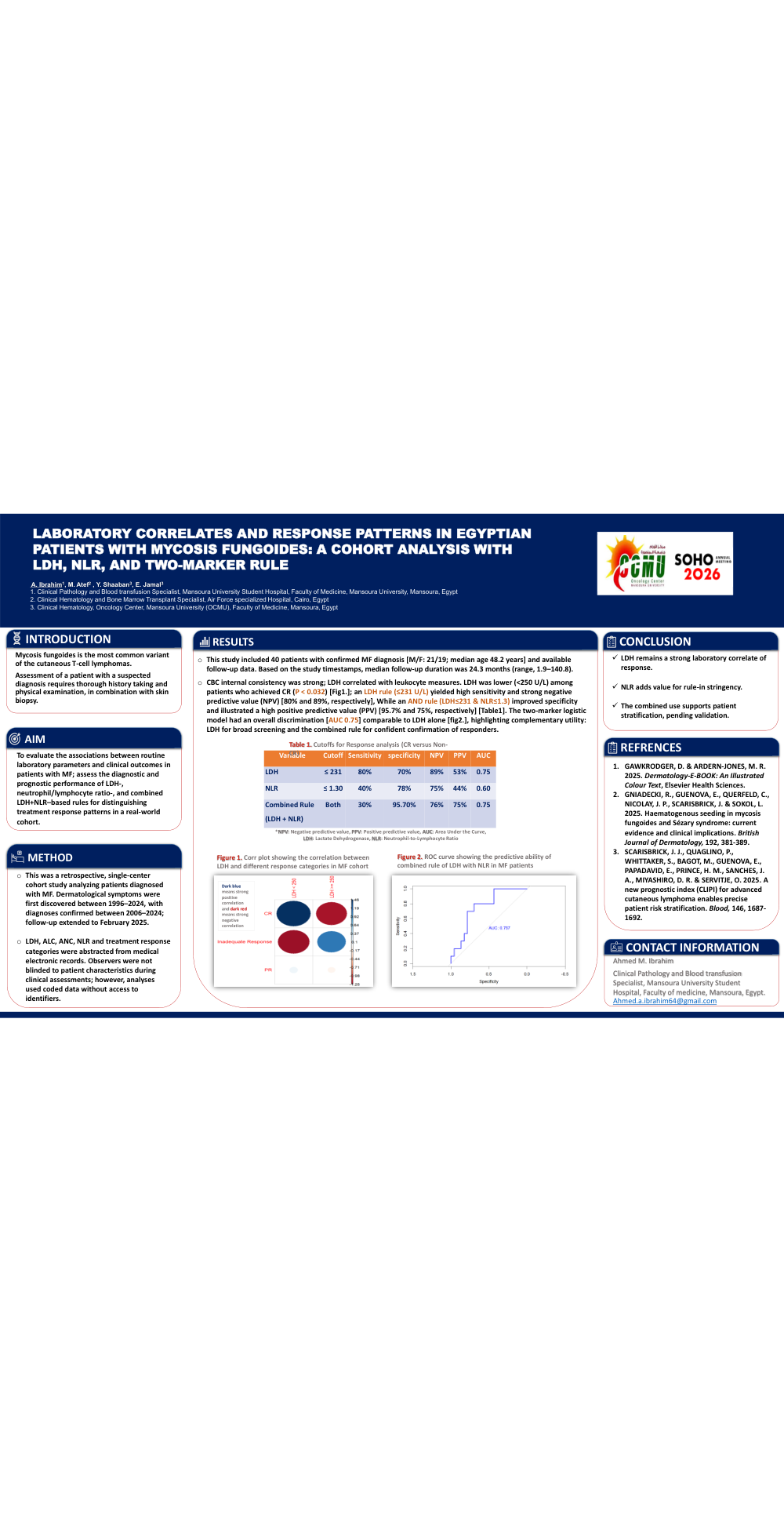
Laboratory Correlates and Response Patterns in Egyptian Patients With Mycosis Fungoides: A Cohort Analysis With LDH, NLR, and Two-Marker Rule
Poster Presenter
Authors
Part of Topic
T-Cell Lymphoma (TCL)
Laboratory Correlates and Response Patterns in Egyptian Patients with Mycosis Fungoides: A Cohort Analysis with LDH, NLR, and Two‑Marker Rule
A. Ibrahim1, M. Atef2 , Y. Shaaban3, E. Jamal3
1. Clinical Pathology and Blood transfusion Specialist, Mansoura University Student Hospital, Faculty of Medicine, Mansoura University, Mansoura, Egypt
2. Clinical Hematology and Bone Marrow Transplant Specialist, Air Force specialized Hospital, Cairo, Egypt
3. Clinical Hematology, Oncology Center, Mansoura University (OCMU), Faculty of Medicine, Mansoura, Egypt
INTRODUCTION
Mycosis fungoides is the most common variant of the cutaneous T-cell lymphomas.
Assessment of a patient with a suspected diagnosis requires thorough history taking and physical examination, in combination with skin biopsy.
AIM
To evaluate the associations between routine laboratory parameters and clinical outcomes in patients with MF; assess the diagnostic and prognostic performance of LDH-, neutrophil/lymphocyte ratio-, and combined LDH+NLR–based rules for distinguishing treatment response patterns in a real‑world cohort.
METHOD
- This was a retrospective, single‑center cohort study analyzing patients diagnosed with MF. Dermatological symptoms were first discovered between 1996–2024, with diagnoses confirmed between 2006–2024; follow-up extended to February 2025.
- LDH, ALC, ANC, NLR and treatment response categories were abstracted from medical electronic records. Observers were not blinded to patient characteristics during clinical assessments; however, analyses used coded data without access to identifiers.
RESULTS
- This study included 40 patients with confirmed MF diagnosis [M/F: 21/19; median age 48.2 years] and available follow‑up data. Based on the study timestamps, median follow‑up duration was 24.3 months (range, 1.9–140.8).
- CBC internal consistency was strong; LDH correlated with leukocyte measures. LDH was lower (<250 U/L) among patients who achieved CR (P < 0.032) [Fig1.]; an LDH rule (≤231 U/L) yielded high sensitivity and strong negative predictive value (NPV) [80% and 89%, respectively], While an AND rule (LDH≤231 & NLR≤1.3) improved specificity and illustrated a high positive predictive value (PPV) [95.7% and 75%, respectively] [Table1]. The two‑marker logistic model had an overall discrimination [AUC 0.75] comparable to LDH alone [fig2.], highlighting complementary utility: LDH for broad screening and the combined rule for confident confirmation of responders.
CONCLUSION
- LDH remains a strong laboratory correlate of response.
- NLR adds value for rule‑in stringency.
- The combined use supports patient stratification, pending validation.
REFERENCES
- GAWKRODGER, D. & ARDERN-JONES, M. R. 2025. Dermatology-E-BOOK: An Illustrated Colour Text, Elsevier Health Sciences.
- GNIADECKI, R., GUENOVA, E., QUERFELD, C., NICOLAY, J. P., SCARISBRICK, J. & SOKOL, L. 2025. Haematogenous seeding in mycosis fungoides and Sézary syndrome: current evidence and clinical implications. British Journal of Dermatology, 192, 381-389.
- SCARISBRICK, J. J., QUAGLINO, P., WHITTAKER, S., BAGOT, M., GUENOVA, E., PAPADAVID, E., PRINCE, H. M., SANCHES, J. A., MIYASHIRO, D. R. & SERVITJE, O. 2025. A new prognostic index (CLIPI) for advanced cutaneous lymphoma enables precise patient risk stratification. Blood, 146, 1687-1692.