1,267 posters, 47 videos, 13 topics, 4 sessions, 853 authors
ePostersLive by SciGen Technologies S.A. All rights reserved.
SOHO 2026 Annual Meeting
September 9 - 12, 2026 | George R. Brown Convention Center, Houston, Texas

TCL - 1236
From Hodgkin Lymphoma to Thymoma: A Comprehensive Map of Second Primary Malignancy Risk in 14,765 CTCL Patients
Poster Presenter
Authors
Part of Topic
T-Cell Lymphoma (TCL)
From Hodgkin Lymphoma to Thymoma: A Comprehensive Map of Second Primary Malignancy Risk in 14,765 CTCL Patients
Joshua A. Kent, BA¹; Anna Chen, BA¹; Yoni Sacknovitz, BA¹; Samuel A. Fisch, MPH⁵; Sarah A. Erem, MD²; Barbara Pro, MD³,⁴; Seda S. Tolu, MD³,⁴; Alejandro Gru, MD¹,²,⁴; Alfred I. Neugut, MD, PhD³,⁴,⁵; Larisa J. Geskin, MD¹,⁴
Departments of Dermatology ¹, Pathology ², and Medicine ³, and the Herbert Irving Comprehensive Cancer Center ⁴, Vagelos College of Physicians and Surgeons, and the Department of Epidemiology ⁵, Mailman School of Public Health, Columbia University, New York, NY
Herbert Irving
Comprehensive Cancer Center
Department of Dermatology
Cutaneous T-cell lymphoma (CTCL) generally follows an indolent course, yet patients face elevated risks of second primary malignancies (SPMs).
Prior studies vary in cohort size, follow-up duration, and subtype granularity; a meta-analysis reported a pooled SIR of 2.18 across studies from 1950–2019.
Proposed mechanisms — shared biology, therapy, immune dysregulation, and surveillance bias — have not been separable in a single cohort.
Objective
To quantify SPM risk in CTCL using a bidirectional design that pairs the conventional forward analysis with a reverse analysis, separating biologically meaningful associations from bias.
Methods
SEER 2000–2022, Multiple Primary – Standardized Incidence Ratio (MPSIR) session; SEER*Stat 8.3.6.
14,765 patients with CTCL as a first primary (ICD-O-3 9700/3, 9701/3, 9702/3, 9708/3, 9709/3, 9718/3, 9719/3, 9726/3).
SIRs (observed ÷ expected) with 95% CIs, referenced to age-, sex-, race-, and calendar-year–matched population rates.
Reverse MP-SIR: risk of CTCL as a second primary after each of 131 index cancer sites. A 1-year latency exclusion was applied in both directions.
Hematologic second primaries appear earliest; solid tumors follow years later. A therapy-induced leukemia would be expected to take longer, so the compressed hematologic timeline favors shared lymphoid biology over treatment causation.
Interpretation
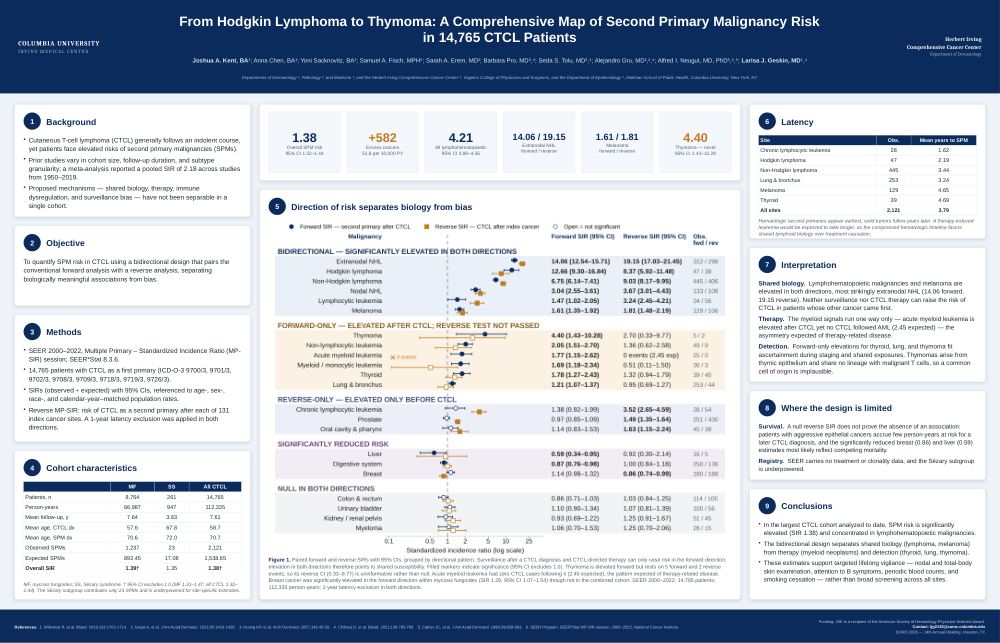
Shared biology. Lymphohematopoietic malignancies and melanoma are elevated in both directions, most strikingly extranodal NHL (14.06 forward, 19.15 reverse). Neither surveillance nor CTCL therapy can raise the risk of CTCL in patients whose other cancer came first.
Therapy. The myeloid signals run one way only — acute myeloid leukemia is elevated after CTCL yet no CTCL followed AML (2.45 expected) — the asymmetry expected of therapy-related disease.
Detection. Forward-only elevations for thyroid, lung, and thymoma fit ascertainment during staging and shared exposures. Thymomas arise from thymic epithelium and share no lineage with malignant T cells, so a common cell of origin is implausible.
Where the design is limited
Survival. A null reverse SIR does not prove the absence of an association: patients with aggressive epithelial cancers accrue few person-years at risk for a later CTCL diagnosis, and the significantly reduced breast (0.86) and liver (0.59) estimates most likely reflect competing mortality.
Registry. SEER carries no treatment or clonality data, and the Sézary subgroup is underpowered.
In the largest CTCL cohort analyzed to date, SPM risk is significantly elevated (SIR 1.38) and concentrated in lymphohematopoietic malignancies.
Figure 1. Paired forward and reverse SIRs with 95% CIs, grouped by directional pattern. Surveillance after a CTCL diagnosis and CTCL-directed therapy can only raise risk in the forward direction; elevation in both directions therefore points to shared susceptibility. Filled markers indicate significance (95% CI excludes 1.0). Thymoma is elevated forward but rests on 5 forward and 2 reverse events, so its reverse CI (0.33–9.77) is uninformative rather than null. Acute myeloid leukemia had zero CTCL cases following it (2.45 expected), the pattern expected of therapy-related disease. Breast cancer was significantly elevated in the forward direction within mycosis fungoides (SIR 1.29, 95% CI 1.07–1.54) though not in the combined cohort. SEER 2000–2022; 14,765 patients; 112,335 person-years; 1-year latency exclusion in both directions.
These estimates support targeted lifelong vigilance — nodal and total-body skin examination, attention to B symptoms, periodic blood counts, and smoking cessation — rather than broad screening across all sites.