1,267 posters, 47 videos, 13 topics, 4 sessions, 853 authors
ePostersLive by SciGen Technologies S.A. All rights reserved.
SOHO 2026 Annual Meeting
September 9 - 12, 2026 | George R. Brown Convention Center, Houston, Texas

CT - 1186
Role of Total Body Irradiation in Hematopoietic Stem Cell Transplantation for Philadelphia Chromosome-Positive Acute Lymphoblastic Leukemia: Implications for Clinical Practice
Poster Presenter
Authors
Part of Topic
Cellular Therapy (CT)
Role of Total Body Irradiation in Hematopoietic Stem Cell Transplantation for Philadelphia Chromosome-Positive Acute Lymphoblastic Leukemia: Implications for Clinical Practice
Authors: H. Figueiroa, V.R. Rocha, A. Américo, F. R. Kerbauy, P. Scheinberg
Affiliation: A Beneficência Portuguesa de São Paulo, Brazil
Introduction
The Philadelphia chromosome (Ph+) occurs in ~25% of adult ALL cases. Before tyrosine kinase inhibitors (TKIs), long-term survival was <20% with chemotherapy alone and ~40% with allogeneic hematopoietic cell transplantation (allo-HCT). Imatinib integration has significantly improved outcomes.
Method
Retrospective, observational study at Beneficência Portuguesa de São Paulo, Brazil. Eligible patients were ≥18 years with Ph+ acute lymphoblastic leukemia (ALL) who underwent bone marrow transplantation (BMT) between October 2017 and July 2025. Primary objective: evaluate the impact of conditioning regimen intensity on relapse incidence. Secondary objectives: overall survival (OS) and progression-free survival (PFS).
Results
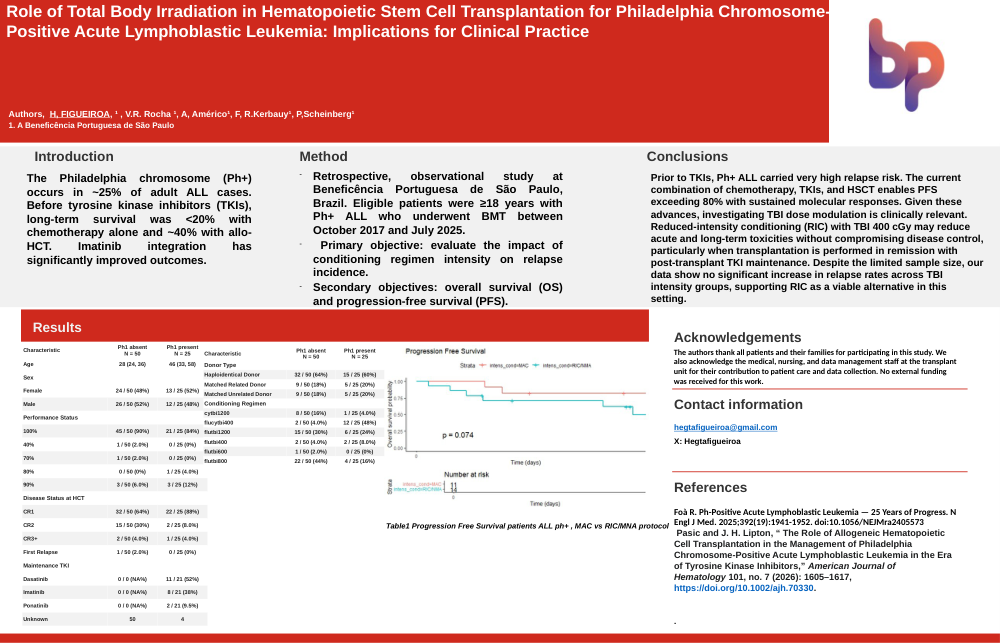
Cohort of 75 patients (50 Ph1-negative, 25 Ph1-positive) undergoing hematopoietic stem cell transplantation (HSCT), characterized by age, sex, performance status, disease status at HCT, donor type (haploidentical, matched related, matched unrelated), conditioning regimen (TBI-based protocols), conditioning intensity (myeloablative conditioning [MAC] vs. reduced-intensity/non-myeloablative conditioning [RIC/NMA]), and post-transplant TKI maintenance (dasatinib, imatinib, ponatinib). Progression-free survival by conditioning intensity (MAC vs. RIC/NMA) showed p = 0.074.
Conclusions
Prior to TKIs, Ph+ ALL carried very high relapse risk. The current combination of chemotherapy, TKIs, and HSCT enables PFS exceeding 80% with sustained molecular responses. Given these advances, investigating total body irradiation (TBI) dose modulation is clinically relevant. Reduced-intensity conditioning (RIC) with TBI 400 cGy may reduce acute and long-term toxicities without compromising disease control, particularly when transplantation is performed in remission with post-transplant TKI maintenance. Despite the limited sample size, our data show no significant increase in relapse rates across TBI intensity groups, supporting RIC as a viable alternative in this setting.
Acknowledgements
The authors thank all patients and their families for participating in this study. We also acknowledge the medical, nursing, and data management staff at the transplant unit for their contribution to patient care and data collection. No external funding was received for this work.
References
1. Foà R. Ph-Positive Acute Lymphoblastic Leukemia — 25 Years of Progress. N Engl J Med. 2025;392(19):1941-1952. doi:10.1056/NEJMra2405573
2. Pasic and J. H. Lipton. The Role of Allogeneic Hematopoietic Cell Transplantation in the Management of Philadelphia Chromosome-Positive Acute Lymphoblastic Leukemia in the Era of Tyrosine Kinase Inhibitors. American Journal of Hematology. 2026;101(7):1605-1617. https://doi.org/10.1002/ajh.70330
Contact information
Email: hegtafigueiroa@gmail.com
X (Twitter): @Hegtafigueiroa
Keywords: total body irradiation, TBI, hematopoietic stem cell transplantation, HSCT, Philadelphia chromosome, Ph+, acute lymphoblastic leukemia, ALL, tyrosine kinase inhibitor, TKI, conditioning intensity, reduced-intensity conditioning, RIC, myeloablative conditioning, MAC, progression-free survival, relapse