1,267 posters, 47 videos, 13 topics, 4 sessions, 853 authors
ePostersLive by SciGen Technologies S.A. All rights reserved.
SOHO 2026 Annual Meeting
September 9 - 12, 2026 | George R. Brown Convention Center, Houston, Texas

CT - 1175
Comparative Outcomes of Haploidentical and Matched Donor Stem Cell Transplantation Versus Autologous Transplantation in Hematologic Malignancies: A Meta-Analytic Synthesis
Poster Presenter
Authors
Part of Topic
Cellular Therapy (CT)
Background
Stem cell transplantation remains a cornerstone in treating hematologic malignancies. This synthesis compares efficacy and safety profiles of haploidentical hematopoietic stem cell transplantation with posttransplant cyclophosphamide (HAPLO-PTCy) vs matched donors, and of allogeneic stem cell transplantation (allo-SCT) vs autologous stem cell transplantation (auto-SCT), in specific lymphoma and other hematologic malignancy subtypes.
Methods
Systematic reviews and meta-analyses published between 2019 and 2021 were included. Extracted data comprised study size, patient population, primary outcomes (overall survival [OS], progression-free survival [PFS], graft-vs-host disease [GVHD], relapse, non-relapse/treatment-related mortality [NRM/TRM]), and pooled effect estimates with 95% confidence intervals (CIs).
Results
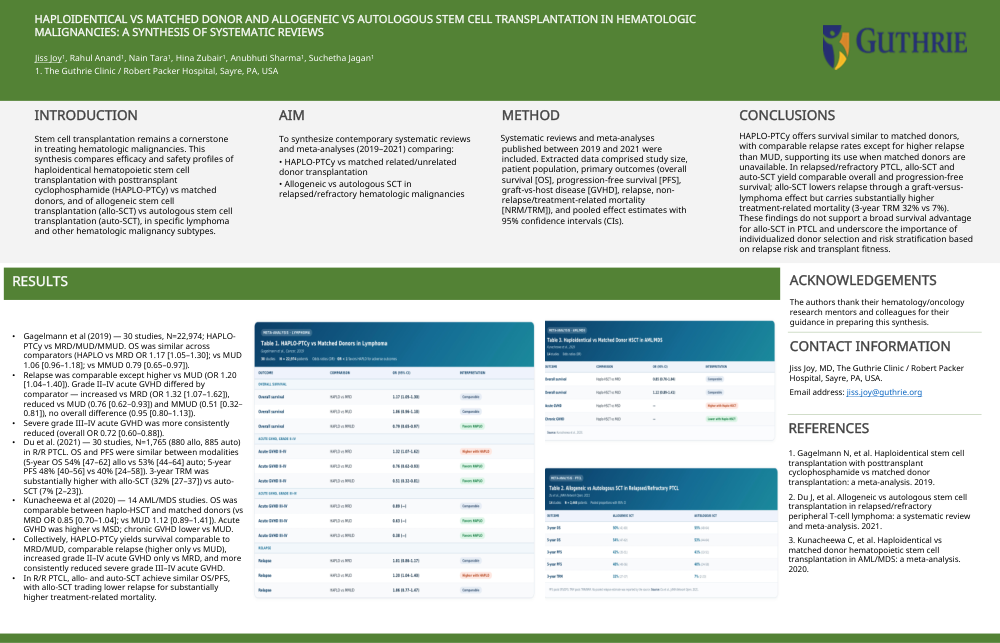
Gagelmann et al (2019) — 30 studies, N=22,974; HAPLO-PTCy vs MRD/MUD/MMUD. OS was similar across comparators (HAPLO vs MRD OR 1.17 [1.05–1.30]; vs MUD 1.06 [0.96–1.18]; vs MMUD 0.79 [0.65–0.97]). Relapse was comparable except higher vs MUD (OR 1.20 [1.04–1.40]). Grade II–IV acute GVHD differed by comparator — increased vs MRD (OR 1.32 [1.07–1.62]), reduced vs MUD (0.76 [0.62–0.93]) and MMUD (0.51 [0.32–0.81]), no overall difference (0.95 [0.80–1.13]). Severe grade III–IV acute GVHD was more consistently reduced (overall OR 0.72 [0.60–0.88]).
Du et al (2021) — 30 studies, N=1,765 (880 allo, 885 auto) in R/R PTCL. OS and PFS were similar between modalities (5-year OS 54% [47–62] allo vs 53% [44–64] auto; 5-year PFS 48% [40–56] vs 40% [24–58]). 3-year TRM was substantially higher with allo-SCT (32% [27–37]) vs auto-SCT (7% [2–23]).
Kunacheewa et al (2020) — 14 AML/MDS studies. OS was comparable between haplo-HSCT and matched donors (vs MRD OR 0.85 [0.70–1.04]; vs MUD 1.12 [0.89–1.41]). Acute GVHD was higher vs MSD; chronic GVHD lower vs MUD.
Collectively, HAPLO-PTCy yields survival comparable to MRD/MUD, comparable relapse (higher only vs MUD), increased grade II–IV acute GVHD only vs MRD, and more consistently reduced severe grade III–IV acute GVHD. In R/R PTCL, allo- and auto-SCT achieve similar OS/PFS, with allo-SCT trading lower relapse for substantially higher treatment-related mortality.
Conclusion
HAPLO-PTCy offers survival similar to that of matched donors, with relapse comparable except higher vs MUD, supporting its use when matched donors are unavailable. In relapsed/refractory PTCL, allo-SCT and auto-SCT yield comparable overall and progression-free survival; allo-SCT lowers relapse through a graft-versus-lymphoma effect but carries substantially higher treatment-related mortality (3-year TRM 32% vs 7%). These findings do not support a broad survival advantage for allo-SCT in PTCL and underscore the importance of individualized donor selection and risk stratification based on relapse risk and transplant fitness.