1,267 posters, 47 videos, 13 topics, 4 sessions, 853 authors
ePostersLive by SciGen Technologies S.A. All rights reserved.
SOHO 2026 Annual Meeting
September 9 - 12, 2026 | George R. Brown Convention Center, Houston, Texas

CML - 1071
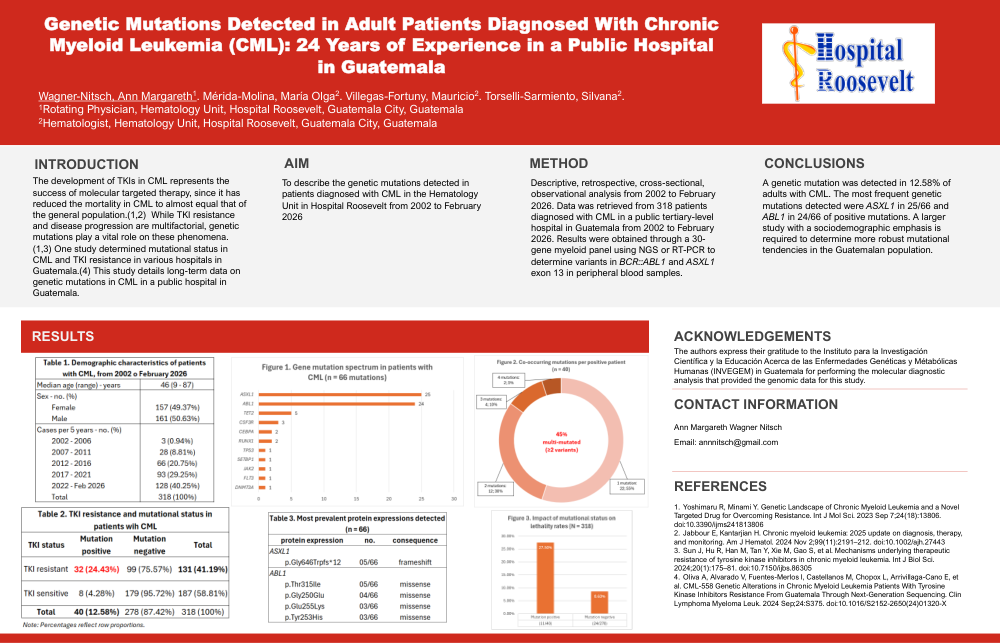
Genetic Mutations Detected in Adult Patients Diagnosed With Chronic Myeloid Leukemia (CML): 24 Years of Experience in a Public Hospital in Guatemala
Poster Presenter
Authors
Part of Topic
Chronic Myeloid Leukemia (CML)
INTRODUCTION
The development of TKIs in CML represents the success of molecular targeted therapy, since it has reduced the mortality in CML to almost equal that of the general population.(1,2) While TKI resistance and disease progression are multifactorial, genetic mutations play a vital role on these phenomena. (1,3) One study determined mutational status in CML and TKI resistance in various hospitals in Guatemala.(4) This study details long-term data on genetic mutations in CML in a public hospital in Guatemala.
AIM
To describe the genetic mutations detected in patients diagnosed with CML in the Hematology Unit in Hospital Roosevelt from 2002 to February 2026
METHOD
Descriptive, retrospective, cross-sectional, observational analysis from 2002 to February 2026. Data was retrieved from 318 patients diagnosed with CML in a public tertiary-level hospital in Guatemala from 2002 to February 2026. Results were obtained through a 30-gene myeloid panel using NGS or RT-PCR to determine variants in BCR::ABL1 and ASXL1 exon 13 in peripheral blood samples.
CONCLUSIONS
A genetic mutation was detected in 12.58% of adults with CML. The most frequent genetic mutations detected were ASXL1 in 25/66 and ABL1 in 24/66 of positive mutations. A larger study with a sociodemographic emphasis is required to determine more robust mutational tendencies in the Guatemalan population.