1,267 posters, 47 videos, 13 topics, 4 sessions, 853 authors
ePostersLive by SciGen Technologies S.A. All rights reserved.
SOHO 2026 Annual Meeting
September 9 - 12, 2026 | George R. Brown Convention Center, Houston, Texas

CT - 1025
Where Are the Trials? Geographic Imbalances in CAR-T Cell Therapy Access for Lymphoma
Poster Presenter
Authors
Part of Topic
Cellular Therapy (CT)
Where Are the Trials? Geographic Imbalances in CAR‑T Cell Therapy Accessfor Lymphoma
INTRODUCTION
CAR T-cell therapy has changed outcomes in relapsed/refractory lymphoma, but trial availability — and early access to advanced cellular therapy — may be unevenly distributed worldwide.
AIM
We assessed the global registry landscape of CAR T-cell therapy trials for lymphoma and explored barriers reported by collaborators in resource-constrained settings.
METHOD
We performed a cross-sectional registry-based study of lymphoma CAR T-cell studies registered in ClinicalTrials.gov and the EU Clinical Trials Register from 2007 to 2026. Records were deduplicated across registries using public identifiers, sponsor, title, phase, and start year, with manual review of uncertain matches. Contextual collaborator input from Pakistan, India, Lebanon, and Albania was summarized descriptively and was not formal qualitative research.
No hypothesis was tested. The primary outcome measures were prespecified as the absolute numbers and percentages. Prespecified variables were study type, recruitment status, age eligibility, interventional-study phase, and country income group using World Bank classifications. Combined phases were preserved as registered.
RESULTS
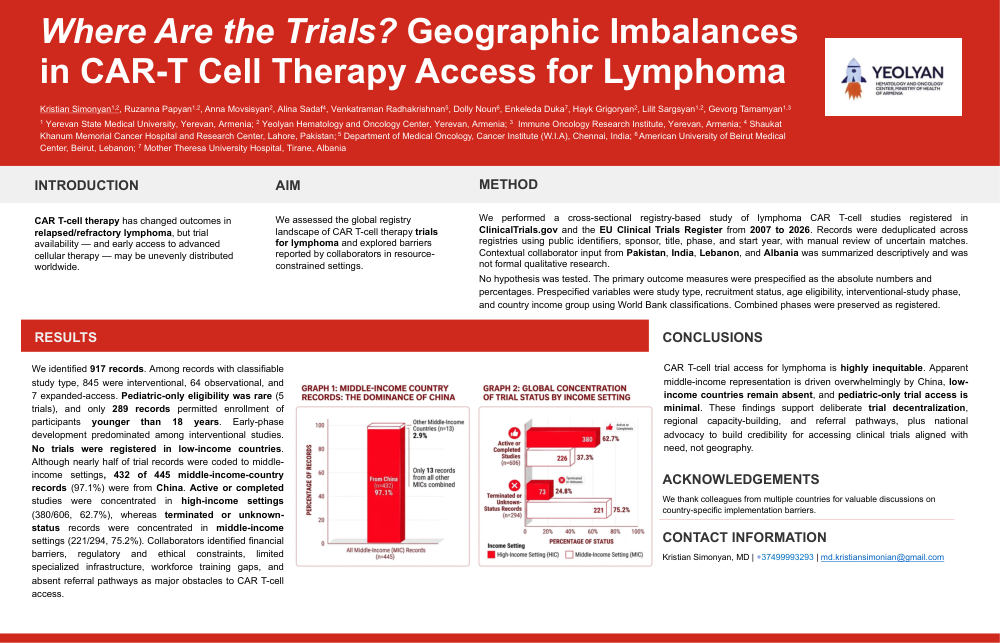
We identified 917 records. Among records with classifiable study type, 845 were interventional, 64 observational, and 7 expanded-access. Pediatric-only eligibility was rare (5 trials), and only 289 records permitted enrollment of participants younger than 18 years. Early-phase development predominated among interventional studies. No trials were registered in low-income countries. Although nearly half of trial records were coded to middle-income settings, 432 of 445 middle-income-country records(97.1%) were from China. Active or completed studies were concentrated in high-income settings (380/606, 62.7%), whereas terminated or unknown-status records were concentrated in middle-income settings (221/294, 75.2%). Collaborators identified financial barriers, regulatory and ethical constraints, limited specialized infrastructure, workforce training gaps, and absent referral pathways as major obstacles to CAR T-cell access.
CONCLUSIONS
CAR T-cell trial access for lymphoma is highly inequitable. Apparent middle-income representation is driven overwhelmingly by China, low-income countries remain absent, and pediatric-only trial access is minimal. These findings support deliberate trial decentralization, regional capacity-building, and referral pathways, plus national advocacy to build credibility for accessing clinical trials aligned with need, not geography.
ACKNOWLEDGEMENTS
We thank colleagues from multiple countries for valuable discussions on country-specific implementation barriers.
CONTACT INFORMATION
Kristian Simonyan, MD | +37499993293 | md.kristiansimonian@gmail.com