1,267 posters, 47 videos, 13 topics, 4 sessions, 853 authors
ePostersLive by SciGen Technologies S.A. All rights reserved.
SOHO 2026 Annual Meeting
September 9 - 12, 2026 | George R. Brown Convention Center, Houston, Texas

AML - 1018
Temporal Improvements in Overall Survival Among Patients With Acute Myeloid Leukemia Across Racial and Ethnic Groups in the United States: A Population-Based Analysis of Survival Trends from 2000 to 2023
Poster Presenter
Authors
Part of Topic
Acute Myeloid Leukemia (AML)
Temporal Improvements in Overall Survival Among Patients with Acute Myeloid Leukemia Across Racial and Ethnic Groups in the United States: A Population-Based Analysis of Survival Trends from 2000 to 2023
Background:
Acute myeloid leukemia (AML) remains an aggressive hematologic malignancy associated with poor long-term survival despite advances in treatment strategies and supportive care. Over the past two decades, the therapeutic landscape of AML has evolved considerably, while overall survival has improved over time, it remains unclear whether these gains have been observed uniformly across racial and ethnic populations in the United States.
Methods:
We conducted a retrospective population-based analysis of 122,162 patients diagnosed with AML using the SEER database. Patients were categorized by race/ethnicity as non-Hispanic White (NHW), non-Hispanic Black (NHB), Hispanic, and Asian/Pacific Islander (API), and stratified by year of diagnosis into 2000–2005, 2006–2017, and 2018 onward. Overall survival was assessed using Kaplan–Meier methods, and multivariable Cox proportional hazards regression was performed to identify independent predictors of mortality. Analysis was done using SPSS V.26 and P-value 0.05 was considered significant.
Results:
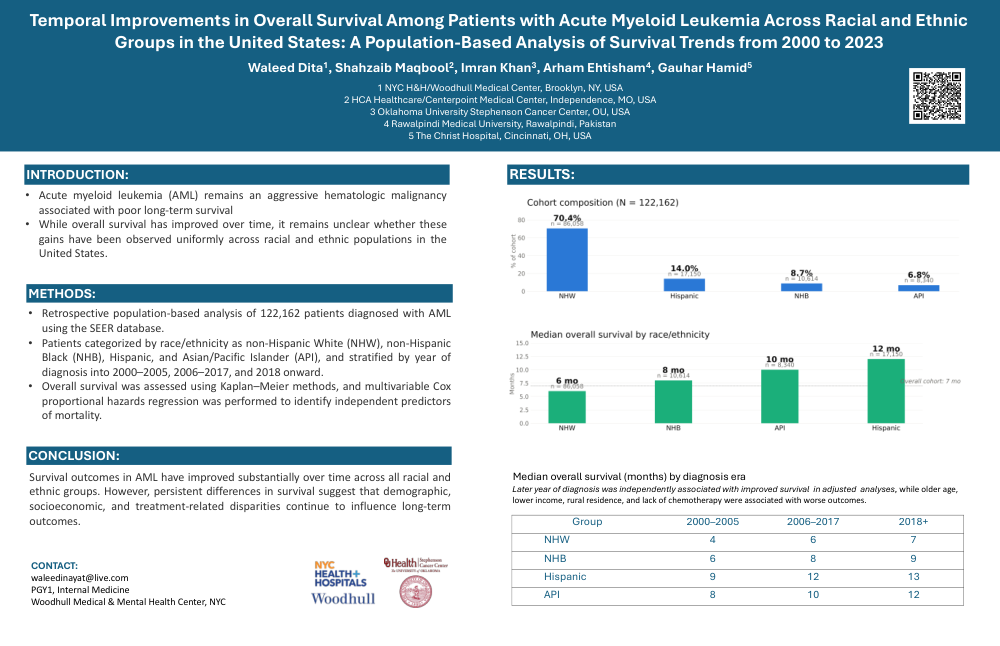
Among 122,162 patients, 86,058 (70.4%) were NHW, 10,614 (8.7%) NHB, 17,150 (14.0%) Hispanic, and 8,340 (6.8%) API. Median age differed significantly across groups, ranging from 57 years in Hispanic patients to 72 years in NHW patients (p<0.001). Median overall survival for the overall cohort was 7 months (95% CI: 6.9–7.1), with significant differences by race/ethnicity (log-rank p<0.001): NHW 6 months, NHB 8 months, Hispanic 12 months, and API 10 months. Survival improved over time across all groups. In NHW patients, median survival increased from 4 months in 2000–2005 to 6 months in 2006–2017 and 7 months in 2018 onward. Corresponding improvements were observed in NHB patients (6, 8, and 9 months), Hispanic patients (9, 12, and 13 months), and API patients (8, 10, and 12 months). In adjusted analyses, later year of diagnosis was independently associated with improved survival (HR 0.991, 95% CI 0.990–0.992; p<0.001), while older age, lower income, rural residence, and lack of chemotherapy were associated with worse outcomes.
Conclusion:
Survival outcomes in AML have improved substantially over time across all racial and ethnic groups. However, persistent differences in survival suggest that demographic, socioeconomic, and treatment-related disparities continue to influence long-term outcomes.
Keywords
Acute myeloid leukemia; temporal survival trends; racial disparities; population-based study; SEER database