1,267 posters, 47 videos, 13 topics, 4 sessions, 853 authors
ePostersLive by SciGen Technologies S.A. All rights reserved.
SOHO 2026 Annual Meeting
September 9 - 12, 2026 | George R. Brown Convention Center, Houston, Texas

MM - 966
Safety Profile of Elotuzumab-Based Regimens in Multiple Myeloma: A Systematic Review and Meta-Analysis of Randomized Controlled Trials
Part of Topic
Multiple Myeloma (MM)
Safety Profile of Elotuzumab-Based Regimens in Multiple Myeloma: A Systematic Review and Meta-Analysis of Randomized Controlled Trials
1Fnu Raja, 2Kaung Htet Hla Win, 3Anid Hassan, 4Momna Nisar, 5Medhansh Biradar, 6Imandi Venkata Lakshmi, 7Unsa Ali
1Federal Medical and Dental College, Islamabad, ICT, Pakistan; 2One Brooklyn Health/Interfaith Medical Center, NYC, NY, USA; 3Hackensack Meridian Jersey Shore University Medical Center, Neptune, NY, USA; 4Woodhull medical and mental health center, NYC, NY, USA; 5All India Institute of Medical Sciences, Raipur, Chhattisgarh, India; 6All India Institute of Medical Sciences, Raipur, Chhattisgarh, India; 7Dow Medical Cellege, Kaarachi, Sindh, Pakistan.
Keywords: Elotuzumab, Regimens, Multiple Myeloma, Meta-analysis, Safety
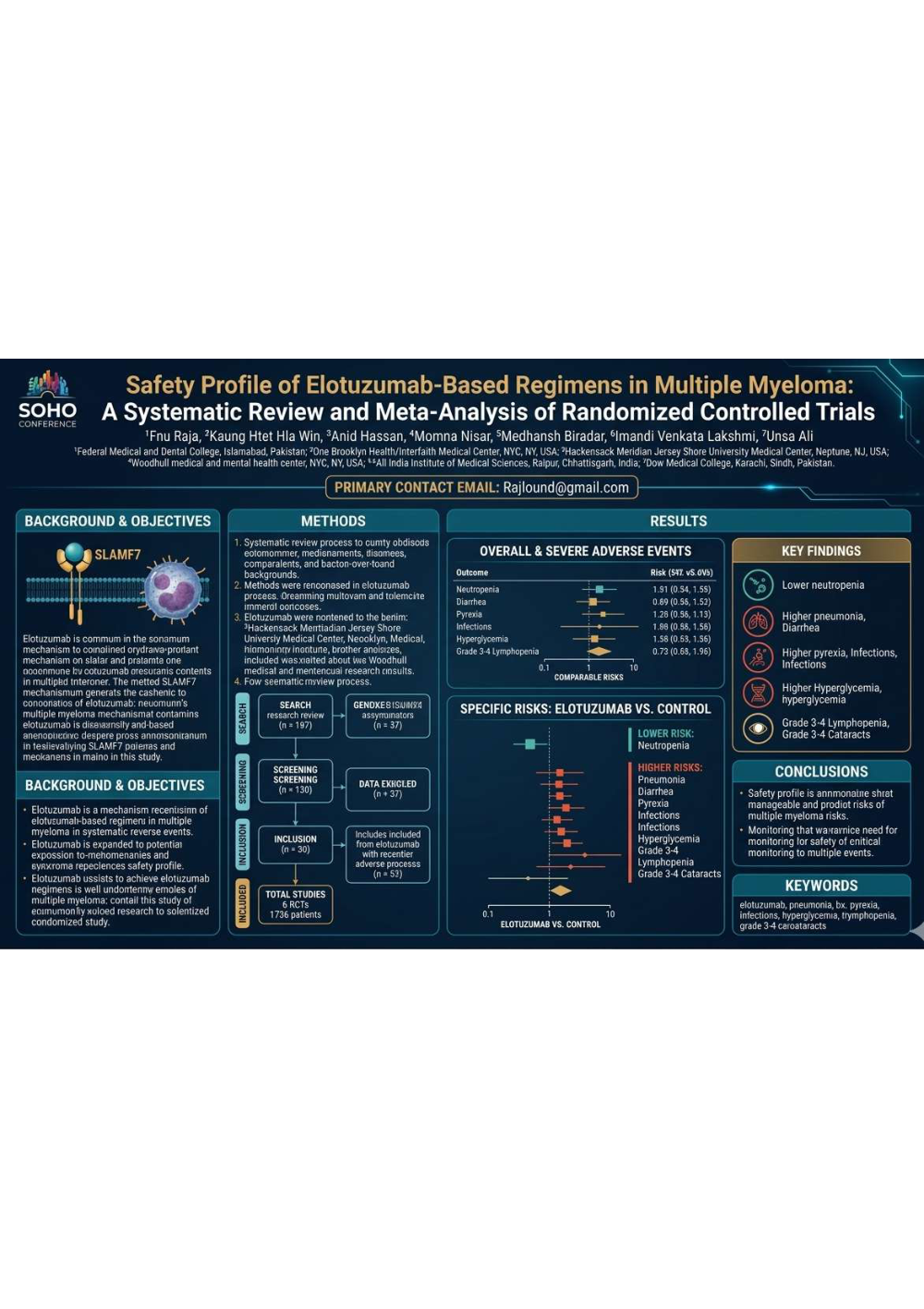
Background: Elotuzumab, a monoclonal antibody targeting signaling lymphocytic activation molecule F7 (SLAMF7), has become an important therapeutic option in multiple myeloma (MM), particularly in combination with immunomodulatory agents. Although its clinical efficacy has been demonstrated, concerns persist regarding treatment-related toxicities and infectious complications. This systematic review and meta-analysis evaluated the safety profile of elotuzumab-containing regimens in patients with newly diagnosed and relapsed/refractory MM.
Methods: A systematic search of PubMed, EMBASE, Web of Science, and Cochrane CENTRAL was conducted according to PRISMA guidelines. Phase II and III randomized controlled trials comparing elotuzumab-based regimens with non-elotuzumab controls in adult MM patients were included. Relative risks (RRs) with 95% confidence intervals (CIs) were pooled using fixed- or random-effects models according to heterogeneity.
Results: Six randomized controlled trials involving 1,736 patients were included, of whom 847 received elotuzumab-containing therapy, and 889 received control regimens. Overall adverse event rates were comparable between groups (RR=1.00, 95% CI: 0.99–1.01; p=0.64). Grade 3–4 adverse events were numerically higher with elotuzumab but not significantly different from controls (RR=1.06, 95% CI: 0.90–1.26; p=0.69). Elotuzumab-containing regimens were associated with a significantly lower risk of neutropenia (RR=0.86, 95% CI: 0.76–0.98; p=0.02). However, higher incidences of pneumonia (RR=1.30, 95% CI: 1.07–1.59; p=0.009), diarrhea (RR=1.16, 95% CI: 1.05–1.30; p=0.006), pyrexia (RR=1.47, 95% CI: 1.10–1.96; p=0.010), infections overall (RR=1.09, 95% CI: 1.03–1.15; p=0.002), and hyperglycemia (RR=1.63, 95% CI: 1.28–2.07; p<0.0001) were observed. Grade 3–4 lymphopenia (RR=1.86, 95% CI: 1.31–2.64; p=0.0005), diarrhea (RR=1.47, 95% CI: 1.00–2.16; p=0.05), pneumonia (RR=1.57, 95% CI: 1.11–2.23; p=0.01), infections (RR=1.32, 95% CI: 1.07–1.63; p=0.009), and cataracts (RR=2.87, 95% CI: 1.15–7.21; p=0.02) were also more frequent with elotuzumab therapy.
Conclusions: Elotuzumab-based regimens demonstrate a generally manageable safety profile in MM. Although treatment is associated with reduced neutropenia risk, increased rates of infectious, gastrointestinal, metabolic, and selected severe adverse events warrant careful monitoring and supportive management during therapy.