1,267 posters, 47 videos, 13 topics, 4 sessions, 853 authors
ePostersLive by SciGen Technologies S.A. All rights reserved.
SOHO 2026 Annual Meeting
September 9 - 12, 2026 | George R. Brown Convention Center, Houston, Texas

MM - 956
Autologous Stem Cell Transplantation for Multiple Myeloma: Real World Outcomes from a Single Centre in Pakistan
Poster Presenter
Authors
Part of Topic
Multiple Myeloma (MM)
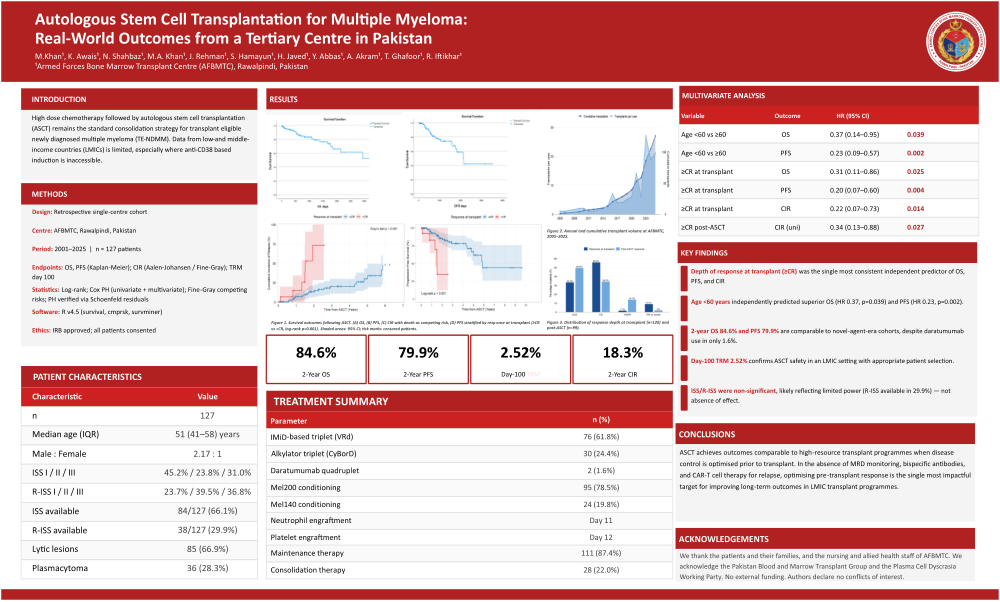
Autologous Stem Cell Transplantation for Multiple Myeloma: Real-World Outcomes from a Tertiary Centre in Pakistan
M. Khan, K. Awais, N. Shahbaz, M.A. Khan, J. Rehman, S. Hamayun, H. Javed, Y. Abbas, A. Akram, T. Ghafoor, R. Iftikhar
Armed Forces Bone Marrow Transplant Centre (AFBMTC), Rawalpindi, Pakistan
Introduction
High-dose chemotherapy followed by autologous stem cell transplantation (ASCT) remains the standard consolidation strategy for transplant-eligible newly diagnosed multiple myeloma (TE-NDMM). Data from low- and middle-income countries (LMICs) is limited, especially where anti-CD38-based induction is largely inaccessible.
Methods
Design: Retrospective single-centre cohort. Centre: AFBMTC, Rawalpindi, Pakistan. Period: 2001–2025 (n = 127 patients). Endpoints: overall survival (OS) and progression-free survival (PFS) by Kaplan-Meier; cumulative incidence of relapse (CIR) by Aalen-Johansen/Fine-Gray; treatment-related mortality (TRM) at day 100. Statistics: log-rank test, Cox proportional hazards (univariate and multivariate) with proportional hazards assumption verified via Schoenfeld residuals. Software: R v4.5 (survival, cmprsk, survminer packages). Ethics: IRB approved; all patients consented.
Patient Characteristics
n = 127. Median age 51 years (IQR 41–58). Male:female ratio 2.17:1. ISS I/II/III: 45.2%/23.8%/31.0% (available in 84/127, 66.1%). R-ISS I/II/III: 23.7%/39.5%/36.8% (available in 38/127, 29.9%). Lytic lesions present in 66.9%. Plasmacytoma in 28.3%.
Treatment Summary
IMiD-based triplet (VRd): 76 (61.8%). Alkylator triplet (CyBorD): 30 (24.4%). Daratumumab quadruplet: 2 (1.6%). Mel200 conditioning: 95 (78.5%). Mel140 conditioning: 24 (19.8%). Median neutrophil engraftment day 11; platelet engraftment day 12. Maintenance therapy: 111 (87.4%). Consolidation therapy: 28 (22.0%).
Results
2-year OS: 84.6%. 2-year PFS: 79.9%. Day-100 TRM: 2.52%. 2-year CIR: 18.3%. On multivariate analysis, age <60 years independently predicted superior OS (HR 0.37, 95% CI 0.14–0.95, p=0.039) and PFS (HR 0.23, 95% CI 0.09–0.57, p=0.002). Achieving ≥CR at transplant independently predicted superior OS (HR 0.31,95% CI 0.11-0.86 p=0.025), PFS (HR 0.20, 95% CI o.07-0.60, p=0.004), and CIR (HR 0.22, 95% CI0.07-0.73, p=0.014). ≥CR post-ASCT also predicted lower CIR (HR 0.34, 95% CI 0.13-0.88, p=0.027).
Key Findings
Depth of response at transplant (≥CR) was the single most consistent independent predictor of OS, PFS, and CIR. Age <60 years independently predicted superior OS and PFS. 2-year OS of 84.6% and PFS of 79.9% are comparable to novel-agent-era cohorts despite daratumumab use in only 1.6% of patients. Day-100 TRM of 2.52% confirms ASCT safety in an LMIC setting with appropriate patient selection. ISS/R-ISS were non-significant, likely reflecting limited power (R-ISS available in only 29.9%) rather than absence of effect.
Conclusions
ASCT achieves outcomes comparable to high-resource transplant programmes when disease control is optimised prior to transplant. In the absence of MRD monitoring, bispecific antibodies, and CAR-T cell therapy for relapse, optimising pre-transplant response is the single most impactful target for improving long-term outcomes in LMIC transplant programmes.
Acknowledgements
We thank the patients and their families, and the nursing and allied health staff of AFBMTC. We acknowledge the Pakistan Blood and Marrow Transplant Group and the Plasma Cell Dyscrasia Working Party. No external funding. Authors declare no conflicts of interest.