1,267 posters, 47 videos, 13 topics, 4 sessions, 853 authors
ePostersLive by SciGen Technologies S.A. All rights reserved.
SOHO 2026 Annual Meeting
September 9 - 12, 2026 | George R. Brown Convention Center, Houston, Texas

AML - 897
Treatment Intensity Does Not Improve Survival in TP53-Mutated Acute Myeloid Leukemia: Real-World Outcomes From a Racially Diverse Academic Center
Poster Presenter
Authors
Part of Topic
Acute Myeloid Leukemia (AML)
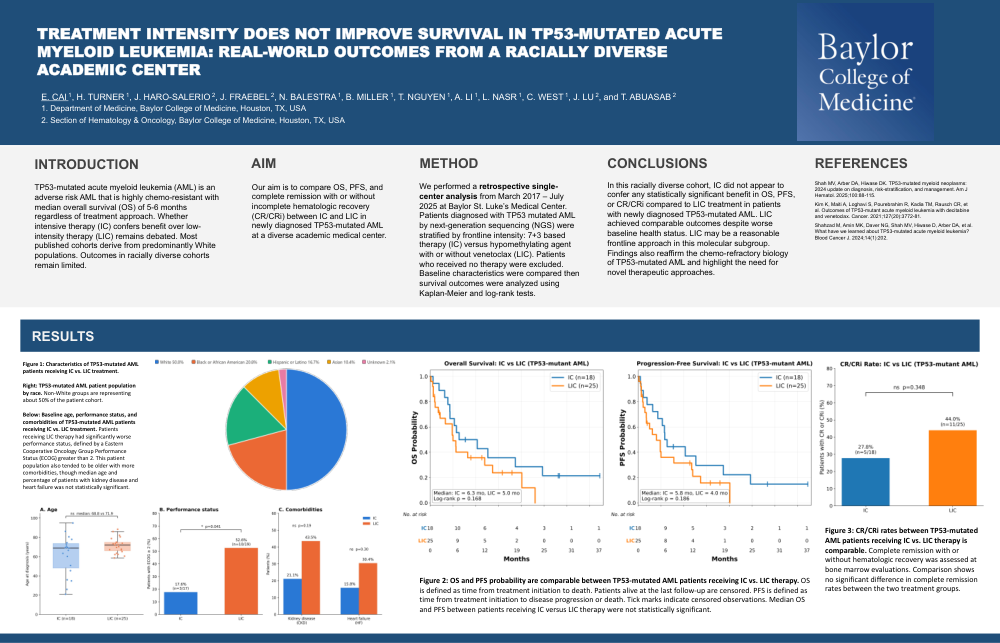
Introduction: TP53-mutated acute myeloid leukemia (AML) is an adverse risk AML that is highly chemo-resistant with median overall survival (OS) of 5-6 months regardless of treatment approach. Whether intensive therapy (IC) confers benefit over low-intensity therapy (LIC) remains debated. Most published cohorts derive from predominantly White populations. Outcomes in racially diverse cohorts remain limited. Aim: Our aim is to compare OS, PFS, and complete remission with or without incomplete hematologic recovery (CR/CRi) between IC and LIC in newly diagnosed TP53-mutated AML at a diverse academic medical center. Method: We performed a retrospective single-center analysis from March 2017 – July 2025 at Baylor St. Luke’s Medical Center. Patients diagnosed with TP53 mutated AML by next-generation sequencing (NGS) were stratified by frontline intensity: 7+3 based therapy (IC) versus hypomethylating agent with or without venetoclax (LIC). Patients who received no therapy were excluded. Baseline characteristics were compared then survival outcomes were analyzed using Kaplan-Meier and log-rank tests. Conclusions: In this racially diverse cohort, IC did not appear to confer any statistically significant benefit in OS, PFS, or CR/CRi compared to LIC treatment in patients with newly diagnosed TP53-mutated AML. LIC achieved comparable outcomes despite worse baseline health status. LIC may be a reasonable frontline approach in this molecular subgroup. Findings also reaffirm the chemo-refractory biology of TP53-mutated AML and highlight the need for novel therapeutic approaches.