1,267 posters, 47 videos, 13 topics, 4 sessions, 853 authors
ePostersLive by SciGen Technologies S.A. All rights reserved.
SOHO 2026 Annual Meeting
September 9 - 12, 2026 | George R. Brown Convention Center, Houston, Texas

ALL - 896
Early Mortality in Acute Leukemias: Real-World Data From a Resource-Limited Public Referral Center in Baja California Sur, Mιxico, 2022-2026.
Poster Presenter
Authors
Part of Topic
Acute Lymphoblastic Leukemia (ALL)
Early Mortality in Acute Leukemias: Real-World Data From a Resource-Limited Public Referral Center in Baja California Sur, México, 2022–2026
Avendaño Castañeda, Emmanuel Alejandro
Sánchez Hernández, Fatima Saray
Instituto Mexicano del Seguro Social, Hospital General de Zona No.1 Baja California Sur
Introduction
Acute leukemias represent hematologic emergencies associated with high morbidity and mortality due to infectious, hemorrhagic, and metabolic complications. Early mortality, defined as death occurring within the first 30–60 days after diagnosis or treatment initiation, is an important quality indicator in hematologic care. In specialized international centers, early mortality rates are typically below 10%.
Limited epidemiological data are available in regions with restricted access to specialized hematologic care, particularly in low-population states such as Baja California Sur, highlighting the need for regional evidence.
Objective
To describe early mortality in patients with acute leukemias treated at Hospital General de Zona No. 1 in La Paz, a state referral public center, during 2022–2026.
Materials and Methods
A retrospective observational study was conducted in patients diagnosed with acute leukemia treated between 2022 and 2026 at Hospital General de Zona No. 1 in La Paz. Cases confirmed by morphology, histopathology, and/or flow cytometry were included. Early mortality and demographic and clinical variables related to in-hospital outcomes were evaluated.
Results
Thirty-eight patients with acute leukemia were included. Mean age at diagnosis was 35.3 ± 10.4 years, with acute lymphoblastic leukemia being the predominant subtype. Most patients came from municipalities outside La Paz, mainly Los Cabos.
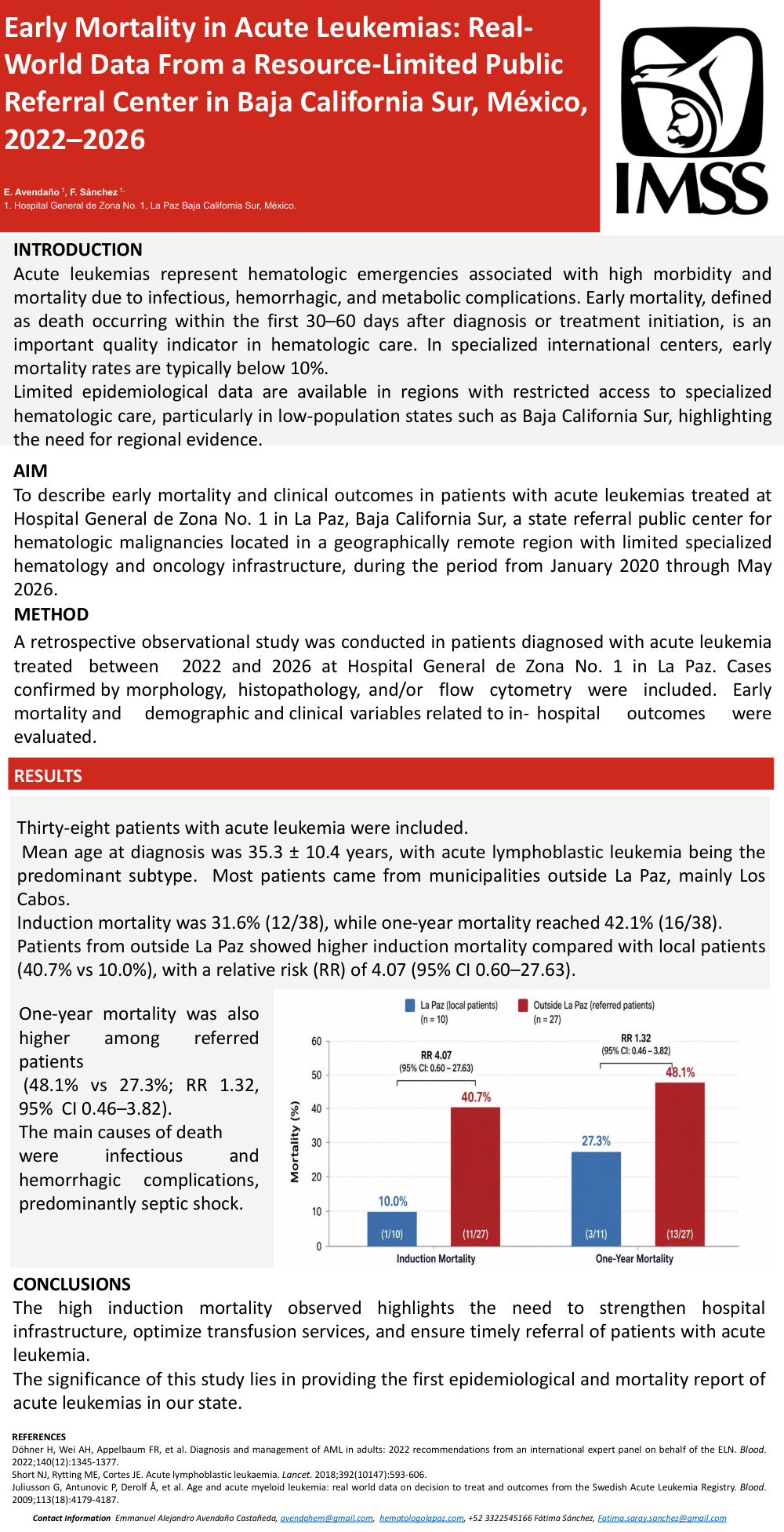
Induction mortality was 31.6% (12/38), while one-year mortality reached 42.1% (16/38). Patients from outside La Paz showed higher induction mortality compared with local patients (40.7% vs 10.0%), with a relative risk (RR) of 4.07 (95% CI 0.60–27.63). One-year mortality was also higher among referred patients (48.1% vs 27.3%; RR 1.32, 95% CI 0.46–3.82).
The main causes of death were infectious and hemorrhagic complications, predominantly septic shock.
Conclusions
The high induction mortality observed highlights the need to strengthen hospital infrastructure, optimize transfusion services, and ensure timely referral of patients with acute leukemia. Strengthening hematologic care networks may reduce treatment delays and improve clinical outcomes in Baja California Sur.
The significance of this study lies in providing the first epidemiological and mortality report of acute leukemias in our state.