1,267 posters, 47 videos, 13 topics, 4 sessions, 853 authors
ePostersLive by SciGen Technologies S.A. All rights reserved.
SOHO 2026 Annual Meeting
September 9 - 12, 2026 | George R. Brown Convention Center, Houston, Texas

AML - 872
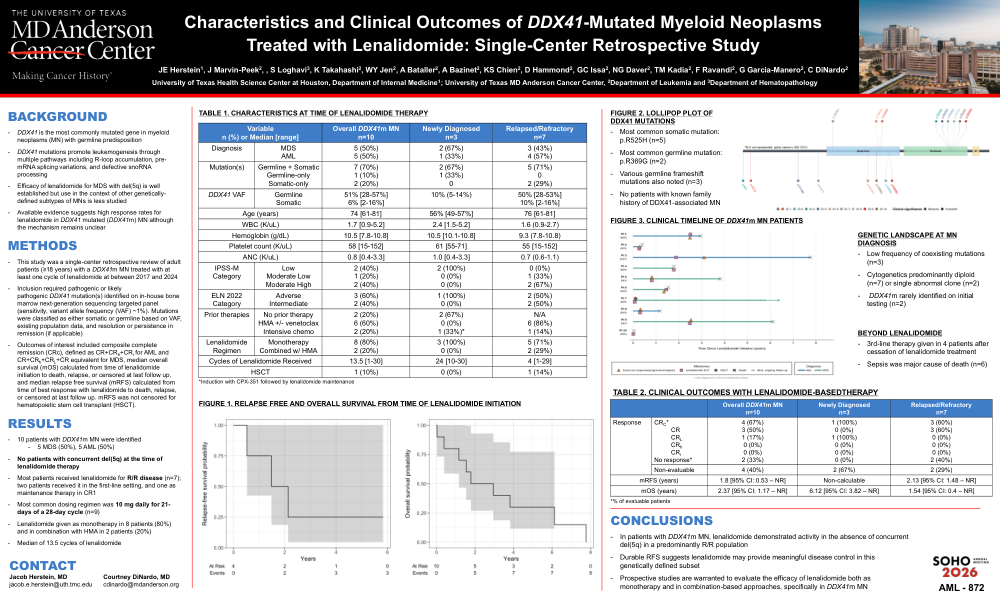
Characteristics and Clinical Outcomes of DDX41-Mutated Myeloid Neoplasms Treated with Lenalidomide: Single-Center Retrospective Study
Poster Presenter
Authors
Part of Topic
Acute Myeloid Leukemia (AML)
BACKGROUND
-DDX41 is the most commonly mutated gene in myeloid neoplasms (MN) with germline predisposition
-DDX41 mutations promote leukemogenesis through multiple pathways including R-loop accumulation, pre-mRNA splicing variations, and defective snoRNA processing
-Efficacy of lenalidomide for MDS with del(5q) is well established but use in the context of other genetically-defined subtypes of MNs is less studied
-Available evidence suggests high response rates for lenalidomide in DDX41 mutated (DDX41m) MN although the mechanism remains unclear
METHODS
-This study was a single-center retrospective review of adult patients (≥18 years) with a DDX41m MN treated with at least one cycle of lenalidomide at between 2017 and 2024
-Inclusion required pathogenic or likely pathogenic DDX41 mutation(s) identified on in-house bone marrow next-generation sequencing targeted panel (sensitivity, variant allele frequency (VAF) ~1%). Mutations were classified as either somatic or germline based on VAF, existing population data, and resolution or persistence in remission (if applicable)
-Outcomes of interest included composite complete remission (CRc), defined as CR+CRh+CRi for AML and CR+CRh+CRL+CR equivalent for MDS, median overall survival (mOS) calculated from time of lenalidomide initiation to death, relapse, or censored at last follow up, and median relapse free survival (mRFS) calculated from time of best response with lenalidomide to death, relapse, or censored at last follow up. mRFS was not censored for hematopoietic stem cell transplant (HSCT).
RESULTS
-10 patients with DDX41m MN were identified
-5 MDS (50%), 5 AML (50%)
-No patients with concurrent del(5q) at the time of lenalidomide therapy
-Most patients received lenalidomide for R/R disease (n=7); two patients received it in the first-line setting, and one as maintenance therapy in CR1
-Most common dosing regimen was 10 mg daily for 21-days of a 28-day cycle (n=9)
-Lenalidomide given as monotherapy in 8 patients (80%) and in combination with HMA in 2 patients (20%)
-Median of 13.5 cycles of lenalidomide
CONCLUSIONS
-In patients with DDX41m MN, lenalidomide demonstrated activity in the absence of concurrent del(5q) in a predominantly R/R population
-Durable RFS suggests lenalidomide may provide meaningful disease control in this genetically defined subset
-Prospective studies are warranted to evaluate the efficacy of lenalidomide both as monotherapy and in combination-based approaches, specifically in DDX41m MN