1,267 posters, 47 videos, 13 topics, 4 sessions, 853 authors
ePostersLive by SciGen Technologies S.A. All rights reserved.
SOHO 2026 Annual Meeting
September 9 - 12, 2026 | George R. Brown Convention Center, Houston, Texas

AML - 851
FIRST-LINE TREATMENT OUTCOMES IN TP53-MUTATED ACUTE MYELOID LEUKEMIA: A SYSTEMATIC REVIEW AND META-ANALYSIS
Poster Presenter
Authors
Part of Topic
Acute Myeloid Leukemia (AML)
First-Line Treatment Outcomes in TP53-Mutated Acute Myeloid Leukemia: A
Systematic Review and Meta-Analysis
Ali H. Mohamedi1, Khaled Al Bakri2, Anika Patel1, Ashwin Sunderraj1, Abril Carrillo1, Huda Baidoun3, Julia Anderson2, Alejandro Marino Velarde2, Vivian Irizarry-Gatell2, Robert Collins2
Stephen Chung2, Amir Toor Clayton Jackson2, Yazan Madanat2
1. Department of Internal Medicine, UT Southwestern, Dallas, TX; 2. Department of Internal Medicine – Hematology Oncology, UT Southwestern, Dallas, TX; 3. University of Jordan, Amman,Jordan
Background
• TP53m AML is an adverse-risk subtype
with treatment resistance, frequent relapse,
and poor survival.
• Frontline approaches include IC, LIT, and
HMA ± VEN.
AIMS
• The optimal frontline strategy remains
uncertain due to variable response and
survival outcomes.
• Evaluate the efficacy of frontline treatment
strategies in TP53-mutated AML by
comparing response to different therapies
• Assess whether improved treatment
responses translate into meaningful
survival benefit
Conclusions
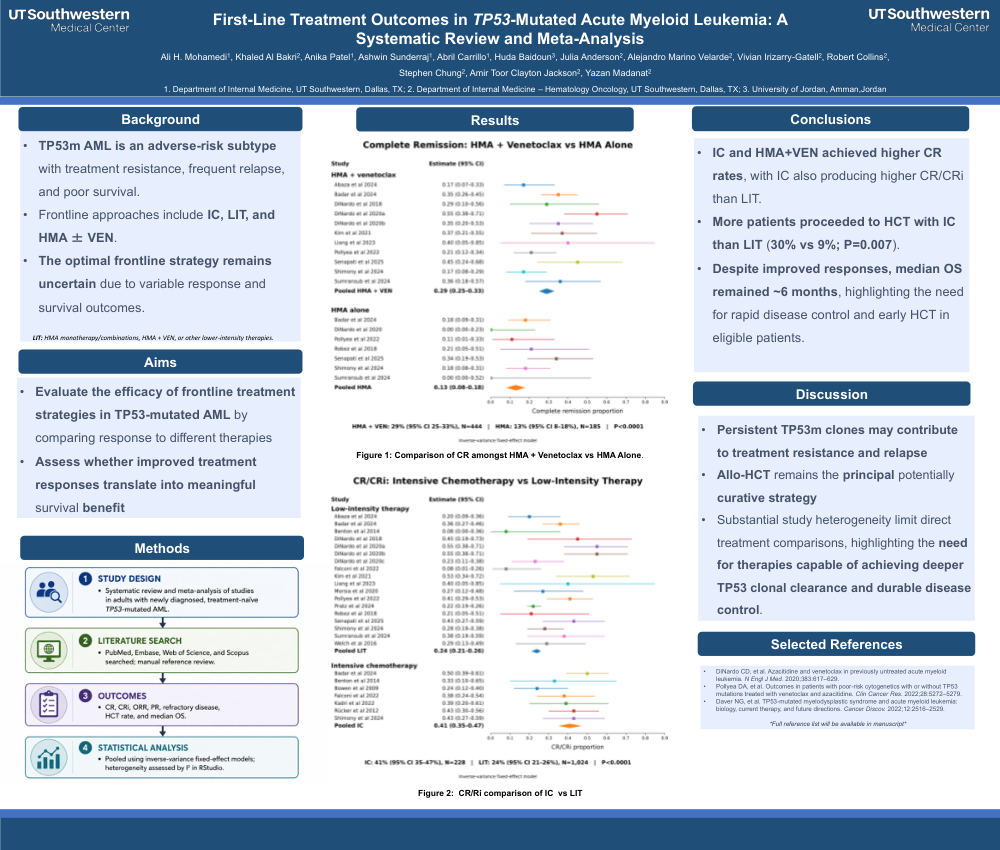
IC and HMA+VEN achieved higher CR
rates, with IC also producing higher CR/CRi
than LIT.
• More patients proceeded to HCT with IC
than LIT (30% vs 9%; P=0.007).
• Despite improved responses, median OS
remained ~6 months, highlighting the need
for rapid disease control and early HCT in
eligible patients.
Discussion
Persistent TP53m clones may contribute
to treatment resistance and relapse
• Allo-HCT remains the principal potentially
curative strategy
• Substantial study heterogeneity limit direct
treatment comparisons, highlighting the need
for therapies capable of achieving deeper
TP53 clonal clearance and durable disease
control.
Selected References
• DiNardo CD, et al. Azacitidine and venetoclax in previously untreated acute myeloid
leukemia. N Engl J Med. 2020;383:617–629.
• Pollyea DA, et al. Outcomes in patients with poor-risk cytogenetics with or without TP53
mutations treated with venetoclax and azacitidine. Clin Cancer Res. 2022;28:5272–5279.
• Daver NG, et al. TP53-mutated myelodysplastic syndrome and acute myeloid leukemia:
biology, current therapy, and future directions. Cancer Discov. 2022;12:2516–2529.
*Full reference list will be available in manuscript*