1,267 posters, 47 videos, 13 topics, 4 sessions, 853 authors
ePostersLive by SciGen Technologies S.A. All rights reserved.
SOHO 2026 Annual Meeting
September 9 - 12, 2026 | George R. Brown Convention Center, Houston, Texas

MM - 845
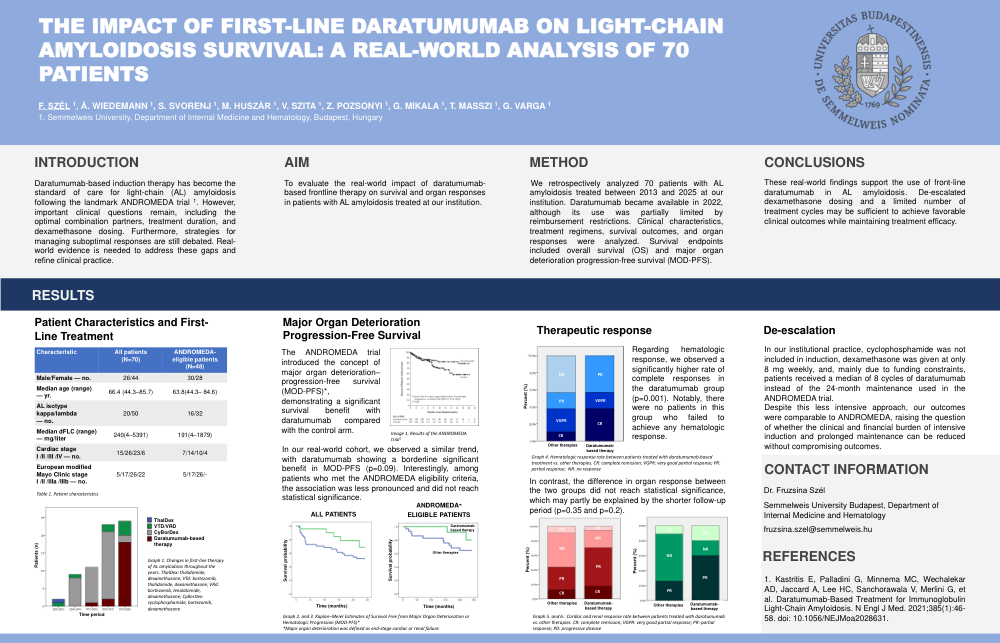
THE IMPACT OF FIRST-LINE DARATUMUMAB ON LIGHT-CHAIN AMYLOIDOSIS SURVIVAL: A REAL-WORLD ANALYSIS OF 70 PATIENTS
Poster Presenter
Authors
Part of Topic
Multiple Myeloma (MM)
The Impact of First-Line Daratumumab on Light-Chain Amyloidosis Survival: A Real-World Analysis of 70 Patients
F. Szél 1, Á. Wiedemann 1, S. Svorenj 1, M. Huszár 1, V. Szita 1, Z. Pozsonyi 1, G. Mikala 1, T. Masszi 1, G. Varga 1
1. Semmelweis University, Department of Internal Medicine and Hematology, Budapest, Hungary
INTRODUCTION
Daratumumab-based induction therapy has become the standard of care for light-chain (AL) amyloidosis following the landmark ANDROMEDA trial 1. However, important clinical questions remain, including the optimal combination partners, treatment duration, and dexamethasone dosing. Furthermore, strategies for managing suboptimal responses are still debated. Real-world evidence is needed to address these gaps and refine clinical practice.
AIM
To evaluate the real-world impact of daratumumab-based frontline therapy on survival and organ responses in patients with AL amyloidosis treated at our institution.
METHOD
We retrospectively analyzed 70 patients with AL amyloidosis treated between 2013 and 2025 at our institution. Daratumumab became available in 2022, although its use was partially limited by reimbursement restrictions. Clinical characteristics, treatment regimens, survival outcomes, and organ responses were analyzed. Survival endpoints included overall survival (OS) and major organ deterioration progression-free survival (MOD-PFS).
RESULTS
The ANDROMEDA trial introduced the concept of major organ deterioration–progression-free survival (MOD-PFS)*, demonstrating a significant survival benefit with daratumumab compared with the control arm. In our real-world cohort, we observed a similar trend, with daratumumab showing a borderline significant benefit in MOD-PFS (p=0.09). Interestingly, among patients who met the ANDROMEDA eligibility criteria, the association was less pronounced and did not reach statistical significance.
Regarding hematologic response, we observed a significantly higher rate of complete responses in the daratumumab group (p=0.001). Notably, there were no patients in this group who failed to achieve any hematologic response. In contrast, the difference in organ response between the two groups did not reach statistical significance, which may partly be explained by the shorter follow-up period (p=0.35 and p=0.2).
In our institutional practice, cyclophosphamide was not included in induction, dexamethasone was given at only 8 mg weekly, and, mainly due to funding constraints, patients received a median of 8 cycles of daratumumab instead of the 24-month maintenance used in the ANDROMEDA trial.Despite this less intensive approach, our outcomes were comparable to ANDROMEDA, raising the question of whether the clinical and financial burden of intensive induction and prolonged maintenance can be reduced without compromising outcomes.
CONCLUSIONS
These real-world findings support the use of front-line daratumumab in AL amyloidosis. De-escalated dexamethasone dosing and a limited number of treatment cycles may be sufficient to achieve favorable clinical outcomes while maintaining treatment efficacy.