1,267 posters, 47 videos, 13 topics, 4 sessions, 853 authors
ePostersLive by SciGen Technologies S.A. All rights reserved.
SOHO 2026 Annual Meeting
September 9 - 12, 2026 | George R. Brown Convention Center, Houston, Texas

MM - 813
Generalizability Gaps in BCMA- and GPRC5D-Directed Immunotherapy Trials for Relapsed/Refractory Multiple Myeloma: A Trial-Level Eligibility Analysis
Poster Presenter
Authors
Part of Topic
Multiple Myeloma (MM)
Abstract
Background
BCMA- and GPRC5D-directed immunotherapies have transformed treatment for relapsed/refractory multiple
myeloma (RRMM), but pivotal trial populations may not reflect medically complex patients in routine practice. We
evaluated whether eligibility criteria in key RRMM immunotherapy trials limit enrollment of clinically vulnerable
populations.
Methods
We performed a trial-level eligibility analysis of pivotal or registrational BCMA- and GPRC5D-directed immunotherapy
trials in RRMM. ClinicalTrials.gov, PubMed/MEDLINE, FDA labels, primary publications, protocols,
and sponsor protocol summaries were reviewed. Criteria were extracted across six vulnerability domains:
ECOG performance status (ECOG-PS), renal dysfunction/dialysis, cytopenias, infection/immunosuppression,
aggressive disease biology, and prior immune redirection. A domain was classified as restricted or not clearly
represented when criteria explicitly excluded the subgroup or imposed performance status, organ function,
hematologic, infection-related, disease-specific, or prior-therapy thresholds likely to limit enrollment. Each trial
received a vulnerability-restriction score from 0 to 6.
Results
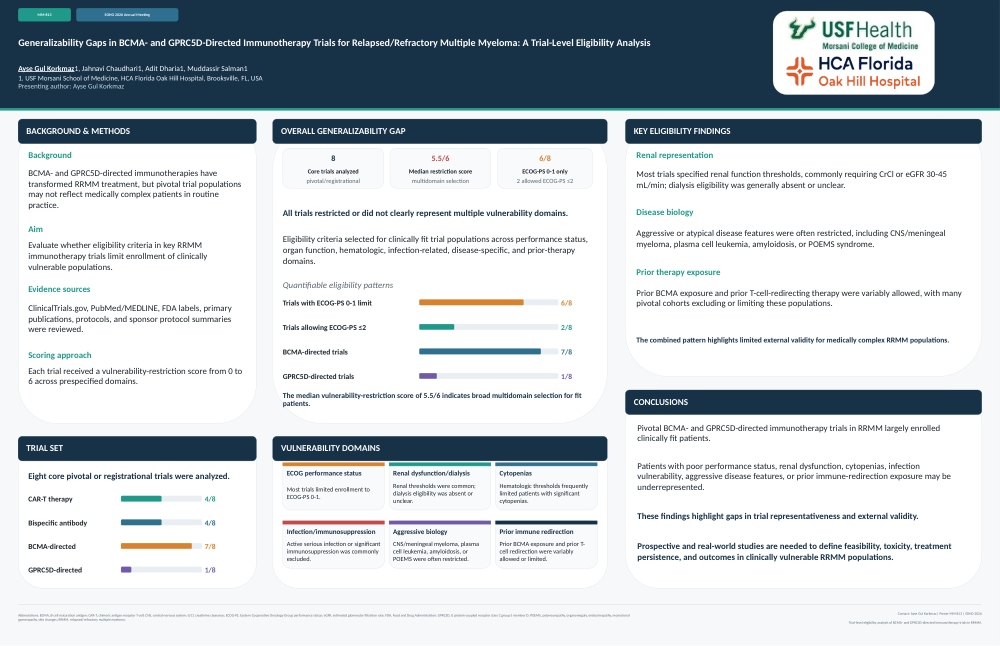
Eight core pivotal or registrational trials were analyzed, including four CAR-T therapy and four bispecific
antibody studies. Seven evaluated BCMA-directed therapy, and one evaluated GPRC5D-directed therapy. All
trials restricted or did not clearly represent multiple vulnerability domains. Six of eight trials limited enrollment
to ECOG-PS 0–1, while two allowed ECOG-PS ≤2. Renal function thresholds were specified in most trials,
commonly requiring CrCl or eGFR 30–45 mL/min; dialysis eligibility was generally absent or unclear. Hematologic
thresholds were frequently required, limiting representation of patients with significant cytopenias. Patients with
active serious or uncontrolled infection and clinically significant immunosuppression were commonly excluded.
Aggressive or atypical disease features, including CNS/meningeal myeloma, plasma cell leukemia, amyloidosis,
or POEMS syndrome, were often restricted. Prior BCMA exposure and prior T-cell–redirecting therapy were
variably allowed, with many pivotal cohorts excluding or limiting these populations. The median vulnerability-
restriction score was 5.5 of 6, indicating multidomain selection for clinically fit trial populations.
Conclusion
Pivotal BCMA- and GPRC5D-directed immunotherapy trials in RRMM largely enrolled clinically fit patients and
may underrepresent individuals with poor performance status, renal dysfunction, cytopenias, infection vulnerability,
aggressive disease features, or prior immune-redirection exposure. These findings highlight gaps in trial
representativeness and external validity. Prospective and real-world studies are needed to define feasibility,
toxicity, treatment persistence, and outcomes in clinically vulnerable RRMM populations.
BCMA: B-cell maturation antigen, CAR-T: chimeric antigen receptor T-cell, CNS: central nervous system, CrCl:
creatinine clearance, ECOG: Eastern Cooperative Oncology Group, eGFR: estimated glomerular filtration rate,
FDA: Food and Drug Administration, GPRC5D: G protein-coupled receptor class C group 5 member D, POEMS:
polyneuropathy, organomegaly, endocrinopathy, monoclonal gammopathy, skin changes
Keywords
MM, relapsed/refractory multiple myeloma, BCMA, GPRC5D, trial representativeness, external validity