1,267 posters, 47 videos, 13 topics, 4 sessions, 853 authors
ePostersLive by SciGen Technologies S.A. All rights reserved.
SOHO 2026 Annual Meeting
September 9 - 12, 2026 | George R. Brown Convention Center, Houston, Texas

MM - 770
Ciltacabtagene Autoleucel in Lenalidomide-Refractory Multiple Myeloma Responding to Bridging Therapy: CARTITUDE-4 Cytogenetic Subgroup Analysis
Poster Presenter
Authors
Part of Topic
Multiple Myeloma (MM)
iltacabtagene Autoleucel in Lenalidomide-Refractory Multiple Myeloma Responding to Bridging Therapy: CARTITUDE-4 Cytogenetic Subgroup Analysis
Introduction
Previous analyses from the phase 3 CARTITUDE-4 study of patients with lenalidomide-refractory multiple myeloma (MM) after 1–3 prior lines of therapy (pLOT) who were treated with ciltacabtagene autoleucel (cilta-cel) have shown that survival and safety outcomes vary by cytogenetic risk status and response to bridging therapy (BT).
– Patients with high- or standard-risk cytogenetics treated with cilta-cel had improved progression-free survival (PFS) and overall survival (OS) compared with patients treated with standard of care (SOC).
– Partial response or better (≥PR) during BT was associated with better survival and safety outcomes with cilta-cel.
Emerging real-world data underscore the importance of effective BT before infusion with cilta-cel.
Here, we present efficacy and safety for patients who received cilta-cel as study treatment according to response to BT and cytogenetic risk (median study follow-up, 33.6 months).
Results
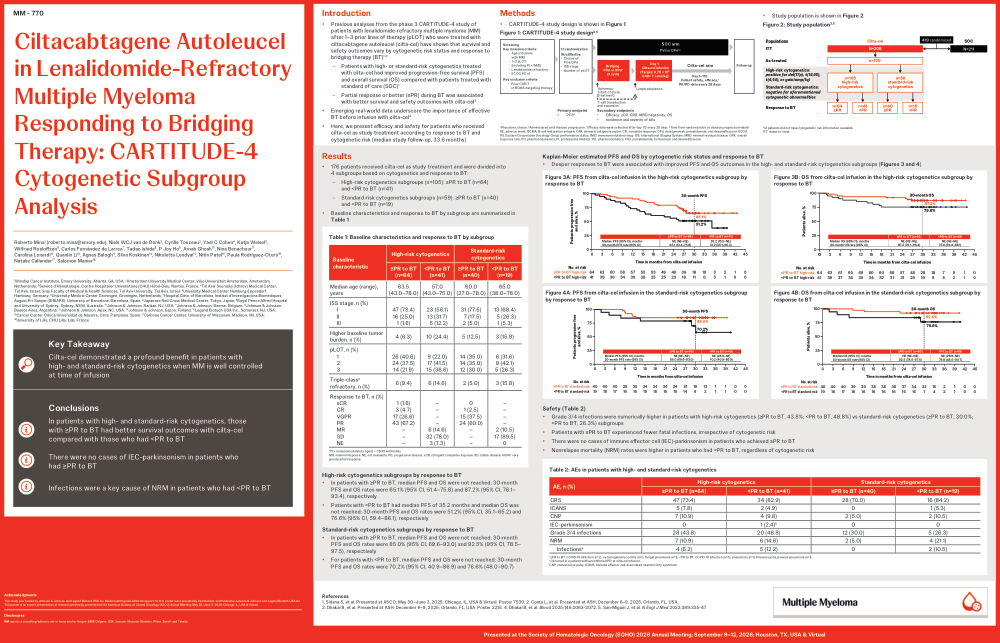
176 patients received cilta-cel as study treatment and were divided into 4 subgroups based on cytogenetics and response to BT:
– High-risk cytogenetics subgroups (n=105): ≥PR to BT (n=64) and <PR to BT (n=41)
– Standard-risk cytogenetics subgroups (n=59): ≥PR to BT (n=40) and <PR to BT (n=19)
Baseline characteristics and response to BT by subgroup are summarized in Table 1.
High-risk cytogenetics subgroups by response to BT
In patients with ≥PR to BT, median PFS and OS were not reached; 30-month PFS and OS rates were 65.1% (95% CI, 51.4–75.8) and 87.2% (95% CI, 76.1–93.4), respectively.
Patients with <PR to BT had median PFS of 35.2 months and median OS was not reached; 30-month PFS and OS rates were 51.2% (95% CI, 35.1–65.2) and 75.6% (95% CI, 59.4–86.1), respectively.
Standard-risk cytogenetics subgroups by response to BT
In patients with ≥PR to BT, median PFS and OS were not reached; 30-month PFS and OS rates were 85.0% (95% CI, 69.6–93.0) and 92.5% (95% CI, 78.5–97.5), respectively.
For patients with <PR to BT, median PFS and OS were not reached; 30-month PFS and OS rates were 70.2% (95% CI, 40.9–86.9) and 76.6% (48.0–90.7).
Safety
Grade 3/4 infections were numerically higher in patients with high-risk cytogenetics (≥PR to BT, 43.8%; <PR to BT, 48.8%) vs standard-risk cytogenetics (≥PR to BT, 30.0%; <PR to BT, 26.3%) subgroups.
Patients with ≥PR to BT experienced fewer fatal infections, irrespective of cytogenetic risk.
There were no cases of immune effector cell (IEC)-parkinsonism in patients who achieved ≥PR to BT.
Nonrelapse mortality (NRM) rates were higher in patients who had <PR to BT, regardless of cytogenetic risk.
Kaplan-Meier estimated PFS and OS by cytogenetic risk status and response to BT
Deeper responses to BT were associated with improved PFS and OS outcomes in the high- and standard-risk cytogenetics subgroups (Figures 3 and 4).
Key Takeaway
Cilta-cel demonstrated a profound benefit in patients with high- and standard-risk cytogenetics when MM is well controlled at time of infusion.
Conclusions
In patients with high- and standard-risk cytogenetics, those with ≥PR to BT had better survival outcomes with cilta-cel compared with those who had <PR to BT.
There were no cases of IEC-parkinsonism in patients who had ≥PR to BT.
Infections were a key cause of NRM in patients who had <PR to BT.