1,267 posters, 47 videos, 13 topics, 4 sessions, 853 authors
ePostersLive by SciGen Technologies S.A. All rights reserved.
SOHO 2026 Annual Meeting
September 9 - 12, 2026 | George R. Brown Convention Center, Houston, Texas

CT - 761
Efficacy of Talicabtagene Autoleucel in Relapsed/Refractory B-NHL in Complete Response at the Time of Infusion: A Single-Center Study
Poster Presenter
Authors
Part of Topic
Cellular Therapy (CT)
Video
Title: Efficacy of talicabtagene autoleucel in relapsed/refractory B-NHL in complete response at the time of infusion: a single-centre study
Authors: S. Pereira, H. Jain, B. Bagal, A. Shetty, L. Nayak, M. Sengar
Affiliation: Department of Medical Oncology, Adult Hematolymphoid Group, Tata Memorial Centre (ACTREC), Homi Bhabha National Institute, Mumbai, India
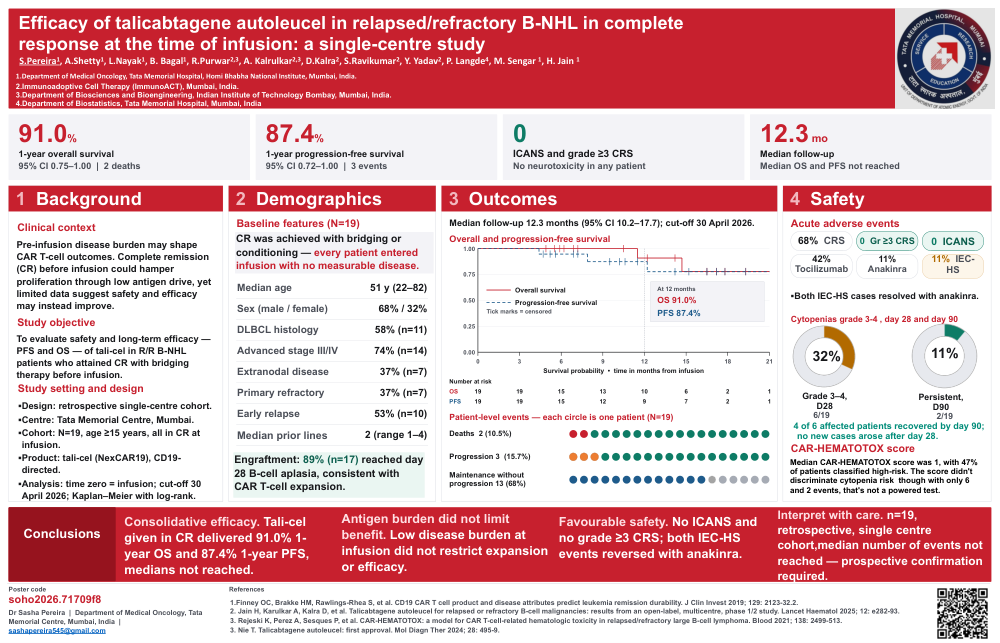
Background: The impact of pre-infusion disease burden on CAR T-cell therapy outcomes remains debated. Complete remission (CR) before infusion could theoretically hamper CAR T-cell proliferation through low antigen drive, yet limited clinical data suggest safety and efficacy may instead improve.
Objective: To evaluate safety and long-term efficacy — progression-free survival (PFS) and overall survival (OS) — of talicabtagene autoleucel (tali-cel) in relapsed/refractory B-cell non-Hodgkin lymphoma (B-NHL) patients who attained complete remission with bridging therapy prior to infusion.
Methods: Retrospective single-centre cohort study at Tata Memorial Centre, Mumbai. Nineteen patients aged 15 years or older with R/R B-NHL who achieved CR with bridging therapy prior to infusion were included. Time zero was defined as date of infusion; data cut-off was 30 April 2026. Kaplan–Meier estimates were used for survival analysis, with log-rank comparison for subgroups.
Patients: Median age 51 years (range 22–82); 68% male. Diffuse large B-cell lymphoma in 58%; 74% had Ann Arbor stage III/IV disease; 37% had extranodal involvement; 37% had primary refractory disease; 53% had early relapse. Median 2 prior lines of therapy (range 1–4). All patients were in complete remission at infusion. Sixty-eight percent (13/19) received post-infusion maintenance therapy, predominantly a BTK inhibitor with or without a PD-1 inhibitor.
Results: At a median follow-up of 12.3 months (95% CI 10.2–17.7), median OS and PFS were not reached. One-year OS was 91.0% (95% CI 0.75–1.00) and one-year PFS was 87.4% (95% CI 0.72–1.00). Cytokine release syndrome occurred in 68% of patients, all grade 1–2; no patient developed ICANS or grade 3–4 CRS. Grade 3–4 cytopenia occurred in 32% (6/19) of patients at day 28 and 11% (2/19) at day 90; of patients with day-28 cytopenia, 4 of 6 had resolved by day 90, with no new cases emerging after day 28. Immune effector cell-associated haemophagocytic lymphohistiocytosis-like syndrome (IEC-HS) occurred in 2 patients, both of whom recovered with anakinra. Median CAR-HEMATOTOX score was 1 (range 0–4); 47% of patients were high-risk (score ≥2). Grade 3–4 cytopenia rates were similar across CAR-HEMATOTOX risk groups at both timepoints. Three patients had a PFS event, two patients died (1 sepsis, 1 cause unknown).
Conclusions: Talicabtagene autoleucel consolidation in patients already in complete remission delivered high 1-year survival with a favourable safety profile, including no ICANS and no grade 3–4 CRS. Low disease burden at infusion did not appear to limit efficacy. Given the retrospective design, small sample size (n=19), and wide confidence intervals, prospective confirmation is required.