1,267 posters, 47 videos, 13 topics, 4 sessions, 853 authors
ePostersLive by SciGen Technologies S.A. All rights reserved.
SOHO 2026 Annual Meeting
September 9 - 12, 2026 | George R. Brown Convention Center, Houston, Texas

AML - 724
Comparative Efficacy and Safety of FLT3 Inhibitor-Based Frontline Regimens in Newly Diagnosed FLT3-Mutated Acute Myeloid Leukemia: A Systematic Review and Network Meta-Analysis
Poster Presenter
Authors
Part of Topic
Acute Myeloid Leukemia (AML)
Comparative Efficacy and Safety of FLT3 Inhibitor-Based Frontline Regimens in Newly Diagnosed FLT3-Mutated Acute Myeloid Leukemia: A Systematic Review and Network Meta-Analysis
Sadhu Aishwarya Reddy1, Zoya Sohail2, Deepti Botlaguduru3, Rakhshanda khan4, HarshawardhanDhanraj Ramteke5, Dineshbaba Murugavel6
1Northwestern Mchenry hospital/ Rosalind franklin University, Mchenry, Illinois, USA; 2Rawalpindi Medical University, Rawalpindi, Pakistan; 3Keck School of Medicine, University of Southern California, California, USA; 4Ayaan institute of medical sciences, moinabad, Telangana, India; 5Rhythm heart and critical care hospitals, Nagpur, Maharashtra India; 6Ivane javakhishvili tbilisi state university, Tbilisi, Georgia
Keywords:
Acute Myeloid Leukemia, FLT3 inhibitors, network meta-analysis, quizartinib, venetoclax
Objective:
To compare the efficacy and safety of frontline FLT3 inhibitor–based regimens in newly diagnosed FLT3-mutated AML using a Bayesian network meta-analysis.
Introduction
The rapid expansion of FLT3 inhibitors (FLT3i) and venetoclax-based combinations has transformed the frontline landscape for FLT3-mutated AML. However, the optimal integration of these agents remains controversial due to a lack of head-to-head trials. This study aims to provide a comparative hierarchy of current therapeutic backbones to guide clinical decision-making.
Methods
We conducted a systematic search of PubMed, EMBASE, and major conference proceedings (ASCO, ASH, SOHO). A Bayesian network meta-analysis (NMA) was performed using a random-effects model to compare regimens including intensive chemotherapy (7+3) plus midostaurin or quizartinib, venetoclax-based doublets/triplets, and CPX-351. Surface Under the Cumulative Ranking (SUCRA) curves were utilized for treatment ranking.
Results
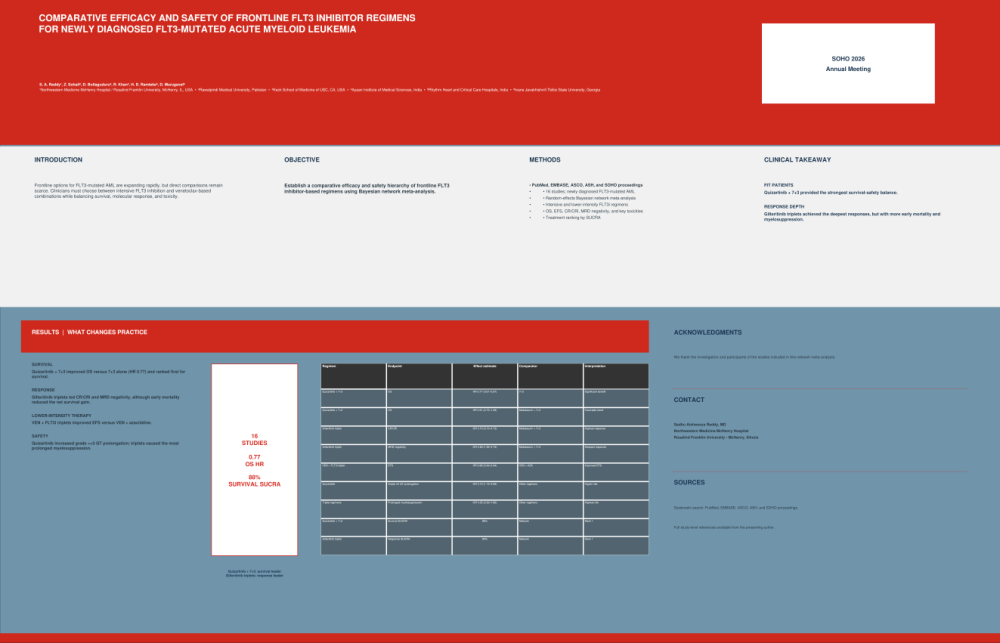
Analysis of 16 studies showed Quizartinib + 7+3 significantly improved OS compared to 7+3 alone (HR 0.77, 95% CI: 0.61–0.97) and trended superior to Midostaurin + 7+3 (HR 0.91, 95% CI: 0.75–1.09). Gilteritinib-based triplets achieved the highest CR/CRi rates (OR 3.15, 95% CI: 2.10–4.72) and MRD negativity (OR 2.80, 95% CI: 1.65–4.75) versus Midostaurin + 7+3, though OS benefit was partially offset by early mortality. For HMA-backbones, VEN + FLT3i triplets outperformed VEN + AZA doublets in EFS (HR 0.68, 95% CI: 0.49–0.94). Safety analysis revealed Quizartinib was associated with higher Grade > 3 QT prolongation (OR 2.10, 95% CI: 1.15–3.84), while triplet regimens showed the highest risk of prolonged myelosuppression (OR 4.25, 95% CI: 2.30–7.80). SUCRA rankings identified Quizartinib + 7+3 (SUCRA 88%) and Gilteritinib-triplets (SUCRA 84%) as the top-performing nodes for survival and depth of response, respectively.
Conclusion
While triplet therapies offer the deepest molecular responses, quizartinib-based intensive induction currently represents the most favorable balance of survival and safety for fit patients; notably, the overall risk of bias across included studies was low.