1,267 posters, 47 videos, 13 topics, 4 sessions, 853 authors
ePostersLive by SciGen Technologies S.A. All rights reserved.
SOHO 2026 Annual Meeting
September 9 - 12, 2026 | George R. Brown Convention Center, Houston, Texas

AML - 720
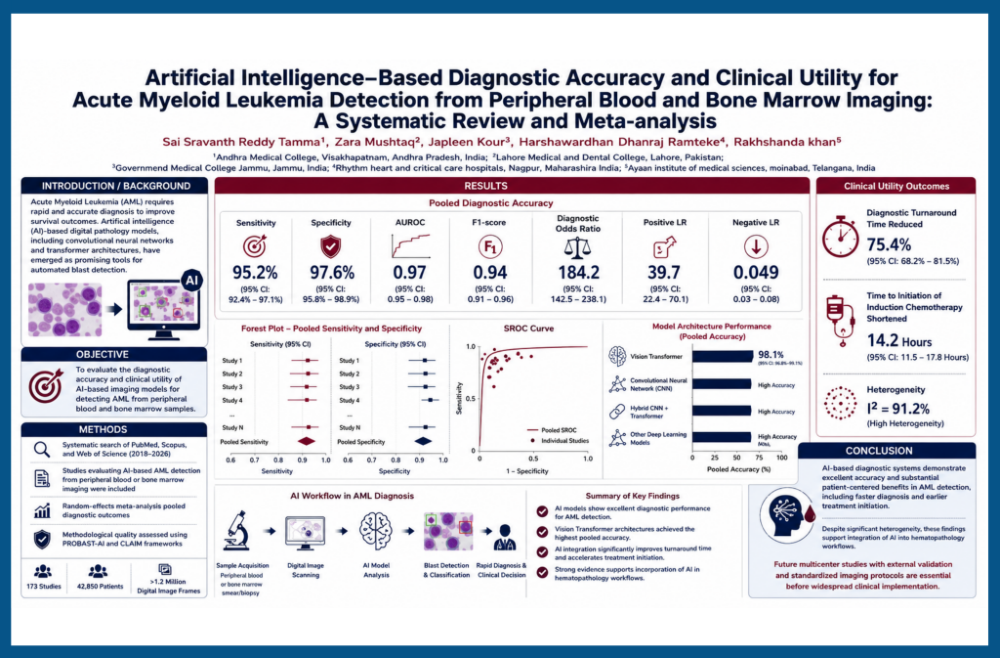
Artificial Intelligence–Based Diagnostic Accuracy and Clinical Utility for Acute Myeloid Leukemia Detection from Peripheral Blood and Bone Marrow Imaging: A Systematic Review and Meta-Analysis
Poster Presenter
Authors
Part of Topic
Acute Myeloid Leukemia (AML)
Artificial Intelligence–Based Diagnostic Accuracy and Clinical Utility for Acute Myeloid Leukemia Detection from Peripheral Blood and Bone Marrow Imaging: A Systematic Review and Meta-analysis
Sai Sravanth Reddy Tamma1, Zara Mushtaq2, Japleen Kour3, Harshawardhan Dhanraj Ramteke4, Rakhshanda khan5
1Andhra Medical College, Visakhapatnam, Andhra Pradesh, India; 2Lahore Medical and Dental College, Lahore, Pakistan; 3Government Medical College Jammu, Jammu, India; Rhythm heart and critical care hospitals, Nagpur, Maharashtra India; 5Ayaan institute of medical sciences, moinabad, Telangana, India
Keywords:
Acute Myeloid Leukemia, artificial intelligence, digital pathology, bone marrow imaging, diagnostic accuracy
Objective:
To evaluate the diagnostic accuracy and clinical utility of AI-based imaging models for detecting AML from peripheral blood and bone marrow samples.
Introduction
Acute Myeloid Leukemia (AML) requires rapid and accurate diagnosis to improve survival outcomes. Artificial intelligence (AI)-based digital pathology models, including convolutional neural networks and transformer architectures, have emerged as promising tools for automated blast detection. This systematic review and meta-analysis evaluated the diagnostic accuracy and clinical utility of AI systems in AML.
Methods
A systematic search of PubMed, Scopus, and Web of Science was conducted from 2018–2026 following PRISMA-DTA guidelines. Studies evaluating AI-based AML detection from peripheral blood or bone marrow imaging were included. Random-effects meta-analysis pooled diagnostic outcomes. Methodological quality was assessed using PROBAST-AI and CLAIM frameworks.
Results
A total of 173 studies comprising 42,850 patients and over 1.2 million digital image frames were included. AI models demonstrated a pooled sensitivity of 95.2% (95% CI: 92.4%–97.1%) and specificity of 97.6% (95% CI: 95.8%–98.9%). The pooled AUROC was 0.97 (95% CI: 0.95–0.98), with an F1-score of 0.94 (95% CI: 0.91–0.96). Diagnostic odds ratio reached 184.2 (95% CI: 142.5–238.1), while positive and negative likelihood ratios were 39.7 (95% CI: 22.4–70.1) and 0.049 (95% CI: 0.03–0.08), respectively. Vision Transformer models achieved the highest pooled accuracy at 98.1% (95% CI: 96.8%–99.1%). AI-assisted workflows reduced diagnostic turnaround time by 75.4% (95% CI: 68.2%–81.5%) and shortened initiation of induction chemotherapy by 14.2 hours (95% CI: 11.5–17.8 hours). Significant heterogeneity was observed (I²=91.2%).
Conclusion
AI-based diagnostic systems demonstrate excellent accuracy and substantial patient-centered benefits in AML detection, including faster diagnosis and earlier treatment initiation. Despite significant heterogeneity, these findings support integration of AI into hematopathology workflows. Future multicenter studies with external validation and standardized imaging protocols are essential before widespread clinical implementation.