1,267 posters, 47 videos, 13 topics, 4 sessions, 853 authors
ePostersLive by SciGen Technologies S.A. All rights reserved.
SOHO 2026 Annual Meeting
September 9 - 12, 2026 | George R. Brown Convention Center, Houston, Texas

CML - 713
Blastic Crisis of CML in a Patient With Underlying CLL.
Poster Presenter
Authors
Part of Topic
Chronic Myeloid Leukemia (CML)
Blastic crisis of CML in a patient with underlying CLL
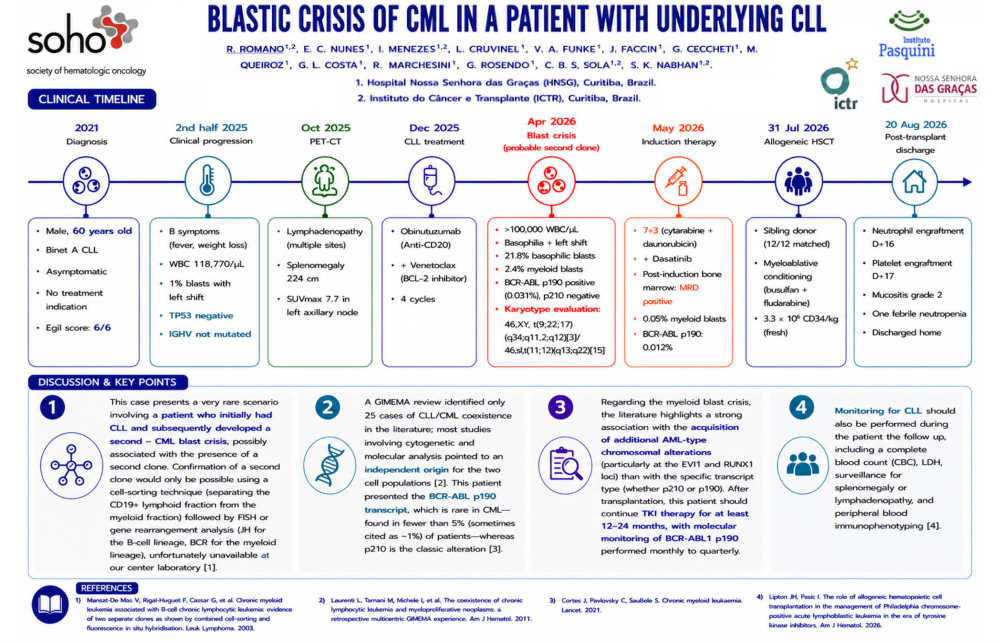
Patient is male, 60 years old, diagnosed with Binet A CLL in 2021. At diagnosis, blood count showed 12,750 leukocytes, 29% neutrophils, and 65% lymphocytes. Peripheral blood immunophenotyping showed 39% mature CD5+ B lymphocytes (EGIL 6/6), confirming the CLL diagnosis. Initially, the patient was asymptomatic and did not meet treatment criteria. In the second half of 2025, almost 4 years after the diagnosis, the patient developed B symptoms (fever and weight loss) and a blood count showed Hb 10.9, Ht 34.4, MCV 92.5, leukocytes 118,770, lymphocytes 31% (1% blasts with a stepwise shift to promyelocytes), and 324,000 platelets. A PET-CT scan was performed in October 2025, revealing lymphadenopathy in the axillary chains, hepatic hilum, retroperitoneum, mesentery, internal and external iliac chains – only one left axillary lymph node showed high uptake (SUVmax 7.7); splenomegaly (224 cm); a small amount of free fluid in the pelvis; and diffuse heterogeneity of the bone trabeculae.
At that time, treatment for CLL with Gaziva (obinotuzumab – Anti-CD20) + Venetoclax (iBCL2) was chosen, started in December 2025. The patient finished four cycles of treatment. While on venetoclax, the patient developed a blood count with > 100,000 leukocytes, basophilia, and a stepwise shift to metamyelocytes. Peripheral blood immunophenotyping revealed 21.8% basophilic blasts and 2.4% myeloid blasts, characterizing acute leukemia. Karyotype evaluation 46,XY, t(9;22;17)(q34;q11.2;q12)[3]/46,sl,t(11;12)(q13;q22)[15]. 05/12/26 BCR ABL p190 was positive 0.031%, p210 was negative. Interpreted as a possible myeloid blast crisis in a patient with a history of CLL undergoing clinical treatment with venetoclax. Thus, suggesting a double clone, with CLL as the baseline in 2021 and evolving into a CML blast crisis in 2026.
The patient received an induction with protocol 7+3 + dasatinib and was referred in CR1 with bone marrow immunophenotyping with 0.05% myeloid blasts and BCR ABL p190: 0.012% for allogeneic transplantation. Sibling donor (12/12 matched related), myeloablative conditioning with busulfan 9.6 and fludarabine 150mg/m2 and immunoprophylaxis platform with cyclosporine and methotrexate. Infusion of 3.3 x 10⁶ CD34/kg fresh on 07/31/26. The patient had neutrophilic engraftment on D+16 and platelet engraftment on D+17. Intercurrent events were only grade 2 mucositis and one febrile neutropenia. The patient was discharged home after the bone marrow transplant on August 20, 2026.
DISCUSSION
This case presents a very rare scenario involving a patient who initially had CLL and subsequently developed CML blast crisis, possibly associated with the presence of a second clone. Confirmation of a second clone would only be possible using a cell-sorting technique (separating the CD19+ lymphoid fraction from the myeloid fraction) followed by FISH or gene rearrangement analysis (JH for the B-cell lineage, BCR for the myeloid lineage). CD19+ cells (lymphoid clone) reportedly lacked the BCR-ABL rearrangement, whereas all CD19-negative cells exhibited the fusion, demonstrating that Ph+ transformation occurred in a non-B cell subset [1]. Although this cell-sorting technique was not performed in the present case, the clinical course—CLL present for 4 years without meeting treatment criteria, followed by the emergence of a probable second clone manifesting as CML blast crisis after four cycles of CLL treatment—strongly suggests the presence of two distinct clones.
A GIMEMA review identified only 25 cases of CLL/CML coexistence in the literature; most studies involving cytogenetic and molecular analysis pointed to an independent origin for the two cell populations [2].
This patient presented the BCR-ABL p190 transcript, which is rare in CML—found in fewer than 5% (sometimes cited as ~1%) of patients—whereas p210 is the classic alteration [3]. Regarding blast crisis, the literature highlights an interesting distinction based on lineage: secondary lymphoid blastic transformation in CML was exclusively associated with p210 in a large series of 1,855 Ph+ leukemia cases, typically requiring the acquisition of kinase domain mutations or Ph gene amplification to achieve the activity necessary for lymphoid transformation. Conversely, myeloid blastic transformation (observed in this case) was more strongly associated with the acquisition of additional AML-type chromosomal alterations (particularly at the EVI1 and RUNX1 loci) than with the specific transcript type (whether p210 or p190).
Following transplantation, this patient should continue TKI therapy for at least 12–24 months, with molecular monitoring of BCR-ABL1 p190 performed monthly to quarterly, adjusting the duration based on the depth and stability of the molecular response. Some studies suggest that extending maintenance therapy further may reduce the risk of relapse [4]. Monitoring for CLL should also be performed, involving a complete blood count (CBC), LDH, surveillance for splenomegaly or lymphadenopathy, and peripheral blood immunophenotyping.
REFERENCES
1) Mansat-De Mas V, Rigal-Huguet F, Cassar G, et al. Chronic myeloid leukemia associated with B-cell chronic lymphocytic leukemia: evidence of two separate clones as shown by combined cell-sorting and fluorescence in situ hybridisation. Leuk Lymphoma. 2003.
2) Laurenti L, Tarnani M, Nichele I, et al. The coexistence of chronic lymphocytic leukemia and myeloproliferative neoplasms: a retrospective multicentric GIMEMA experience. Am J Hematol. 2011.
3) Cortes J, Pavlovsky C, Saußele S. Chronic myeloid leukaemia. Lancet. 2021.
4) Pasic I, Lipton JH. The role of allogeneic hematopoietic cell transplantation in the management of Philadelphia chromosome-positive acute lymphoblastic leukemia in the era of tyrosine kinase inhibitors. Am J Hematol. 2026.