1,267 posters, 47 videos, 13 topics, 4 sessions, 853 authors
ePostersLive by SciGen Technologies S.A. All rights reserved.
SOHO 2026 Annual Meeting
September 9 - 12, 2026 | George R. Brown Convention Center, Houston, Texas

CML - 709
Co-Existing Myeloid Mutations at Diagnosis Are Associated With Increased Tyrosine Kinase Inhibitor Utilization in Chronic Phase CML
Poster Presenter
Authors
Part of Topic
Chronic Myeloid Leukemia (CML)
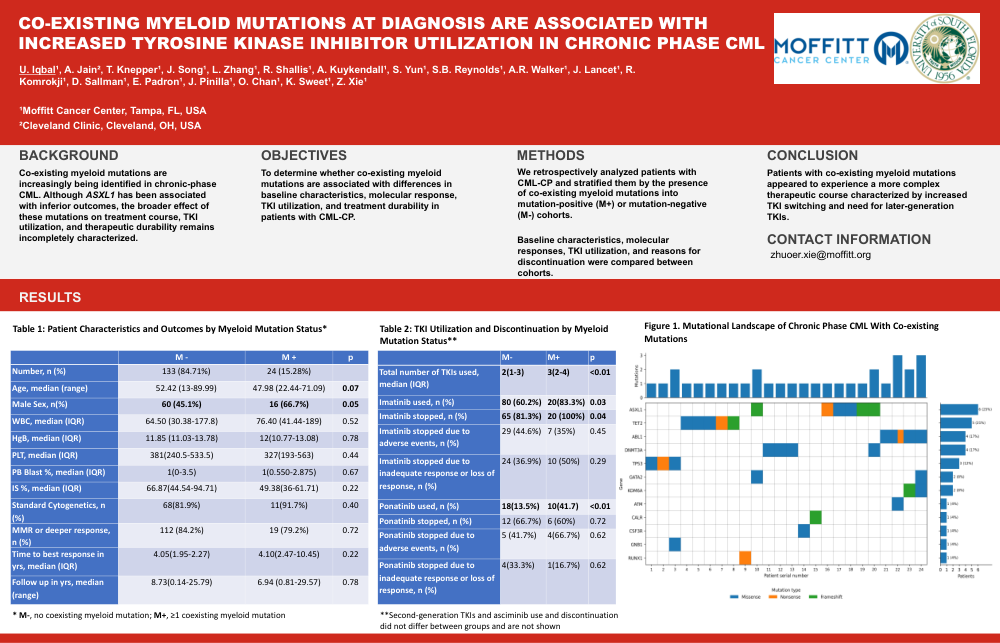
CML-709 · Publication and Poster presentation Co-Existing Myeloid Mutations at Diagnosis Are Associated With Increased Tyrosine Kinase Inhibitor Utilization in Chronic Phase CML Umar Iqbal 1 , Akriti Jain2, Tod Knepper1, Jinming Song1, Ling Zhang1, Rory Shallis1, Andrew Kuykendall1, Seongseok Yun1, Sam B Reynolds1, Alison R Walker1, Jeffrey Lancet1, Rami Komrokji1, David Sallman1, Eric Padron1, Javier Pinilla1, Onyee Chan1, Kendra Sweet1, Zhuoer Xie1 1 Moffitt Cancer Center, Tampa, FL, USA 2 Cleveland Clinic, Cleveland, OH, USA Abstract Background Co-existing myeloid mutations are increasingly recognized in patients with chronic phase chronic myeloid leukemia (CML-CP). While certain mutations, such as ASXL1 , have been associated with inferior outcomes, the broader impact of co-existing myeloid mutations on treatment course, TKI utilization, and therapeutic durability remain incompletely characterized. Methods We retrospectively analyzed patients with CML-CP who underwent routine next-generation sequencing as part of institutional evaluation and stratified them by the presence of co-existing myeloid mutations. Baseline charac teristics, molecular responses, TKI utilization, and reasons for discontinuation were compared between cohorts. Results Among 157 patients with CML-CP, 24 (15.3%) were myeloid mutation-positive and 133 (84.7%) were mutation negative. There was a trend toward younger age at diagnosis in the mutation-positive cohort compared with the mutation-negative cohort (median, 48.0 vs 52.4 years; P =0.07) and a trend toward male predominance (66.7% vs 45.1%; P =0.05). Other baseline characteristics, including white blood cell count, hemoglobin, platelet count, peripheral blood blast percentage, and BCR::ABL1 transcript levels, were similar between the cohorts. Rates of major molecular response or deeper response (≥MMR) were comparable between the mutation-positive and mutation-negative cohorts (79.2% vs 84.2%; P =0.72). Median time to best response was similar between the two groups (4.1 years [IQR, 2.47–10.45] vs 4.05 years [IQR, 1.95–12.27]; P =0.22). Among mutation-positive patients, 32 unique mutations were identified across 24 patients. The most frequently mutated genes were ASXL1 (n=6, 25%), TET2 (n=5, 20.8%), DNMT3A (n=4, 16.7%), and TP53 (n=3, 12.5%). Median variant allele frequency was 38.7% (IQR, 9.7–48.5). Despite comparable rates of ≥MMR, mutation-positive patients experienced a more complex treatment course, requiring a higher number of TKIs than mutation-negative patients (median, 3 vs 2; P <0.001). Imatinib exposure was more common in the mutation-positive cohort (83.3% vs 60.2%; P =0.03), and all imatinib-exposed mutation-positive patients discontinued imatinib compared with 81.3% of mutation-negative patients (P =0.04). Use of ponatinib, a third-generation TKI often reserved for resistant or high-risk disease, was also significantly higher among mutation-positive patients (41.7% vs 13.5%; P <0.001). Conclusion Patients with co-existing myeloid mutations appeared to experience a more complex therapeutic course charac terized by increased TKI switching and need for later-generation TKIs. ASXL1 : additional sex combs like 1; BCR::ABL1 : breakpoint cluster region::ABL proto-oncogene 1; DNMT3A : DNA methyltransferase 3 alpha); IQR: interquartile range; MMR: major molecular response; TKI: tyrosine kinase inhibitor; TET2 : tet methylcytosine dioxygenase 2;TP53 : tumor protein p53. Keywords CML, TKI, CHIP, co-mutation, imatinib, ponatinib